
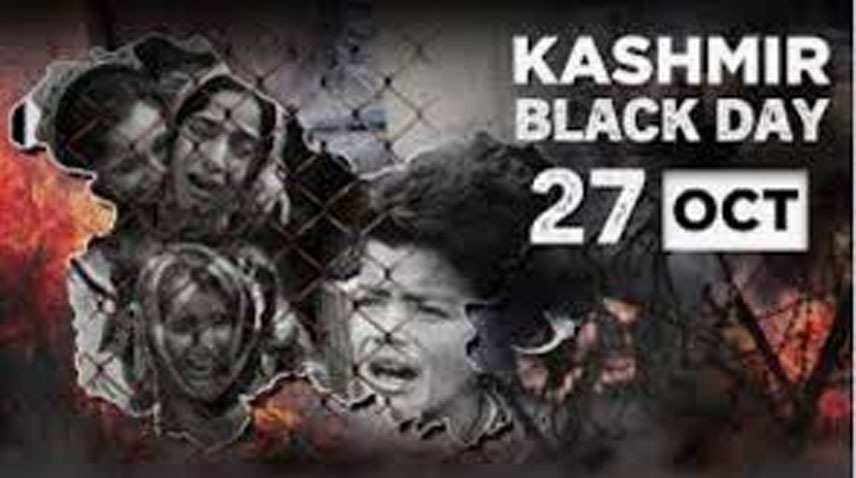
ISLAMABAD (TNS) Kashmiris on both sides of the Line of Control and around the world will observe October 27 as Black Day to remind the world of India’s illegal occupation of Jammu and Kashmir. According to Kashmir Media Service, on October 27, 1947, India forcibly occupied Jammu and Kashmir by landing its troops in Srinagar, which was against the will of the Kashmiri people and a clear violation of the plan to partition the subcontinent. The suffering of the people of Jammu and Kashmir under Indian occupation began with the occupation by the Indian army in 1947 and this situation has worsened over the decades. As Kashmir’s Black Day is being observed on October 27, 2025, the leadership of Prime Minister Shehbaz Sharif once again expressed Pakistan’s unwavering solidarity with the Kashmiri people in their just and courageous struggle for their right to self-determination. The Prime Minister of Pakistan’s vision for Kashmir is not limited to rhetoric or symbolic gestures. It is born from a shared pain and a deep sense of purpose. For him, Kashmir is not just a political issue, but a human issue that tests the conscience of every Pakistani. He has repeatedly emphasized that the wounds of the Kashmiri people run deep in the hearts of all Pakistanis and that the unbreakable bond between Pakistan and Kashmir is based on a collective dream of faith, history and freedom. Kashmir Black Day is one of the darkest moments in the history of the subcontinent. On October 27, 1947, Indian forces invaded Jammu and Kashmir, violating the principles of partition and the aspirations of its people. What began as an illegal occupation turned into decades of systematic oppression, including human rights violations, mass detentions, communication blackouts, and demographic manipulation. Yet the indomitable spirit of the Kashmiri people continues to thwart every attempt to silence them. Every year, October 27 is observed in Pakistan and around the world as a reminder that the Kashmiri struggle for freedom has not been forgotten. The leadership of the Prime Minister of Pakistan represents a new generation, which approaches the Kashmir cause with new energy, compassion, and clarity.
The Prime Minister of Pakistan has consistently kept the Kashmir cause close to his heart throughout his political journey. He has worked to transform solidarity into meaningful public engagement. Under his guidance, the government has observed Kashmir Solidarity Day, Kashmir Day Celebrated with extraordinary enthusiasm and engagement, his vision combines emotional resonance with strategic foresight. The Prime Minister ensured that the cause of Kashmir is a living moral commitment. The Prime Minister’s stand on Kashmir is one of moral clarity and diplomatic wisdom. The Prime Minister has consistently reiterated that there can be no peace in South Asia without a just and peaceful resolution of the Kashmir dispute in accordance with the resolutions of the United Nations Security Council and the aspirations of the Kashmiri people. Pakistan has always continued its moral, political and diplomatic support to the Kashmiri people. Quaid-e-Azam had said that Kashmir is the jugular vein of Pakistan and Pakistan has always taken care of its jugular vein. The Kashmiri nation has decided that their destination is Pakistan. Long live our Pak Army and Kashmiris will always fight for the struggle of occupied Kashmir. An important meeting was held in Islamabad under the chairmanship of Federal Minister for Kashmir Affairs, Gilgit-Baltistan Engineer Amir Muqam to observe October 27 as “Black Day”. Addressing the meeting, Engineer Amir Muqam said that India occupied a large part of Jammu and Kashmir on October 27, 1947, against the wishes of the Kashmiris and in clear violation of the partition formula of the subcontinent. Kashmiris are creating a great history of sacrifices for freedom from Indian occupation, for which I salute them. India has so far martyred millions of Kashmiris and has completely converted the area into a military cantonment to maintain its illegal occupation. This year too, October 27 will be celebrated as a black day in a grand manner and the Ministry of Kashmir Affairs has prepared a comprehensive action plan in this regard.
Sheikh Abdul Mateen, leader of the All Parties Hurriyat Conference Azad Jammu and Kashmir branch, said on this occasion that October 27 is a very dark day in the history of Jammu and Kashmir when India occupied the land of Kashmiris by violating their wishes. No power in the world can separate Kashmiris and Pakistanis from each other. Sheikh Abdul Mateen said that on October 27, anti-India rallies and processions will be held in major cities of Azad Jammu and Kashmir, Pakistan and around the world and a clear message will be given to India that Kashmiris will continue their struggle until its illegal occupation is ended. The meeting was attended by the leadership of the All Parties Hurriyat Conference Azad Jammu and Kashmir branch, Additional Secretary Kashmir Affairs Gilgit-Baltistan Kamran-ur-Rehman Khan, as well as representatives from the Ministry of Foreign Affairs, Ministry of Kashmir Affairs, Gilgit-Baltistan, Ministry of Interior, Ministry of Information and Broadcasting, Ministry of Communications, Cabinet Division, Ministry of Education and Professional Training, Ministry of Information Technology, PIA, ICT, Islamabad Police, Motorway Police, CDA, MCI and representatives from all provinces including Azad Jammu and Kashmir and Gilgit-Baltistan. The Pakistan Army’s involvement in Kashmir began after the partition of the state, which included helping tribal fighters in the 1947-1948 Kashmir War.Pakistan has always continued to provide moral, political and diplomatic support to the Kashmiri people. Quaid-e-Azam had said that Kashmir is the jugular vein of Pakistan and Pakistan has always taken care of its jugular vein. The Kashmiri nation has decided that their destination is Pakistan. Long live our Pak Army and Kashmiris will always fight for the struggle of occupied Kashmir.
The Pakistan Army’s involvement in Kashmir began after the partition of the state, which included supporting tribal fighters in the Kashmir War of 1947-1948. Since then, the Pakistan Army has been involved in the ongoing tensions and border clashes in the region. This issue has been around since the time of the Partition of India and has witnessed several wars till now, the most famous of which were fought in 1947, 1965, 1999 and 2025. During the first Kashmir war between Pakistan and India, tribal fighters entered Kashmir with the help of the Pakistani army and occupied some areas. After the intervention of the United Nations, a ceasefire was reached and the then borders became the “Line of Control”. May 8, 2025 Prime Minister Shehbaz Sharif has given a blunt message that India will definitely have to bear the consequences of the blatant mistake made by India last night, and every drop of the blood of the martyrs will definitely be accounted for. Prime Minister Shehbaz Sharif said that the world saw that it took a few hours to bring down a much larger enemy, and the planes that were the pride of India have now become ashes and a symbol of lesson. Our falcons struck back at the enemy, this was our crushing response. It should be noted that the Indian army, in a cowardly attack in the darkness of the night, targeted the civilian population in Kotli, Muzaffarabad and Bagh areas of Azad Kashmir, as well as Muridke and Ahmedpur Sharqia, in which two mosques were martyred, while 31 Pakistanis, including two children, were martyred and 51 were injured in the attacks. Pakistan Army Spokesperson Lieutenant General Ahmed Sharif Chaudhry said that the brave people and forces of Pakistan want to convince them that every drop of blood of innocent civilians will be accounted for. On the other hand, Chief of Army Staff General Syed Asim Munir says that we have fought three wars for the sake of Kashmir, if we have to fight 10 wars, we will fight them. Undoubtedly, Kashmir will be free one day. On February 5, 2025, Army Chief General Syed Asim Munir visited Muzaffarabad on the occasion of Kashmir Solidarity Day. On this occasion, he visited the Martyrs’ Memorial and paid tribute to the martyrs. The General recited Fateha and laid flowers at the Martyrs’ Memorial. Addressing the Kashmiri elders, the Army Chief said that Indian atrocities and growing Hindutva extremism strengthen the resolve of the Kashmiris in their struggle. Kashmir will definitely be a part of Pakistan one day as per the will of the Kashmiris. We will give a befitting reply to any aggression against India. The Army Chief appreciated the spirit of the officers and soldiers of the Pakistan Army during the visit. He praised the unwavering dedication, professionalism and war preparedness of the officers and soldiers. Army Chief General Syed Asim Munir had said that the relationship between Kashmir and Pakistan is inseparable, Kashmir was a part of Pakistan yesterday, it is today and will remain so tomorrow, one generation of Kashmiris has been handing over the torch of freedom to another generation, if we remain united and strong, we can face every difficulty. It should be noted that today the people of Pakistan express solidarity with the Kashmiris and reiterate their resolve that until occupied Kashmir is freed from the clutches of Indian tyranny, support for the Kashmiris will continue.The situation in Kashmir is becoming increasingly dire in the face of India’s extremist Hindutva government. Since August 5, 2019, when India unilaterally abrogated Articles 370 and 35A, Prime Minister Shehbaz Sharif condemns these injustices with moral strength and political conviction. The Prime Minister calls India’s actions state-sponsored terrorism and a grave violation of international law. At the same time, the Prime Minister has deep hopes that the sacrifices of Kashmiris will not go in vain and the dawn of justice will surely dawn in the valley. For Maryam Nawaz, the youth are at the center of this struggle. Today, as Pakistan prepares to observe Kashmir Black Day 2025, Prime Minister Shehbaz Sharif’s voice resonates with determination and compassion. His leadership reminds the world that Kashmir has not been forgotten, and that Pakistan is a steadfast defender of the right to freedom of its people. Shahbaz Sharif has rekindled the emotional bond between Pakistan and Kashmir, binding the two through shared sacrifice, faith and hope. The Prime Minister of Pakistan’s moral conviction is a beacon of hope for a region yearning for justice and peace. As Pakistan celebrates October 27, it does so with a renewed resolve, guided by a leader, the Prime Minister of Pakistan, who understands that freedom movements are not driven by force but by faith, perseverance and moral truth. The path to justice may be long but as the Prime Minister of Pakistan often reminds us, the dawn of freedom will dawn in the Kashmir Valley. On Kashmir’s Black Day, Pakistan stands united with the brave people of Kashmir — their pain is our pain, their struggle, our struggle, and their freedom, our unwavering promise,October 27 is observed as Black Day across the world. Pakistan will always continue to extend its full moral, diplomatic and political support to the Kashmiris to stop the gross human rights violations in occupied Jammu and Kashmir and to implement the resolutions of the United Nations Security Council. Pakistan will continue to do so until the final resolution of the dispute in accordance with the aspirations of the Kashmiri people. Pakistan has expressed its constant support and solidarity with the oppressed Kashmiris since the beginning of Indian occupation in 1947. Three successive generations of Kashmiris have lost their lives. On October 27, 1947, India illegally landed its troops in occupied Jammu and Kashmir. India has been forcibly occupying Jammu and Kashmir since then. In the last 78 years, India has taken several steps to maintain its illegal rule over Jammu and Kashmir, including the heinous conspiracy of constituencies, the addition of certificates for non-Kashmiris to vote, the addition of illegal certificates. New laws on land and property ownership These immoral and illegal measures are in violation of relevant UN Security Council resolutions and the Geneva Conventions. Today, occupied Jammu and Kashmir is one of the most militarized regions in the world. The real representatives of the Kashmiri people have been arbitrarily detained for years. A massive media blackout and censorship are in place to hide oppression and dissent. Thousands of innocent Kashmiri men, women and children have lost their lives at the hands of Indian brutality over the past three decades, but India has failed to subjugate the Kashmiri people. The latest developments in the Middle East have not allowed the Middle East conflicts to continue for a long time, as 78 years ago on this day, India forcibly occupied the state of Jammu and Kashmir without any legal justification. Kashmir Black Day is observed on 27 October as the day of Indian occupation of Jammu and Kashmir, which began on 27 October 1947. Kashmir Black Day commemorates the arrival of Indian troops in Srinagar and is considered a day of sorrow and resistance for Kashmiris who see this action as an illegal invasion of Kashmir and a struggle for their right to self-determination. The unilateral and illegal actions of 5 August 2019 are a blatant violation of the United Nations Security Council resolutions, the Kashmiri people are enduring multi-faceted restrictions, their leadership has been imprisoned and their voice has been suppressed. However, the continued violations of human rights cannot stop the just struggle of the Kashmiris. International media should hold India accountable for brutality and human rights violations Pakistan has stressed on several occasions that peace and stability in South Asia depends on a peaceful resolution of the Kashmir dispute India does not realize that it cannot suppress the freedom struggle of Kashmiris by the use of force,
Kashmir Day is observed every year on 27 October as the beginning of the “illegal occupation” of the region. It is observed as a symbol of resistance and a reminder of the ongoing struggle of the people of Kashmir for their right to self-determination. Events include protests, rallies, seminars, and awareness-raising through social media and exhibitions that showcase the history of the conflict and alleged atrocities. Key themes include commemorating the victims, highlighting alleged human rights violations, and calling for a resolution of the Kashmir issue in accordance with UN resolutions and the will of the Kashmiri people. 27 October marks the beginning of a dark chapter in history On that day, Indian troops landed in Srinagar. Subsequently, the UN Security Council resolutions upheld the fundamental right of the Kashmiri people to decide their own fate through a fair and impartial plebiscite. However, by reneging on its repeated promises to implement these resolutions, India has been continuously denying the Kashmiri people their inalienable right to self-determination. Since August 5, 2019, India has been making multi-pronged efforts to further consolidate its hold on Kashmir and to dispossess the Kashmiris of their land. The brave sons and daughters of Jammu and Kashmir bravely resisted all Indian attempts at oppression and domination, and due to the selfless sacrifices of the Kashmiris, India has failed to subjugate the Kashmiris. Peace in South Asia is Pakistan’s top priority. However, for lasting peace in the region, the Kashmir dispute needs to be resolved in accordance with the UN Security Council resolutions and the aspirations of the Kashmiris. Pakistan stands in complete solidarity with the Kashmiris in their struggle to achieve their inalienable right to self-determination. It will continue to provide strong political, moral and diplomatic support to their just struggle.