
ISLAMABAD (TNS) Quaid-e-Azam said that Kashmir is our jugular vein. Due to efforts of Prime Minister of Pakistan, Kashmir issue has been highlighted at international level,
According to the UN Security Council resolution and the wishes of the Kashmiri people, a peaceful solution to Kashmir is the only way to maintain peace and stability in the region. October 27 is observed as Black Kashmir Day, which commemorates the entry of Indian troops into Kashmir and occupation of the territory in 1947. The role of the United Nations has been important in this conflict, in which the right of self-determination of the Kashmiri people has been supported through Security Council resolutions. The right of self-determination of the Kashmiri people has been recognized in UN resolutions. The resolutions have emphasized dialogue to resolve the conflict and the protection of citizens. The United Nations has highlighted the importance of protecting the human rights of the Kashmiri people as well as their rights. All parties need to take steps for peace and promote dialogue. The international community must play a role in resolving the conflict. The United Nations and the international community should support the right of the Kashmiri people to self-determination and take effective measures to resolve the conflict. The Prime Minister of Pakistan is highlighting the Kashmir issue at every international forum. His efforts have helped in highlighting the Kashmir issue at the international level. He has presented the Kashmir issue at various international forums and drawn the attention of the international community to it. The Kashmir issue is now under discussion at the international level. It has received the support of world leaders, which has raised the voice of the Kashmiri people at the international level. The pressure on India has increased by creating a global public opinion in favor of Kashmir. India seems to be isolated internationally, which may force it to reconsider its policies. The Prime Minister’s efforts are playing a significant role in resolving the Kashmir issue and raising the hopes of the Kashmiri people. He is raising the Kashmir issue at various international forums and appealing to the international community for help in resolving the issue. The Prime Minister has highlighted the Kashmir issue in the meetings of the United Nations General Assembly and stressed the importance of its resolution for peace and stability in South Asia.
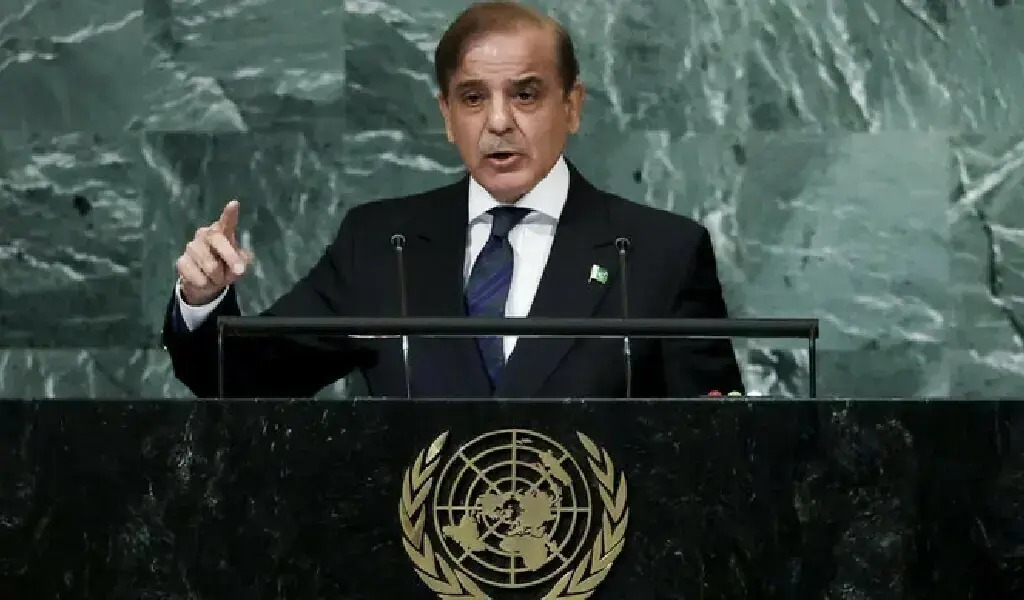
 The Prime Minister has also highlighted the Kashmir issue in the meetings of the Organization of Islamic Cooperation and has appealed to Islamic countries to support the Kashmiri people. The Prime Minister has also raised the Kashmir issue in bilateral meetings with heads of various countries and requested their help in resolving the issue. In his address to the UN General Assembly, the Prime Minister of Pakistan said that the resolution of the Kashmir dispute is essential for peace and stability in South Asia and the UN resolutions can be used as a basis for this. The Prime Minister described the Kashmir dispute as a long-standing issue that poses a threat to peace and stability in South Asia. He stressed the importance of the UN resolutions that recognize the right of the Kashmiri people to self-determination. The Prime Minister appealed to the international community to pay attention to the Kashmir issue and play a role in its resolution. He stressed the need for peace and stability in South Asia and said that the resolution of the Kashmir issue is essential for this. The Prime Minister’s address once again highlighted the Kashmir issue at the international level and clarified Pakistan’s position on the issue. India should know that it cannot suppress the genuine aspirations of the Kashmiri people through its oppressive tactics. Pakistan has always expressed its unwavering solidarity with the Kashmiri brothers and sisters. It will continue to extend its full moral, diplomatic and political support to them until the final resolution of the Jammu and Kashmir dispute in accordance with the relevant UN Security Council resolutions. The Prime Minister of the Islamic Republic of Pakistan, Shahbaz Sharif, in his message on the occasion of the “Black Day” of October 27, 2025, said that 78 years ago on this day, Indian forces landed in Srinagar. Since then, India has suppressed the legitimate aspirations of the Kashmiri people to determine their own destiny. It has failed to fulfill its obligations under the relevant UN Security Council resolutions. The people of Jammu and Kashmir illegally occupied by India have faced innumerable hardships during the last 78 years. However, their resolve to achieve their inalienable right to self-determination is as strong as it was in 1947. Today, I pay my heartfelt tribute to the sacrifices made by the Kashmiri people in their continuous struggle for their right to self-determination. Undoubtedly, the sacrifices of the Kashmiri people will not go in vain. India has been taking successive steps to strengthen its grip on occupied Jammu and Kashmir since August 5, 2019. India’s nefarious intentions are aimed at undermining the disputed status of occupied Jammu and Kashmir and depriving the Kashmiri people of their democratic right to decide their future. Today, the Kashmiri people are facing the most severe and painful restrictions on their daily lives and livelihoods. The number of political prisoners is in the thousands. The Indian occupation forces operate with impunity under strict anti-terrorism laws.The efforts of the Prime Minister of Pakistan have been made to highlight the Kashmir issue at the international level. Various steps have been taken in this regard, including raising the Kashmir issue at the United Nations, holding meetings with world leaders and expressing support for the Kashmiri people. The Kashmir issue has been an important issue for Pakistan and the government has taken several steps to highlight it at the international level. The aim of these steps is to draw the attention of the international community to the difficulties of the Kashmiri people and their right to self-determination. However, there have been differences between Pakistan and India on this issue and India has been opposing Pakistan’s position on Kashmir. Several efforts have been made to resolve this dispute, but no permanent solution has been found yet. The current situation in Kashmir is tense, especially in Indian Jammu and Kashmir. India has been carrying out large-scale demographic changes in occupied Kashmir since August 5, 2019, which is trying to end the Kashmir issue. October 27, 1947 is one of the darkest and most memorable days in history, when India landed its troops in Jammu and Kashmir to occupy it, resulting in countless casualties and property losses. The people of Kashmir resisted fiercely and fought a war of independence, which continues to this day. Since 1947, the Kashmiri people have been struggling for their freedom and rights. This day is observed as a black day to express solidarity with the Kashmiri people and support their freedom struggle. Kashmir is a disputed territory located between India, Pakistan and China. Its area is about 220,000 square kilometers. Kashmir has a diverse climate, beauty and culture. The Kashmir issue began in 1947 when India and Pakistan were partitioned. At that time, Kashmir was an independent state ruled by a Hindu ruler, but the majority of the population was Muslim. Both India and Pakistan have claimed Kashmir, leading to two major wars between the two countries. Even today, one part of Kashmir is administered by India, while the other part is administered by Pakistan.

The people of Kashmir are struggling for freedom and rights. Efforts are being made to bring their struggle to international attention. The Kashmir issue is a complex and sensitive dispute between India and Pakistan. The dispute began during the partition of the subcontinent in 1947, when the Hindu Maharaja Hari Singh, the ruler of the state of Kashmir, decided to join his state with India, while the majority of the Kashmiri people were Muslims and wanted to join Pakistan. The majority of the Kashmiri people want independence. There are concerns about violence, human rights violations, and political prisoners in Kashmir. The situation has been tense since India revoked Kashmir’s special status in 2019. Finding a solution to the Kashmir issue is a difficult challenge, requiring dialogue and compromise between India, Pakistan, and the Kashmiri people. The Kashmir issue is a complex and sensitive dispute that has been a source of tension and conflict between India and Pakistan for decades. The reasons for the complexity of the dispute include:
The issue of the statehood of Kashmir became controversial when the subcontinent was partitioned in 1947.
Territorial claims: Both India and Pakistan claim the entire region of Kashmir. The majority of the Kashmiri people are Muslim, while India has a Hindu majority population. Kashmir shares borders with Afghanistan, China, and India, which makes it strategically important. Violence, restrictions, and human rights violations continue to occur in Kashmir.
Several attempts have been made to resolve the dispute, but no permanent solution has been found yet.Kashmir issue is one of the world’s oldest conflicts, due to which one and a half billion people of the subcontinent are suffering. A solution to this conflict is indispensable for the restoration of peace and development in this entire region. The main reason behind terrorism and the indebted economy is the bad relations between India and Pakistan, which are rooted in the Kashmir issue. The reason for the lack of progress in resolving this fundamental issue for 78 years is that India considers the state of Jammu and Kashmir as its integral part. The Kashmir issue can be resolved only when the people of the state are recognized as the main parties and a solution is found according to their aspirations. The people of Indian-occupied Kashmir have proved by sacrificing millions of lives that they are not ready to live with India under any circumstances. The important thing is that today the ground realities have changed and today’s objective truth cannot be seen through the lens of 1947.
It is necessary for the Kashmiri people to resolve this issue and its possible and just solution is the right of Kashmiris to self-determination. The right to self-determination has been recognized by the United Nations as a fundamental right and in recent times many small countries have successfully used this right for their independence.
At the time of the partition of the subcontinent, the Muslim League strongly advocated the right of the states to remain independent, while the Congress’s position was that the states should in any case become part of India or Pakistan. The Maharaja of the state, the Prime Minister and the Muslim Conference were in favor of the independence of the state. Due to the strong opposition of the Congress and its support by Britain, no state could remain independent at that time. After the tribal attack, the Maharaja decided in favor of accession to India. It is necessary to convey this message to the people of India that the Kashmiri people are not their enemies, nor their opponents, but rather they themselves are victims of usurper occupation and stand in solidarity with the oppressed people’s struggle against exploitation.At the time of the Partition of India, Kashmir was a separate state in which the Muslim population was close to 80 percent. In principle, it should have been a part of Pakistan, but due to the collusion of the then Viceroy of India and Indian Prime Minister Jawaharlal Nehru, Kashmir could not become a part of Pakistan. Kashmiris rejected the accession to India and started a struggle for independence, which the Indian government tried to suppress severely. Countless Kashmiris were martyred and millions migrated to Pakistan. Jihad against Indian oppression was started. Mujahideen from the Frontier Province and the tribal areas voluntarily joined this war to help their Kashmiri brothers. The people of Punjab also joined this jihad. These mujahideen defeated the state forces and reached near Srinagar. Thus, this was the first Indo-Pak war fought on the issue of Kashmir. Prime Minister Jawaharlal Nehru, fearing the continuous advance of Pakistani forces, requested a ceasefire at the United Nations. The United Nations passed a resolution in 1948 that Kashmir was a disputed territory. It should be resolved according to the opinion of the Kashmiris. In 1951, another such resolution was passed on this issue, but the cunning India did not implement these resolutions, nor could the United Nations implement them, due to which four wars have been fought between Pakistan and India so far. In the last war, the Battle of Haqq, upon the request of Indian Prime Minister Narendra Modi, upon the destruction and certain defeat of India, US President Trump appealed to the Prime Minister of Pakistan and Field Marshal General Asim Munir for a ceasefire. In the Battle of Haqq, India became convinced that a war against Pakistan was inviting its own death, so it started a war against Pakistan through its western ally Afghanistan, but contrary to Afghanistan’s expectations, the Pakistani forces defeated the Afghan army and captured 21 military posts. Unable to withstand Pakistan’s counterattack, the Afghan government repeatedly requested a ceasefire from the Pakistani government. At the request of the Islamic country Qatar, Saudi Arabia and Turkey, Pakistan accepted the ceasefire request. The defeat of India and Afghanistan, the ceasefire between Palestine and Israel, gives hope that the independence of Kashmir is near. The Kashmir issue, since the partition of India in 1947, there has been a dispute between Pakistan, India and Kashmiri freedom fighters over the ownership of occupied Kashmir. Pakistan claims the issue on the basis of the Muslim majority population of Jammu and Kashmir and supports the implementation of UN resolutions to resolve it peacefully. In December 1947, Indian Prime Minister Jawaharlal Nehru sought the help of the UN Security Council to resolve the Kashmir dispute. The right of the people of Jammu and Kashmir to self-determination has been clearly recognized in UN Security Council resolutions. These resolutions call for a free and fair plebiscite under UN supervision to decide the final status of Jammu and Kashmir. Both India and Pakistan have accepted these resolutions. Under Article 25 of the UN Charter, both parties are bound to implement the resolutions. For 78 years, India has obstructed the implementation of UN resolutions on Kashmir. Since 1989, its brutal repression in occupied Jammu and Kashmir has resulted in the deaths of over 100,000 Kashmiris.
Since 5 August 2019, India has taken unilateral and illegal steps to annex occupied Jammu and Kashmir, which its extremist BJP leaders have termed as the “final solution”. The United Nations Security Council Resolution 122 (1957) states that unilateral steps to determine the future of Jammu and Kashmir cannot be a valid option for the State. All unilateral steps taken by India since 5 August 2019 have been considered illegal and null and void. The people of occupied Jammu and Kashmir have clearly rejected India’s unilateral steps. The people of occupied Jammu and Kashmir continue to struggle for freedom and self-determination. In a meeting of the United Nations Security Council, Pakistan’s Permanent Representative to the United Nations highlighted that a resolution of the Jammu and Kashmir dispute is essential for achieving lasting peace in South Asia. The responsibility to create conditions for dialogue regarding the dispute lies with India, for which it is necessary to stop the ongoing human rights violations in occupied Jammu and Kashmir and to revoke the illegal unilateral measures taken since August 5, 2019. The United Nations and its member states are bound by the Charter to promote a peaceful resolution of the Jammu and Kashmir dispute. Pakistan will actively promote this goal using all the methods outlined in the UN Charter. The United Nations High Commissioner for Human Rights has issued reports accusing India of serious human rights violations in Kashmir and demanding the formation of a commission of inquiry. The United Nations High Commissioner for Human Rights has issued reports accusing India of serious human rights violations in Kashmir and calling for the formation of a commission of inquiry. Kashmir is an internationally recognized dispute and it is time for the permanent members of the United Nations to play their role in the peaceful resolution of the Kashmir issue.