

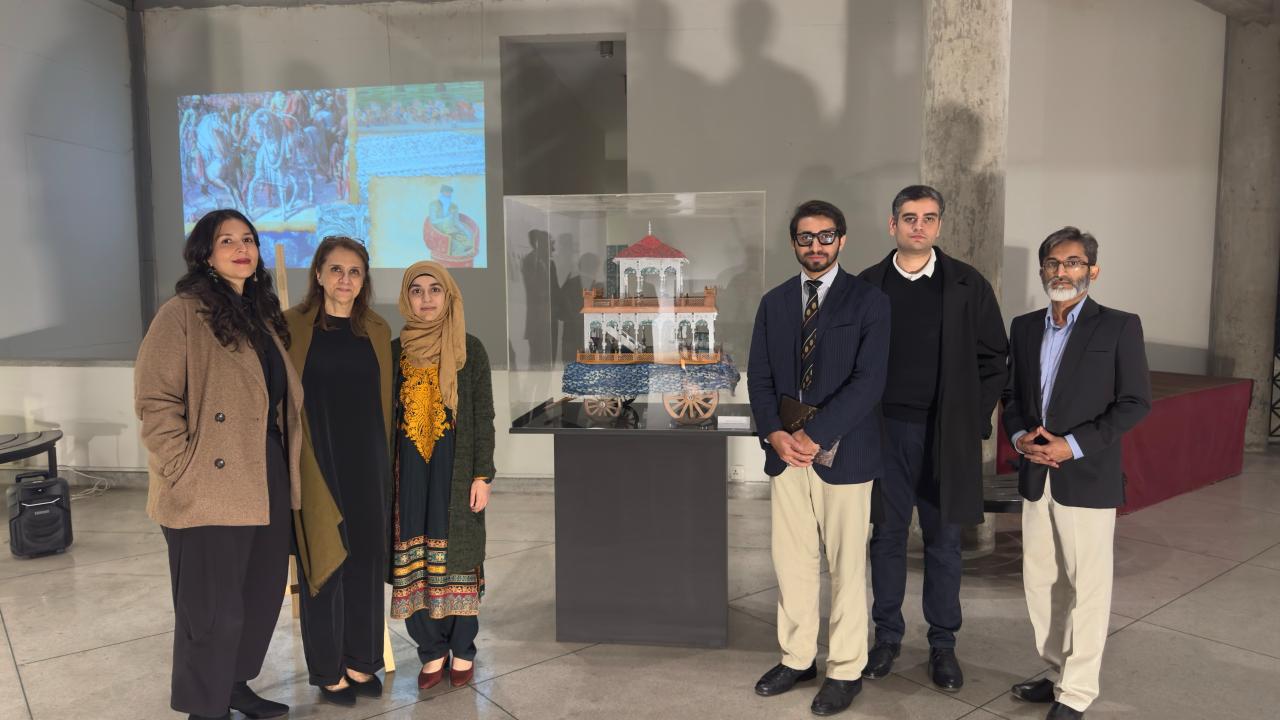
Lahore, December 15, 2025 (TNS)- Lahore University of Management Sciences (LUMS) has unveiled a landmark exhibition that brings back to public consciousness the lost treasures of Maharaja Ranjit Singh’s legendary toshakhāna (royal treasury). Titled “Maharaja Ranjit Singh’s Toshakhāna: The Material Splendour of 19th Century Punjab,” the exhibition re-examines Punjab’s royal material heritage through rigorous research, digital reconstruction, and immersive storytelling, offering audiences a rare window into the cultural and aesthetic life of the Lahore Darbār.
Opened on December 12, 2025, and running through December 19, 2025, at the Mushtaq Ahmad Gurmani School of Humanities and Social Sciences (MGSHSS), LUMS, the exhibition traces the history and dispersal of the famed toshakhāna of Maharaja Ranjit Singh, who ruled Punjab from 1799 to 1839. Once celebrated for its extraordinary objects crafted in gold and silver and embellished with precious stones, the toshakhāna reflected the refined artistic sensibilities and cultural vibrancy of the Lahore Darbār. Many of these prized possessions were later dismantled, auctioned, or lost following the annexation of Punjab in 1849 by the East India Company.
The exhibition is curated by Dr. Nadhra Shahbaz Khan, Associate Professor of Art and Architectural History, and Dr. Murtaza Taj, Associate Professor of Computer Science, whose interdisciplinary collaboration draws on years of research into the dispersal of the toshakhāna. By combining historical inquiry with digital methodologies, the curators have created an exhibition that allows visitors to engage with material culture in new and meaningful ways.
Visitors encounter a rich array of video narratives, infographics, immersive installations, and reimagined models of lost objects, developed by a dedicated team of young researchers: Abdullah Ahmad, Anas Kashmiri, Zeenat Nabi, Ayesha Ali, and Hamza Salar Hassan. Among the narratives presented is a nuanced account of the famed Koh-i-Noor diamond, alongside digital reconstructions of destroyed treasures such as Maharaja Ranjit Singh’s silver bangla, a double-storied mobile throne that was dismantled after annexation, its silver sheets melted down for bullion.
Together, these narratives highlight the social, cultural, and artistic life of Lahore in the 19 th century, encouraging audiences to engage with heritage as a vital dimension of historical understanding rather than as a distant or abstract past. Speaking at the opening ceremony, Vice Chancellor Dr. Ali Cheema emphasised the importance of such scholarly and public engagement initiatives. “Heritage at LUMS aims to centre heritage as a way for us to discover who we are as a people, and to reflect on what inclusive futures could look like,” he said.
The exhibition’s Guest of Honour, the university’s Founding Pro Chancellor, Syed Babar Ali, noted that much of Punjab's dispersed heritage remains scattered across global collections awaiting documentation. The event’s Chief Guest, eminent scholar Fakir Syed Aijazuddin, highlighted the broader stakes of historical inquiry, observing, “Those who forget history are not condemned to be liberated; they are condemned to forfeit it. And that is the danger that confronts us.”
The toshakhāna exhibition forms part of the wider Heritage at LUMS initiative, which seeks to advance heritage scholarship through research, preservation, and public engagement. Dr. Ali Raza, Chair of the Department of Humanities and Social Sciences, spoke about complementary initiatives such as the LUMS Digital Archive and the Lutfullah Khan Archive, entrusted to the University by the late archivist’s family. The collection comprises over 2,500 hours of recordings, which LUMS is actively working to preserve and digitise for future generations.
Reflecting on the curatorial intent, Dr. Khan noted, “The intention is not to mourn what has been lost, but to recall or reimagine, and then read these objects as living portraits of their age; of the hands that shaped them, the eyes that admired them, and the refined aesthetics of a society that brought them into being.”
Open to the public until December 19, 2025, the exhibition underscores LUMS’ commitment to interdisciplinary scholarship and its growing role as a national platform for rethinking heritage through research, technology, and inclusive cultural dialogue.