
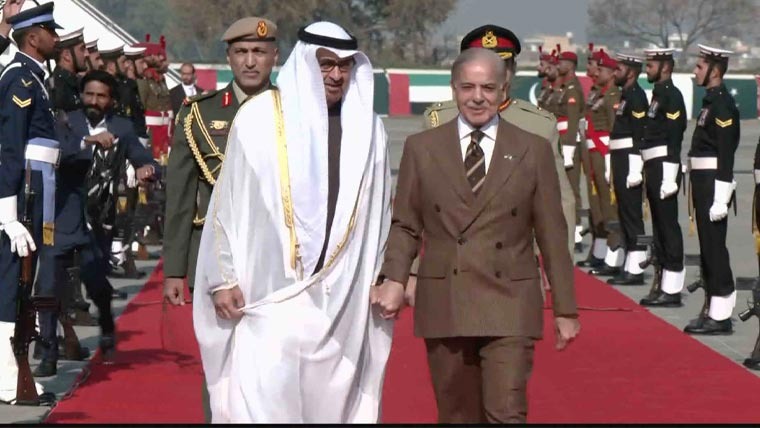
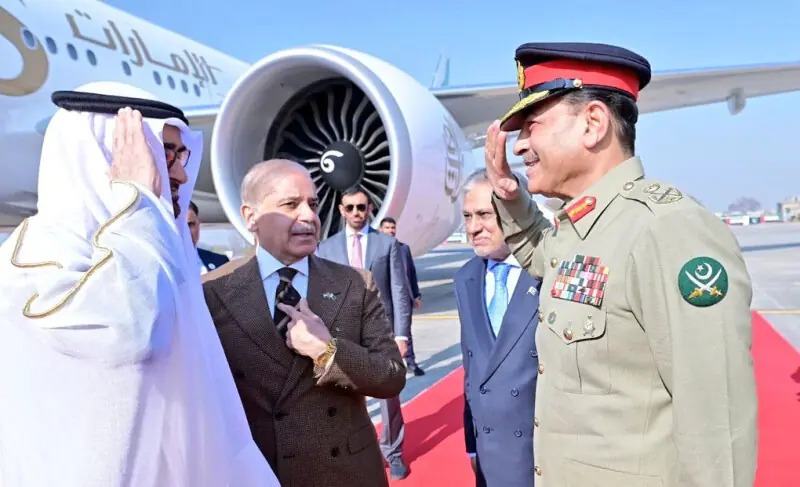
ISLAMABAD (TNS) The first official visit of UAE President Sheikh Mohammed bin Zayed Al Nahyan to Pakistan has brought hope of giving a new dimension to the long-standing relations between the two brotherly countries, in which the UAE President discussed progress on investment, energy, and infrastructure projects, as well as consultations on bilateral strategic relations and regional stability. President Sheikh Mohammed bin Zayed Al Nahyan’s visit to Pakistan reflects the long-standing and brotherly relations between the two countries. The visit is expected to further boost cooperation in the areas of trade, investment, energy, development, and regional stability. When UAE President Sheikh Mohamed bin Zayed Al Nahyan arrived in Pakistan at the invitation of Prime Minister Shehbaz Sharif, the distinguished guest was given a grand welcome. As soon as he entered the airspace, Pakistan Air Force fighter jets escorted the UAE President’s plane and presented an aerial salute. Prime Minister Muhammad Shehbaz Sharif, Deputy Prime Minister Ishaq Dar, and Chief of the Army Staff Field Marshal Syed Asim Munir, along with federal ministers, welcomed the UAE President at Noor Khan Air Base. The Emirati President was given a 21-gun salute, and a guard of honor was also presented. UAE President Sheikh Mohamed bin Zayed also met the federal ministers present at the airport. This was Sheikh Mohamed bin Zayed’s first visit to Pakistan. He expressed his affection for the children and girls representing different cultures of Pakistan who were present for the reception.
 The UAE President was accompanied by a high-level delegation of ministers and senior officials to Pakistan. During the visit, bilateral relations between the two countries, the regional situation, and issues of mutual interest at the global level were discussed. This visit of a world leader in 2025 is being described as a major signal of economic confidence for Pakistan. The year 2025 was a very important year for Pakistan’s diplomacy. At the beginning of the year, Pakistan engaged regional countries, especially in bilateral and trilateral negotiations. In 2025, 9 world leaders visited Pakistan, the first of which was Turkish President Recep Tayyip Erdogan on February 12-13. During this visit, steps were taken to cooperate in the trade, investment, and energy sectors, and a target was set to increase bilateral trade to $5 billion. Along with this, several agreements were signed on enhancing defense cooperation, defense production, and military partnership. During the visit, 24 agreements and memorandums of understanding were signed, as well as a common position was adopted on regional and global affairs, especially the issue of Palestine. From April 20 to 21, UAE Deputy Prime Minister and Foreign Minister Sheikh Abdullah bin Zayed Al Nahyan visited Pakistan. During the visit, consultations were held on bilateral relations, the regional situation, and issues of the Muslim world, as well as discussions on investment, manpower, and trade cooperation. From August 2 to 3, Iranian President Masoud Peshkeshian visited Pakistan. During this visit, the commitment to increase Pak-Iran trade to $ 10 billion was expressed. In addition, it was agreed to expand bilateral relations and regional cooperation. During the visit, Dr. Masoud Peshkeshian visited the shrine of the poet of the East, Allama Iqbal, and public and cultural relations were highlighted. This visit was important in both economic and political terms. Before the arrival of the Iranian president, Iranian Foreign Minister Abbas Araqchi, on May 5, he visited Pakistan. During this visit, tensions in the region, the border situation, and diplomatic coordination were discussed, as well as border cooperation and peace and security. On November 25-26, the Secretary of the Supreme National Security Council of Iran and a very important leader, Dr. Ardeshir Ali Larijani, visited Pakistan, where bilateral issues were discussed. Overall, this year proved to be good in terms of Pak-Iran relations. On September 8-9, the Deputy Prime Minister and Foreign Minister of Kazakhstan, Murat Nurtullu, visited Pakistan, where he met with the President and the Prime Minister. During the visit, discussions were held on access to Central Asia, trade and energy cooperation, as well as regional relations and preparations for future high-level visits. From October 2 to 4, Malaysian Prime Minister Dato’ Sri Anwar Ibrahim visited Pakistan, where the two countries discussed increasing cooperation in many areas, including trade, investment, education, health, defense, and technology. During the visit, the two governments signed MoUs and Agreements, including halal industry, small and medium enterprises, tourism, and diplomatic training, while at the political level, regional peace, stability, and global affairs were discussed. In addition, as an economic development, Malaysia expressed its commitment to increase exports of agricultural products and halal meat from Pakistan; thus, this visit proved to be an important milestone in strengthening Pakistan-Malaysia relations and giving practical form to the mutual partnership. On October 24, Polish Deputy Prime Minister and Foreign Minister Radoslaw Sikorski visited Pakistan, where discussions were held on Pakistan-EU relations and global diplomatic cooperation, as well as trade and investment prospects. King Abdullah II of Jordan visited Pakistan from November 15 to 16. He was warmly welcomed in Pakistan. During the visit, a harmonious position was adopted on the situation in the Middle East, Gaza, and Palestine.The visit of the President of the United Arab Emirates is of great importance in the context of the situation in Central Asia, South Asia, and the Middle East. This visit has sent many messages to the entire region. Everyone knows about the situation in Afghanistan. The issues of Iran and Yemen are also of great importance, while the issues regarding Pakistan, India, and Bangladesh in South Asia are also particularly complex and complicated. The United Arab Emirates is a Gulf country that has deep interests in all these countries and regions. In this regard, it is not difficult to understand the importance of his visit. Of course, this visit is for one day, but the messages received from it are very important. The first message is that the President of the UAE himself has come here and shown that there are deep, friendly, and commercial relations between the UAE and Pakistan, while the two countries are very close to each other in strategic matters. The position of the two countries is also the same in the Palestine conflict. The reception of the President of the UAE was also extraordinary. As soon as Sheikh Mohammed bin Zayed Al Nahyan’s plane entered Pakistani airspace, JF-17 Thunder aircraft saluted him. A formal welcome ceremony was held at Noor Khan Air Base. A well-dressed contingent of the armed forces presented a guard of honor, and the national anthems of both countries were played. During the visit, the UAE President met the Prime Minister of Pakistan, in which bilateral relations as well as global and regional issues were discussed.
A special welcome song was released by the Pakistani government on the occasion of Sheikh Mohammed bin Zayed Al Nahyan’s first official visit to Pakistan.
The lyrics of the song include “Ahla o Sahla, Marhaba”. The song highlights the strong bond of brotherly relations, mutual respect, and cooperation between Pakistan and the UAE.
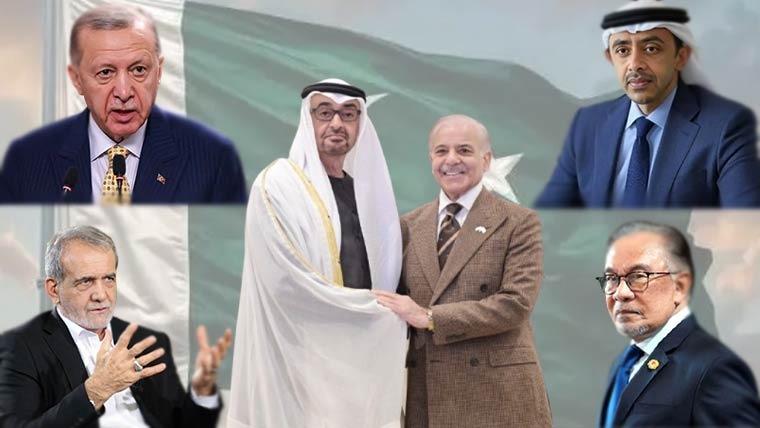
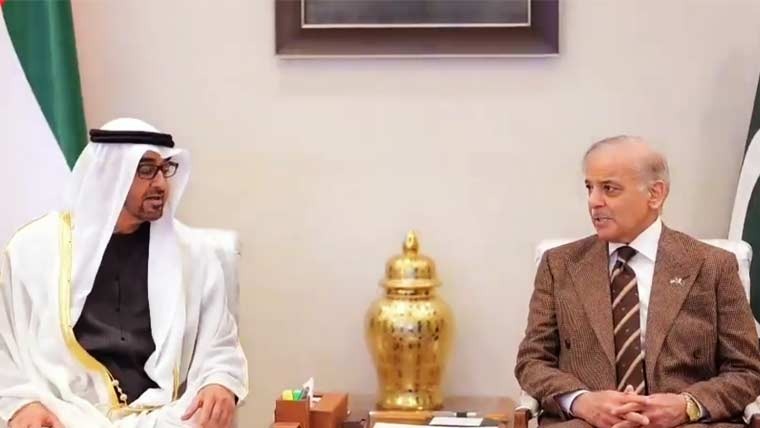
In this way, this extraordinary welcome is a medley of many messages and signals. On this visit of the UAE President, the media circles all agree that relations between Pakistan and the UAE will further improve in the future. During the visit, a detailed meeting between UAE President Sheikh Mohamed bin Zayed Al Nahyan and Prime Minister Shahbaz Sharif discussed further strengthening the long-standing brotherly relations between Pakistan and the UAE. The leaders agreed to further deepen ties in various fields, including economic cooperation, investment, energy infrastructure, IT, and people-to-people contacts, and to increase bilateral trade. The meeting reaffirmed the commitment to continue close coordination and cooperation on regional and global issues. Both leaders expressed satisfaction with the positive direction of bilateral relations and renewed their commitment to work together to achieve the common goals of peace, stability, and sustainable development. The UAE is a country where millions of Pakistanis live for employment. Pakistani people have also invested heavily there. The UAE has also invested in many sectors in Pakistan. There are even royal residences in Rahim Yar Khan. This shows that the nature of the relations between the two countries is very extraordinary. The visit of Sheikh Mohamed bin Zayed Al Nahyan will further strengthen the deep brotherly relations between the two countries and give a new dimension to the strategic partnership. Prime Minister Muhammad Shehbaz Sharif wrote in a post on the social networking website X that he had a very pleasant and constructive conversation with the President of the United Arab Emirates, Sheikh Mohamed bin Zayed Al Nahyan, in which various areas of bilateral cooperation were discussed, as well as efforts made for peace and prosperity. Pakistan is proud of its long-standing, strong, and brotherly relations with the United Arab Emirates. It was a pleasure for me to welcome my dear brother, Sheikh Mohamed bin Zayed Al Nahyan, on an official visit to Pakistan, which led to an increase in happiness and warmth on the occasion of the arrival of the New Year.
Under the patronage of my dear brother Sheikh Mohamed bin Zayed Al Nahyan, bilateral relations between Pakistan and the United Arab Emirates are further strengthening. In a statement released in Urdu, English and Arabic on the social networking website X after returning from a one-day visit to Pakistan, UAE President Sheikh Mohamed bin Zayed Al Nahyan said that in his meeting with Prime Minister Shehbaz Sharif in Islamabad today, various aspects of cooperation between the UAE and Pakistan, especially cooperation in the economic, investment and development sectors, and ways to further strengthen it, were discussed to ensure progress and prosperity for the people of both countries.
The relations between the UAE and Pakistan are of a historical nature, and the Emirates is keen to further promote constructive cooperation between the two countries. He also shared pictures of his visit to Pakistan. Due to Pakistan’s successful foreign policy, Pakistan’s relations with the Gulf and Arab countries have improved a lot compared to the past. Pakistan’s relations with Saudi Arabia are also extraordinary.
It is said about the UAE that it is the second home of many Pakistani investors, while UAE investors call Pakistan their second home. It has also been clear from the recent visit that economic relations between the two countries will increase further. There are vast investment opportunities in Pakistan, while the United Arab Emirates has abundant capital. Similarly, Pakistan has the best talents; there are economists, there are civil engineers, and there are talents in other fields. Pakistani talents have played their role in modernizing the UAE, and they are still playing their role. The UAE’s economy is growing rapidly, and it needs more talent, including doctors, engineers, and labor. Foreign exchange is of utmost importance for Pakistan. If Pakistani talents go to the UAE, a huge amount of foreign exchange will come to Pakistan from there. Apart from this, the UAE is also of utmost importance for Pakistan in strategic matters. The UAE can also play its role as an important player in the recent terrorism issues. Pakistan needs more and more friends at this time because the threats to Pakistan from the northwestern border are continuously increasing.
The situation in Afghanistan has become very complex and complicated. The growing terrorism in Afghanistan has created threats from Central Asia to the Middle East. Tajikistan is directly falling victim to terrorists.
This terrorism is being carried out from the soil of Afghanistan. Regional countries are constantly informing the Taliban regime in Afghanistan that there are training camps for terrorists in their country and that they are moving freely, and from here they are going to neighboring countries and committing acts of terrorism. This situation is also in the eyes of the UAE leadership. Considering these circumstances, it is not difficult to understand the visit of the President of the United Arab Emirates to Pakistan. Foreign Minister Ishaq Dar says that the United Arab Emirates will buy shares worth one billion dollars out of the three billion dollars deposited in the State Bank, after which this amount will no longer be owed to Pakistan. Under this investment project, shares worth one billion dollars of the companies of the Military Foundation will be sold to the United Arab Emirates. Thanks to this project, Pakistan will no longer be responsible for paying one billion dollars out of three billion dollars. It should be noted that the Military Foundation in Pakistan is a trust under which companies operating in various sectors are included. The management of the Fauji Foundation consists of retired army personnel, and it is one of the largest business groups in the country.
Economic experts say that although the Fauji Foundation is an institution established for the welfare of retired army employees and its management also consists of retired employees, the institutions working under it operate on a commercial basis and are working in different sectors of the economy. This agreement was signed during the recent visit of the President of the United Arab Emirates to Pakistan. Under this, the deposit of one billion dollars kept by the United Arab Emirates in Pakistan will be converted into shares of companies affiliated with the Fauji Foundation. After this agreement, this amount will be removed from Pakistan’s debt book.
 About this agreement, it will actually be an ‘accounting treatment’, that is, one billion dollars in the account will be returned to the Emirates, and this amount will appear in the investment in the form of purchase of shares of the Fauji Foundation companies.
The government of Pakistan will pay the Fauji Foundation in rupees for $1 billion, thus ending its liability to pay $1 billion. It is more likely that shares of companies like Mari Energies and Fauji Fertilizers will be sold to the UAE because these are large companies in the Fauji Foundation’s portfolio. The Fauji Foundation will be paid in rupees for $1 billion because $1 billion will be invested, and Pakistan will end up repaying $1 billion.
Fauji Foundation is the largest business group in Pakistan. According to the first Wealth Perception Index 2025, released by the Economic Policy and Business Development (EPBD) think tank in August of this year, Fauji Foundation is the country’s largest business group, with a net worth of $5.90 billion. Fauji Foundation’s business portfolio consists of several large companies, including Mari Energies in the oil and gas exploration and mining sector, Fauji Fertilizers, the country’s largest fertilizer company, Fauji Cement, and Askari Bank. More than 30 industrial units are operating under the foundation, while the organization is also active in the sectors of food, power generation, LPG marketing and distribution, and security services. It may be recalled that recently, the Arif Habib Group consortium had bought Pakistan’s national airline, PIA, by offering Rs135 billion in a bid held for the privatization of the airline.
Fauji Fertilizer, which was among the four groups that were eligible for the PIA bid, had decided not to participate in it a day before the bid, but after the Arif Habib Consortium won the bid, Fauji Fertilizer expressed its desire to be part of the group. Pakistan’s foreign exchange reserves consist of dollars held by the State Bank of Pakistan and commercial banks. The State Bank has foreign exchange reserves of $15.9 billion. Of this, $12 billion consists of deposits held with the central bank by Saudi Arabia, the United Arab Emirates, and China. Of these, $5 billion was held by Saudi Arabia, $4 billion by China, and $3 billion by the United Arab Emirates. Pakistan faces an external deficit due to its external debt and interest payments, and these deposits help to stabilize the exchange rate in the country. These deposits are not kept for free, but Pakistan pays an interest of three to four percent every year on them. By selling the shares of the Fauji Foundation companies, Pakistan will not have to pay interest on the one billion dollars, but when the Emirates buys the shares of the Fauji Foundation, it will have to pay annual profits in the form of dollars.
After withdrawing from the bidding process to buy Pakistan’s national airline (PIA), Fauji Fertilizer Company (FFC) said it will join the Arif Habib Consortium, which successfully bid Rs135 billion for a 75 percent stake. The Privatization Commission of Pakistan’s board meeting expressed satisfaction with the Arif Habib Consortium’s bid of Rs135 billion for 75 percent of PIA at a reference price of Rs100 billion and recommended its approval to the Cabinet Committee on Privatization. Currently, FFC is the largest company on the Pakistan Stock Exchange in terms of market cap, with a value of around Rs500 billion. The company is involved in the manufacturing, purchasing, and marketing of fertilizers and chemicals, while it has invested in cement, energy generation, food processing, and banking operations. The government, on the occasion of the first official visit of UAE President Sheikh Mohammed bin Zayed Al Nahyan to Pakistan A special welcome song by Pakistan. The song released by the government of Pakistan includes scenes of the arrival of the President of the United Arab Emirates to Pakistan, his grand welcome and warm handshake, and a hug with Prime Minister Shahbaz Sharif. The video of the song also includes scenes of handshakes with federal ministers and other officials. The song also shows charming scenes of children presenting flowers to Sheikh Mohamed bin Zayed Al Nahyan. This song reflects the long-standing friendship and public love and respect between the two countries. The lyrics of the welcome song include ‘Ahla wa Sahla, Marhaba’, which is a symbol of the feelings and goodwill of the people of Pakistan for the special guest. The song highlights the strong bond of brotherly relations, mutual respect, and cooperation between Pakistan and the United Arab Emirates.