
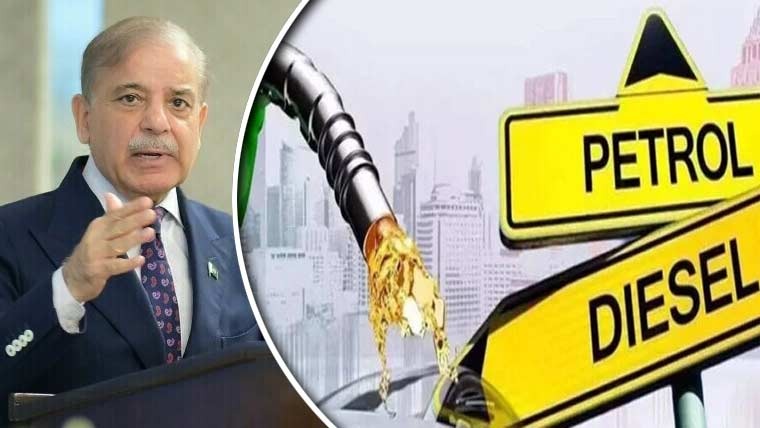
ISLAMABAD (TNS) After the tension in the Middle East and the attacks on two oil tankers in Iraqi waters, oil prices have seen a sharp increase in the global market. In view of the increasing prices at the global level, the possibility of petroleum products becoming more expensive is being shown. The government had increased the prices of petrol and diesel by Rs 55 per liter last week. According to the data as of March 13, 2026, crude oil prices in the global market have surpassed the $100 per barrel level. British Brent crude is trading at $ 100.50 per barrel, and American crude oil is at $95.30 per barrel. According to the report, two international oil tankers were targeted near the Iraqi maritime borders, after which fears of oil supply in the global market increased. According to experts, if tensions persist in the Gulf and near the Strait of Hormuz, further fluctuations in oil prices are likely to occur at the global level. On the other hand, Prime Minister Muhammad Shehbaz Sharif has decided not to increase the prices of petroleum products this time, as promised to the public, despite further increases in oil prices in the global market. According to a statement issued by the Media Wing of the Prime Minister’s Office on Friday, the Prime Minister stated that prices are not being increased to reduce the burden on the common man. The Prime Minister stated that, as promised, relief will be provided to the people in these difficult circumstances to the greatest extent possible. He said that due to tensions in the region, the global economy is currently under pressure, which is likely to have a profound impact on the economy of Pakistan; however, thanks to timely policy-making, saving measures by the government, and financial discipline, efforts are being made to deal with this situation in a humane manner. The Prime Minister stated that, as a servant of Pakistan, he has resolved to begin by addressing the elite and government of this country to alleviate the burden on the poor in these challenging circumstances. Along with the savings measures taken by the federal government, the provincial governments are also fully supporting these measures, which is welcome. The Prime Minister said that, by the grace of God, due to the efforts of the diplomatic and economic teams, an adequate quantity of crude oil is available to meet the country’s needs. The federal and provincial governments are collaborating to ensure that no one is charged more than the price set by the government. He prayed that the situation at the global level improves and the prices of petroleum products stabilize in the global market. Meanwhile, the All Pakistan Petroleum Dealers Association has announced a nationwide strike after Eid. Vice Chairman PPDA Tariq Hassan said that the government increased the price of oil in the dark of night, the petroleum levy was increased by Rs 21, and whose pocket did the remaining Rs 36 per liter go into? A transparent investigation should be conducted on the increase of Rs 55, he said that our margin was promised to increase 2 years ago, but the answer did not come. The price of oil increased by Rs 55 per liter; our cost of buying oil increased, while oil marketing companies benefited from billions of rupees. The leaders of the Petroleum Dealers Association stated that if a transparent investigation into the price increase of petroleum products reveals that their margin has not increased, they will go on an indefinite strike starting from March 26. It should be remembered that Pakistan has adequate oil reserves for March; however, due to the increase in prices in the global market, petrol and diesel are likely to become more expensive. The price of Brent oil in the global market has crossed $ 100 per barrel, and the government has also started implementing austerity measures. A public holiday has been declared in Islamabad to reduce fuel consumption. Additionally, Pakistan has banned the export of jet fuel and petrochemical products. The Petroleum Minister had said yesterday that a formal announcement will be made on the price changes for petroleum products, and the new prices will be determined taking into account the average global prices. It should be noted that due to the tense situation in the region and the rising prices of crude oil in the global market, the government has increased the price of petrol and diesel by Rs 55 per liter last week. The United States has temporarily allowed other countries to purchase Russian oil and petroleum products that are subject to sanctions. According to the report, US Treasury Secretary Scott Besant said that this is a temporary measure aimed at “promoting stability in global energy markets” during the war. This permission of President Trump will remain in effect until April 11. Scott Besant said that this limited and short-term measure applies only to oil that is already in the process of being delivered and will not bring any significant financial benefit to the Russian government. It should be noted that on Thursday, oil prices again went above $100 per barrel, and stock markets saw a decline. Scott Besant added that this temporary increase in oil prices is a short-term disruption, which will ultimately lead to significant benefits for our country and economy in the long run. The price of LNG has increased by $2.26 per MMBTU, and the Oil and Gas Regulatory Authority (OGRA) has issued a notification of LNG prices for March. According to the notification, the price of LNG on the Sui Southern system has increased by $2.26 per MMBTU. LNG on the Sui Northern system has been increased by $2.22 per MMBTU.The new price of LNG for Sui Northern has been set at $13.55 per MMBTU, while the new price of LNG for Sui Southern has been set at $12.53 per MMBTU. Meanwhile, in the meeting of the Senate Standing Committee on Finance, Federal Minister for Petroleum Ali Pervez Malik said that if the government had not increased the prices of petroleum products, the supply would have been suspended, shortages would have arisen, a large circular debt would have been created, and attacks on oil depots would have started. There is a risk of huge losses due to the rationing of petrol. At present, premiums and insurance are not available in the global market. A large ship from Saudi Arabia will first come to Oman and then to Pakistan through small ships. There is no proposal to increase the prices of LNG in the country. Finance Minister Muhammad Aurangzeb said that Pakistan is facing a war-like situation, and the effects of tensions in the region can have an impact on the economy. If the instructions of international financial institutions are not followed, Pakistan may again go to the grey list. Minister of State for Finance Bilal Kayani said that the prices of petroleum products will be reviewed today, and the government will try not to put more burden on the people. The Finance Committee meeting was chaired by Saleem Mandviwala, in which the Finance Minister and the Petroleum Minister gave a briefing on the situation arising from the tension in the region. Petroleum Minister Ali Pervez Malik said that there is an unusual fluctuation in global crude oil prices. Qatar has stopped the supply of LNG to Pakistan due to the war, and a cargo worth $25 million is available for $100 million. Saudi Arabia is cooperating in the supply of oil, but it may take 15 to 20 days to deliver oil from there. He said that fertilizer production in the country is higher than last year, and the closure of six plants is being considered. The Petroleum Minister said that if the government had not increased the prices of petroleum products, the supply would have been suspended and there would have been a shortage of fuel. If the prices were not increased, companies would have stopped imports due to rising costs, and a fuel dry-out situation could have arisen in the country. Committee member Farooq Naik said that the government increased the price of petroleum by Rs 55 per liter on the basis of old stock. Money was taken from the poor and given to the rich, Israel fired missiles, and you fired petrol missiles in Pakistan. He asked whether the government would provide relief to the people if global prices fell. Finance Minister Muhammad Aurangzeb said that Pakistan is facing a war-like situation and tensions in the region could have an impact on the economy. The Petroleum Minister said that if the prices were not increased, fuel imports would have stopped, and there would have been a risk of loss. There is a risk of huge losses due to the rationing of petrol. Petroleum reserves that were purchased at $70 per barrel will now be obtained at $120 per barrel. If the price were not increased, the difference would have become a huge circular debt. If subsidies were given, there would have been a shortage of petroleum products. In this situation, attacks on oil depots would have started. India is still subsidizing fuel; however, the price of LNG is being increased there. The Petroleum Minister said that there is no proposal to increase the price of LNG gas in the country. The price of LNG is increased twice a year in January and July. There has been no decrease in the supply of LPG gas from Iran.
Chairman of the committee Saleem Mandviwala said that if the war continues, there is a fear that the price of petroleum products will go up to Rs 500 per liter, to which the Finance Minister said that oil prices are going up in the global market, and they are trying to manage prices as per the Prime Minister’s instructions. The Petroleum Minister said that a decision will be taken after seeing the new global price on Friday. Minister of State for Finance Bilal Kayani said that the prices of petroleum products will be reviewed again on Friday, and efforts will be made not to put any more burden on the people. Briefing on the negotiations with the IMF, the Finance Minister said that the IMF has appreciated the steps taken till February 2026, and if the tension continues, the impact on external finance, inflation, revenue, and current account will be reviewed. The meeting also took note of the issue of harassment of parliamentarians by the State Bank and the FBR. The members said that politicians, judges, and bureaucrats are facing difficulties in the name of politically exposed persons, and this is affecting the business environment. Deputy Governor of the State Bank, Dr. Inayat Hussain, said that these regulations are in accordance with the conditions of FATF and IMF. The Finance Minister said that if the instructions of the international financial institutions are not followed, Pakistan can go to the grey list again. Chairman of the Pakistan Banking Association Zafar Masood said that a solution can be found on this issue through discussions. The committee decided to form a sub-committee for this issue. Committee member Faisal Sabzwari said that during elections, the Election Commission asks to open new bank accounts, but commercial banks create difficulties in opening accounts. US President Donald Trump says that the United States is the world’s largest oil producer, so when oil prices rise, we make a lot of profit. Donald Trump dismissed the rising global oil prices and market volatility due to the ongoing tension with Iran as insignificant and said that the United States benefits from the increase in oil prices. Making a statement on the social media platform Truth Social, Donald Trump said that the United States is the world’s largest oil producer, so when oil prices rise, we earn a lot, but the most important and most important goal for me is to prevent Iran from obtaining nuclear weapons and destroying the Middle East and the world. The US President said that he will never allow Iran to obtain nuclear weapons. In his statement, Trump described Iran as an evil empire and said that he will never allow the Middle East and the world to be destroyed. It should be noted that this statement by Donald Trump came at a time when the International Energy Agency (IEA) warned that, due to Iran’s increasing attacks, the world may face the largest supply disruption in history in the global oil market. On the other hand, according to the American magazine Axios, President Trump intends to continue the war with Iran for the next three to four weeks. After which, he will decide on the next steps. Meanwhile, according to the American magazine Exxon, Trump’s advisers have warned him that if Iran continues to close the Strait of Hormuz, they will prolong the war and push oil prices to unbearable levels. The ongoing war between Iran and Israel has put the Gulf Arab countries in a difficult situation. Kamal Kharrazi, an adviser to the Supreme Leader of Iran, has said that attacks on the Gulf countries will continue to force US President Donald Trump to back down from the war. On the other hand, US Senator Lindsey Graham also put pressure on the Gulf allies, saying that if they do not join the war against Iran, the US may have to review their defense. The Gulf states are avoiding direct involvement in this war because they fear that they will have to bear the long-term effects. According to an Emirati official, Iran is a permanent neighbor of the region, and relations will eventually have to be restored.
The war is also affecting the global energy market. Oil shipments through the Strait of Hormuz, a key waterway connecting the Gulf to global markets, have almost stopped, putting about a fifth of the world’s oil supply at risk. At the same time, Qatar Energy has also stopped production at some of its gas projects, after which gas prices in Europe increased by about 50%. According to Qatar’s energy minister, if the war continues, the price of crude oil in the global market could reach $ 150 per barrel. In recent days, a water purification plant on Iran’s Qeshm Island was attacked, in response to which Iran damaged a desalination plant in Bahrain with a drone attack. After this incident, concerns have increased about the threats to the water supply system in the Gulf countries. The Gulf countries have about half of the world’s desalination capacity, so attacks on water infrastructure could create a serious crisis for the region. According to analysts, the Gulf governments have so far refrained from joining the war, but it may also be difficult for them to remain neutral in the face of continued attacks.