

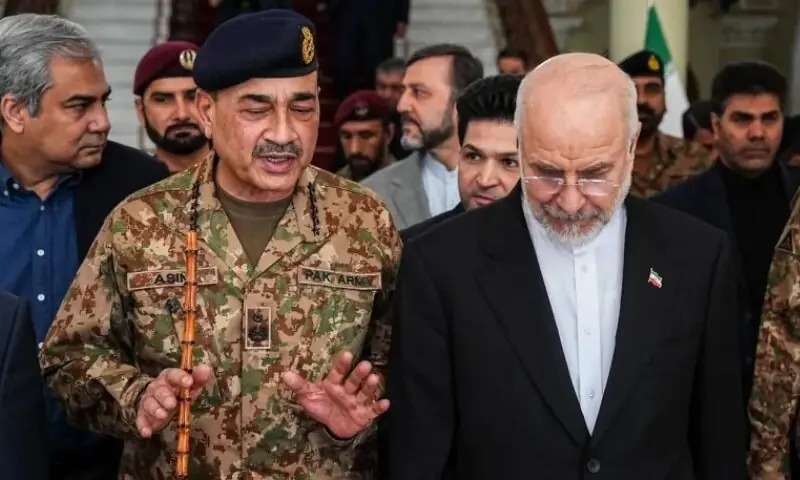
Islamabad (TNS) The second round of talks between the US and Iran is expected soon; however, the re-closure of the Strait of Hormuz has put a question mark on the Iran-US-Islamabad talks. According to a senior Pakistani diplomatic analyst, President Diplomatic Correspondents Forum of Pakistan (DCFP) Asghar Ali Mubarak, the two-week ceasefire is ending on April 22. Pakistan is currently the center of world attention because reaching a final conclusion before the two-week ceasefire period ends is essential for regional peace, for which preparations in Islamabad have reached a peak.
Through diplomatic sources, he said that although the US and Iranian governments have not officially confirmed it, President Donald Trump had already indicated that talks could take place at the end of the week. It should be noted that the Islamabad talks held last week could not end with an agreement despite continuing for several hours, but now there are high hopes at the global level for the second round. US President Donald Trump says that good talks are taking place with Iran, in which the US has taken a tough stance. He said that Iran wants to close the Strait of Hormuz again, but now it cannot blackmail us. At the White House, President Trump said that we have completely destroyed Iran’s top leadership, navy, and air force. He said that we are still talking to Iran; whatever the situation regarding the agreement will be, it will be clear by the end of the day. You can call it a forced regime change; Iran cannot blackmail us anymore. President Trump said that Qassem Soleimani was targeted in Iran, the leadership of the regime was eliminated, Soleimani was responsible for the incapacitation and deaths of many American soldiers, neither their navy, nor their air force, nor any leader. Meanwhile, Iran had expressed its willingness to allow a certain number of ships to pass through on a daily basis after the ceasefire brokered by Pakistan began. However, due to the non-implementation of the ceasefire in Lebanon, Iran had suspended the agreement, which has now been reactivated. According to Iran’s semi-official Tasnim news agency, Iran has not yet approved the next round of talks with the United States. It has been reported that no agreement could be reached on a new round of talks in the current situation, citing relevant officials. According to sources, the impasse arose due to the announcement of a naval blockade against Iran by the United States and the tough demands made in the talks. There has been an exchange of messages between the two countries in recent days, but despite this, no progress has been made. The two-week ceasefire brokered by Pakistan is ending next week on April 22, which has made the Islamabad talks extremely important. Iranian officials have made it clear that for the continuation of the talks, it is necessary for the US to avoid unnecessary and excessive demands; Iran will not participate in long and fruitless talks.
 According to Tasnim, sources further said that Iran has conveyed its position to US officials through Pakistan, while the future situation will depend on the decisions of both sides.
A main event is the tightening control over the Strait of Hormuz, impacting diplomatic negotiations. Saeed Khatibzadeh, Iran’s Deputy Foreign Minister, emphasizes that no date is set for renewed talks as finalizing the negotiation framework is the current priority. Security preparations for pivotal talks in Islamabad are extensive, with heightened police presence and restricted access in sensitive areas. Iran’s conditions for allowing commercial passage through the Strait of Hormuz have been outlined, including a ban on military shipping and mandatory coordination with the Revolutionary Guards. Iranian officials warn that a continued naval blockade against Iran will be interpreted as a ceasefire violation, potentially leading to further restrictions on shipping. Amid new tensions, ship tracking shows hundreds of vessels affected and at least two commercial ships reportedly fired upon. Iranian authorities declare US naval actions as piracy, reinforcing control over the Strait and reflecting the core issue shaping the ongoing diplomatic crisis.
The closure of the Strait of Hormuz by Iran is the central event being commented on by Ebrahim Azizi, head of Iran’s National Security Commission. He references warnings previously given regarding the consequences and points to recent increased maritime activity following US and Israeli actions against Iran.
Iranian officials have made it clear that this situation will continue until the US removes the obstacles imposed on the movement of Iranian ships. On the other hand, the US military has confirmed the continuation of the naval blockade against Iran, after which tensions in the Gulf are likely to increase further. The US Central Command (CENTCOM) has said in a statement on the social media platform ‘X’ that the US is continuing to implement its declared ‘naval blockade’ against ships entering or leaving Iranian ports and coastal areas. The Iranian Revolutionary Guard Corps has prevented two Indian-flagged ships from passing through the Strait of Hormuz. According to Indian media, Iranian gunboats fired on the Indian ships, but there was no loss of life or property in the incident. India has strongly protested the incident and summoned the Iranian ambassador. Indian media has claimed, citing sources, that on Saturday, Iranian gunboats stopped two Indian ships passing through the Strait of Hormuz and opened fire on them, due to which they had to turn back. Immediately after this incident, India summoned the Iranian ambassador and registered a protest. According to the International Shipping Data and Tanker Tracking Service, two ships bound for India, the ‘Jag Arno’ and the ‘Sanmar Herald’, turned back after approaching Oman, north of the Strait of Hormuz. The Sanmar Herald is a supertanker carrying 2 million barrels of Iraqi oil. According to Indian media, the crew on both ships is safe, but the nature and details of the attack are not yet clear. It should be noted that Iran had announced on Friday that it would open the Strait of Hormuz to international commercial ships under three conditions and warned that if the US continued the naval blockade, it would be considered a violation of the ceasefire and the route could be closed again. After Iran announced that it would open the Strait of Hormuz to commercial ships for the duration of the war, US President Donald Trump announced that the naval blockade of Iran would continue. President Trump said in his statement that the US Navy would continue to completely blockade Iranian maritime borders until all points are 100 percent with Iran. On the other hand, despite the 10-day ceasefire between Israel and Lebanon, the Zionist forces continue to attack. A French soldier was killed, and three were injured in an attack on a UN peacekeeping mission in southern Lebanon. The Israeli army, in a statement issued on ‘X’ on Saturday, admitted to multiple attacks in southern Lebanon despite the ceasefire. These attacks were carried out at a time when the Zionist army continued to occupy many areas of southern Lebanon. The statement described the attacks as defensive measures and said that it has the authority to carry out operations to protect its soldiers and Israeli citizens despite the ceasefire. It has hinted at further attacks and said that it will continue to take all necessary measures to protect its citizens and soldiers from possible danger.

It had confirmed the shooting of two commercial ships trying to pass through the Strait of Hormuz. It should be noted that Iran had announced the opening of this important sea passage to all commercial ships after the ceasefire in Lebanon; however, Iran’s Central Military Command announced the closure of the Strait of Hormuz again on Saturday morning in response to the US naval blockade. The international news agency had confirmed the shooting of two commercial ships trying to pass through the Strait of Hormuz on Saturday. The United States and Iran are in secret talks on a three-page deal to end the war, with the biggest deal being to release frozen assets in exchange for Iran’s nuclear stockpile. The US news website Axios reported, citing two US officials and sources familiar with the talks, that under the deal, the US is willing to release $20 billion in frozen Iranian funds on the condition that Iran completely dismantles its stockpile of enriched uranium. Although there has been steady progress in the talks this week, there are still major gaps between the two sides that are being bridged. President Donald Trump said that US and Iranian negotiators will likely meet later this week for a second round of talks to finalize the deal. The talks are expected to take place in Islamabad, as Pakistan is playing the role of mediator in the entire process. According to the report, the Trump administration’s top priority is to prevent Iran from accessing the 2,000 kilograms of enriched uranium, especially the 450 kilograms of material enriched to 60 percent, in its underground nuclear facilities, while Iran is currently in dire need of money to support its economy. The report said that initially, the United States had offered to release $6 billion for humanitarian needs such as food and medicine, but Iran had demanded $27 billion. Now the two sides are talking about $20 billion. The report said that one US official called it a US proposal while another described it as just part of the discussion. The report claims that efforts are being made to find a middle ground on the transfer of nuclear material. The US wanted all the material to be transferred, while Iran was only willing to down-blend it within its country. According to the report, the proposal now under discussion is that some of the material would be transferred to a third country and the rest would be disposed of within Iran under international supervision. In addition, Iran has been asked to voluntarily suspend nuclear enrichment for 20 years, but Iran has agreed to only five years. The first major convoy of oil tankers began passing through the Strait of Hormuz, a key global waterway that has been closed since the US and Israel attacked Iran seven weeks ago. However, the Revolutionary Guards have closed the sea passage again, accusing the US of violating the ceasefire agreement.
 According to marine traffic data, four large ships carrying liquefied petroleum gas and chemicals were recorded passing through Iranian waters on Saturday, and it was claimed that more tankers were following them from the Gulf. However, shortly after, the Revolutionary Guards announced the closure of the Strait of Hormuz again. The development comes at a time when diplomatic efforts between the United States and Iran for a ceasefire and lasting peace are at a peak. US President Donald Trump, while talking to reporters in Washington, hinted at some “good news” regarding Iran, but he refrained from giving details. Trump said that things are going very well with Iran in the Middle East and that talks are expected to continue over the weekend. He made it clear that our main goal is that Iran does not have nuclear weapons, because this issue takes precedence over everything else. On the other hand, Pakistan is currently playing the role of a key mediator in these talks. Pakistani Army Chief Field Marshal Asim Munir has returned from three days of talks in Tehran, while Prime Minister Shehbaz Sharif has also completed visits to Qatar, Saudi Arabia, and Turkey. An initial memorandum of understanding may emerge from this meeting between the United States and Iran in Islamabad, after which a full peace agreement can be reached within 60 days. However, it is still unclear whether a direct high-level meeting between the two countries will be held this weekend. The nuclear program remains the biggest obstacle in the negotiations. President Trump claims that the United States will remove Iran’s stockpile of enriched uranium, while Iranian Foreign Ministry spokesman Esmail Baqai has categorically stated that the material will not be transferred out of the country under any circumstances. Senior clerics have also taken a tougher tone during Friday gatherings in Iran, with Allama Ahmad Khatami saying that our nation does not negotiate on the basis of humiliation. Despite these differences, oil prices have seen a 10 percent drop in global markets.