

By Ms. Sidra Ali, Research Fellow at Pakistan Research Center for a Community with Shared Future (PRCCSF), Islamabad.
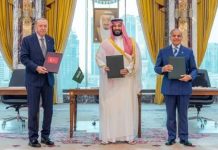
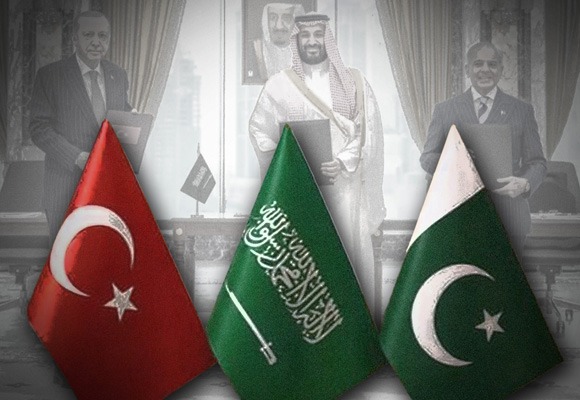
ISLAMABAD (TNS) The signing of the Mecca Joint Defence Agreement by Saudi Arabia, Pakistan, and Turkey at Al-Safa Palace has sent ripples through global chancelleries. Sealed by Prime Minister Shehbaz Sharif, Saudi Crown Prince and Prime Minister Mohammed bin Salman, and Turkish President Recep Tayyip Erdogan, the pact has been hailed by its signatories as a historic “shield of peace”.
The joint statement published by Pakistan’s Foreign Office and Saudi Arabia’s official SPA press agency reflects a shared commitment to strengthening collective security, declaring that “any armed attack against any one of the three states shall be regarded as an attack against them all.”
Predictably, international commentators immediately rushed to label it an “Islamic NATO” or a sectarian axis. However, a closer look at the geopolitical realities, strategic limitations, and motivations of the three middle powers reveals a much more nuanced picture: this is not an aggressive military alliance, but a pragmatic hedging strategy.
Strategic Realities
Unlike mid-20th-century Cold War security frameworks such as the Southeast Asia Treaty Organisation (SEATO) or the Central Treaty Organization (CENTO) – which relied on a traditional patron-client formula where Western powers provided the weapons and funding while member states supplied manpower – the Mecca pact represents an autonomous, post-Western regional alignment. While broader institutional coordination among Muslim-majority states has historically been anchored by diplomatic bodies like the Organisation of Islamic Cooperation (OIC), this trilateral agreement functions primarily as a flexible political signaling framework among three countries independently rather than a hard military alliance.
US President Donald Trump praised the Pact as a positive step towards new relations, self-reliance and regional unity between the three most powerful, leading Muslim countries. Further emphasis has been put on identifying the Pact as a purely defensive joint cooperation programme, to boost collective deterrence, sharing defense technology, and joint military exercises – possibly extending to more countries like Egypt, UAE, in future.
Turkish and Saudi officials were also swift to clarify that the pact is strictly defensive, not aimed at any specific actor, and not a sectarian bloc, military axis, or a rival structure to NATO. Despite borrowing the famous phrase from NATO’s Article 5 – that an attack on one is an attack on all – the Mecca Joint Defence Agreement is not a well-organised, institutionalized military alliance. Because the language is deliberately vague, lacking strict response triggers, a common budget, or enforcement mechanisms, none of the three countries are legally or practically forced to automatically enter a war if another is attacked.
What the Mecca Pact is and What It is Not
To understand the ‘defense posture’ of the Mecca Pact, it’s crucial to first strip away the alarmist rhetoric poised by the critiques. Experts have reiterated the Pact being a totally strategic cooperation and not a ‘Sunni NATO’ at all. It is driven by national interests for a more peaceful, robust region – not a need for a military alliance based on individual sectarian identities of each country. The member nations hold diverging foreign policies, with separate economic and military fronts; which demonstrates that the Mecca Pact is not a monolithic religious front. It is the first step, initiated by some of the strongest Muslim countries towards a more cooperative region away from military interests. Signatories have stated explicitly the pact being open to other regional nations; the transparency indicating that it is not a bloc against non-Sunni nations like Iran.
- Not Against Iran or for Saudi Hegemony:Saudi officials were swift to retort that the pact is neither a “military axis” nor a “sectarian bloc,” nor is it tied to any regional hegemony or nuclear ambitions.
- Not a Bypass of NATO Article 5:Turkish officials reinforced that the agreement is strictly defensive and directed at no specific actor, ensuring it does not conflict with Turkey’s core obligations as a NATO member.
- A Joint Defence Agreement, Not a Global Crusade:At its core, the pact is precisely what its text implies; a cooperative security framework between three middle powers preparing for a shifting global order, rather than an offensive force designed to project power globally.
A Pact with No NATO-like Joint Force
Despite borrowing the famous phrase from NATO’s Article 5- an attack on one is an attack on all – the Mecca Joint Defence Agreement is not a well-organised, institutionalized military alliance.
Unlike NATO, the Mecca Pact lacks integrated military headquarters, a unified command structure, and permanently assigned joint forces. The language is left deliberately vague, not bound under legislation promising military intervention by other signatories in case of an attack on one signatory; leaving none of the three countries legally or practically forced to automatically enter a war if another is attacked.
Without clear definitions of what constitutes aggression, strict triggers for military response, or pre-arranged command coordination, the promise of collective defence remains largely rhetorical. Instead of creating an automatic deterrent, nor an extended deterrence or nuclear sharing in case of Pakistan as a signatory. Individual critiques have been quick to pose the extent of the cooperation in real battlefield scenarios. For instance, if Iran launches a direct armed attack against Saudi Arabia, how extensive will the Pact’s signatories cooperate? Authorities in Riyadh were quick to clariy that similar to NATO, such a scenario will not invoke automatic mutual defense. Instead, the attacked country would formally have to invoke the Pact to request the extent of the required assistance against the belligerent such as logistics, intelligence, ground troops, etc.
While Pakistan has an individual defense security agreement with Mecca, implying that in real battlefield scenario it might not even have to invoke the Mecca Pact. However, Pakistan has always drawn a strict line against direct offensive operations, counter-strikes in another territory and providing an extended deterrence, which remains strictly tied to her own national defense. Likewise, Ankara has little appetite to commit it’s ground forces into a direct, exhausting military battlefield against potential adversaries in the region, including Iran or it’s proxies.
Officials of all three signatories have been quick to reiterate the fact that the Mecca Pact does not serve as a nuclear umbrella and is more of a political signaling for an evolving global order; Hence, the pact only functions as a flexible political statement, allowing each sovereign nation to decide for itself how far it is willing to go.
Unity in Principle, Division in Practice
The initial incubation for the Mecca Pact evolved as regional wars and instability across the Middle East led countries to explore new ways to enhance their security without relying on the United States and other Western powers. For Saudi Arabia, the trilateral pact is part of a calculated hedging strategy following missile and drone strikes on critical oil infrastructure that exposed the vulnerabilities of relying solely on the U.S. security umbrella. For Pakistan, the pact offers enhanced leverage against India, elevates its diplomatic profile following successful mediation roles, and secures continued economic backing from the Gulf. For Turkey, which fields NATO’s second-largest military, the trilateral agreement creates a complex puzzle regarding its Western commitments, yet offers a platform to expand defense manufacturing and regional influence.
The three signatories pool complementary strengths: Saudi Arabia brings global energy production and financial power; Turkey offers a strategic geographical bridge, a major regional military, and a booming defense industry; and Pakistan contributes strong military might, operational experience, and its status as the world’s only nuclear-armed Muslim-majority country. However, each country also maintains distinct security challenges—such as Turkey’s disputes with Greece and Israel, Pakistan’s active conflicts with India and Afghanistan, and Saudi Arabia’s exposure to Iranian aggression and Houthi threats—that may limit deep combat integration.
Turkey’s Article 5 Dilemma
For Turkey – which fields NATO’s second-largest military – the intersection of regional pacts and Western commitments creates a complex puzzle.
If Turkey were to face an adversary outside the direct scope of NATO’s primary focus; perhaps drawn into a wider regional conflagration involving Iran and the Gulf states – its ability to rely on NATO’s Article 5 is far from guaranteed. Western capitals have historically shown limited appetite for direct entanglements in Middle Eastern power struggles.
Yet, introducing the Mecca Pact into this equation does not cleanly solve the problem. Rather than adding an extra layer of foolproof protection, overlapping commitments to NATO and the trilateral pact risk generating command confusion and uncertainty over which alliance takes priority in a crisis.
Pakistan’s Selective Solidarity
Pakistan’s recent military record provides a practical baseline for what this trilateral agreement can actually deliver. Islamabad previously signed a bilateral Strategic Mutual Defence Agreement (SMDA) with Riyadh, and during the regional tensions of the Iran war, Pakistan did activate that partnership by deploying thousands of troops, an air force squadron, and advanced air defence systems to Saudi Arabia.
While a substantial deployment, it was carefully bounded: Pakistani forces did not engage Iran directly, and much of the deployment materialized around or after ceasefires.
If an explicit bilateral defence pact produced symbolic and defensive troop positioning rather than direct combat intervention against a marauding adversary, a looser trilateral agreement involving Turkey’s distinct strategic priorities is unlikely to yield a firmer military reaction. For Islamabad, the true utility of the Mecca Pact lies elsewhere: it offers enhanced leverage against India, elevates its diplomatic profile following successful mediation roles, and secures continued economic backing from the Gulf.
Saudi Arabia’s Hedging Strategy
For Riyadh, the trilateral pact is part of a broader, calculated pivot. Recent regional flare-ups – including missile and drone strikes on critical oil infrastructure – laid bare the vulnerabilities of relying solely on the U.S. security umbrella. Compounded by complex negotiations over civil nuclear cooperation agreements, Saudi leadership has recognized the necessity of building alternative security architecture.
Read side by side, Saudi Arabia’s nuclear framework pursuits and the Mecca Pact tell the same story: hedging. Riyadh is not cutting ties with Washington; rather, it is quietly diversifying its options, gaining access to Pakistan’s military capabilities and nuclear-adjacent prestige, while tapping into Turkey’s booming defence manufacturing sector.
For Europe and the Rest of the Region
For Europe, a more stable and connected region could bring benefits through safer energy supplies, trade routes, and transportation networks. Additionally, the geography of the partnership could allow Europe to benefit from more secure energy and transportation routes, while Pakistan strengthens its role as a bridge connecting the Gulf, Central Asia, China, and Europe.
The Mecca Agreement contributes to a more multipolar regional order by strengthening the role of regional middle powers. For Europe, a more stable and connected region could bring benefits through safer energy supplies, trade routes, and transportation networks, with Pakistan strengthening its role as a bridge connecting the Gulf, Central Asia, China, and Europe. For the United States, Russia, and China, the agreement presents unique opportunities to engage with an independent regional security architecture rather than a hostile bloc.
Amid concerns raised by international observers regarding regional friction, analysts emphasize that neither India nor Israel needs to panic over the pact. Because the agreement lacks operational teeth, strict military integration, or an offensive mandate, it functions more as a diplomatic hedging signal than a battlefield coalition. Ultimately, the Mecca Agreement is a marriage of convenience among three distinct governments with divergent strategic priorities, cloaking themselves in the bold language of collective security to project more strength on paper than they possess in practice. The true test of the pact will not be found in the ink of its signing ceremony, but in how its members react the day its vague commitments are met with a real crisis.
Cohesion Amidst Divergence: Paper Tiger vs. Shield of Peace
The reception of the agreement highlights deep regional divisions:
- The Critics’ View:Skeptics remain unimpressed. Emirati researcher and foreign policy expert Huda Albadi dismissed the pact to the press as a “paper tiger,” warning that it reflects a troubling regional mindset that frequently misattributes the primary source of instability in the Middle East.
- The Triumvirate’s View:Leaders like Prime Minister Shehbaz Sharif have championed the agreement as a vital “shield of peace” born from shared faith, historical brotherhood, and a mutual need to deter external aggression.
Due to this absence of a unified command, an independent joint force like NATO and a strict response triggers, and lack of enforcement mechanisms, the pact functions as a flexible political statement rather than an automatic deterrent. Positively, it is a remarkable sign that the Mecca Agreement is a cooperative MoU rather than an offensive or defensive agreement against the world.
The Mecca Joint Defence Agreement will inevitably be framed by optimists as a historic tectonic shift in the Middle East’s balance of power. In reality, it is a marriage of convenience among three distinct governments with divergent strategic priorities, cloaking themselves in the bold language of collective security to project more strength on paper than they possess in practice.
Ultimately, the true test of the Mecca Pact will not be found in the ink of its signing ceremony, but in how its members react the day its vague commitments are met with a real crisis.