

ISLAMABAD (TNS) Pakistan Railways is a 150-year-old British-built system, there are definitely gaps in it, which efforts are being made to improve over time. Although major train accidents have occurred, it is still the second safest travel facility in Pakistan like other countries in the world. Despite the shortcomings, Pakistan Railways is continuing its services, but its complete improvement will only be achieved after the upgradation of ML-1 under CPEC. Which will build tracks and trains on modern lines. In the financial year 2024-25, Pakistan Railways broke all previous revenue records and earned a revenue of Rs 93 billion. According to the Railways spokesperson, the Railways broke all previous revenue records and earned a record revenue of Rs 93 billion in the financial year ending in June. One and a half billion was earned from military traffic, while Rs 3 billion was earned from other coaching sources, while Rs 9.5 billion was earned from miscellaneous sources. This is the highest level of income in the 78-year history of the railways. Last year, Pakistan Railways earned Rs 88 billion. Karachi Division was at the forefront of income from the passenger train sector with an income of Rs 15 billion, while Lahore was at the second place with an income of more than Rs 11.5 billion. In addition, Karachi earned Rs 28 billion and Multan earned Rs 1 billion from freight trains. Railways Minister Hanif Abbasi said that the railway administration deserves praise for its excellent performance with limited resources. Next year, up to 70 percent of income generation will be possible from freight trains. He said that I salute our workers who have shed blood and sweat for the stability of the institution.
 According to the railway administration, till May 30, Pakistan Railways earned Rs 42 billion from passenger train operations, Rs 29 billion from freight trains and Rs 12 billion from other sources, including land leasing. The Karachi division of PR, leading in terms of revenue, earned Rs 13 billion from passenger trains and Rs 25 billion from freight trains, Lahore division earned Rs 10 billion and Rs 750 million from passenger trains, Rawalpindi and Multan divisions earned Rs 4, 4 billion and Rs 8, 8 billion from freight trains. The revenue of Rs 83 billion (in 11 months) earned till May 30 has never been achieved in the history of Pakistan Railways. Last year, till May 30, 2024, PR earned Rs 77 billion. In the financial year that ended on June 30, 2024, Pakistan Railways earned a revenue of Rs 88 billion, which was 40 percent more than the revenue of Rs 63 billion in the financial year 2022-23. Last year, Rs47 billion of the revenue was generated from ticket sales, Rs28 billion from freight, and Rs13 billion from railway land leasing and other sources. In the financial year 2018-19, PR’s revenue was Rs45 billion, which increased to Rs48.5 billion in 2020-21 and Rs63.5 billion in 2022-23. The increase in revenue was possible due to improved passenger and freight services, although the department had limited resources. It may be recalled that on April 7, 2025, the Railways decided to start an operation to eliminate encroachments on railway land in Punjab and Sindh. Minister for Railways Hanif Abbasi, while giving the task of bringing the regularity of trains to 90 to 95 percent in 3 months, said that no train will be late for anyone, including the minister. On the other hand, on June 27, 2025, Federal Minister for Railways Hanif Abbasi, while talking to the media outside the Parliament House, said that revolutionary changes are being brought in the Ministry of Railways and the development of the railways is being linked to the development of Pakistan. Timely movement of railways is being ensured and all possible facilities are being provided to passengers. He said that record performance has been shown in the first 100 days of his ministry. The condition of railway stations in Lahore, Karachi and Rawalpindi has been improved, while solar panels are being installed at 155 railway stations in the initial phase. International standard public facilities are being provided at the stations, washrooms and waiting rooms are also being made comfortable. Several components of the railway are being outsourced and the railway network is being expanded rapidly. Sindh, Balochistan and Punjab are being interconnected so that better connectivity can be established across the country. According to the Railway Minister, train travel is being made as easy and comfortable as possible and medical and health facilities will also be provided to the passengers. The railway system is being improved under public-private partnership and a major agreement is going to be signed in the coming days which will bring modernization to the railways. He said that the railways will be taken out of losses and made a profitable institution, and now a modern train is being manufactured in Pakistan itself. Railway land worth billions of rupees has been acquired, and the design of a model train will also be presented to the Prime Minister soon. While talking to the media, in response to a question, the Railway Minister had interestingly said that when someone asked him about the railways, he did not take him to dinner, but to the railway station to see for himself what the changes were. On the other hand, I had personally witnessed it last week, but unfortunately, nothing was good for railway passengers in Pakistan. Even in the air-conditioned coach, not a single mobile phone charging point was available for passengers. I had reserved an air-conditioned seat for the Pakistan Express from the Rawalpindi booking office. The Pakistan Express, which was scheduled to depart from Rawalpindi at 6 am on July 5, was attached to the power van after an hour, during which the passengers, especially old women and children, remained worried. When the railway inquiry staff was asked, they clearly told that we do not know about this, why there was an hour’s delay. The Pakistan Express air-conditioned coach number two was badly damaged but was attached to the train for Karachi. All the relevant records can be checked that why the Pakistan Express train left Rawalpindi one hour late without any reason. The train’s air conditioning was not working properly when it was attached to the power train. There was no water in the washroom. I clearly told the train guard of this train, Mr. Bhatti. Near Dinah, a railway employee dressed in a sky blue shirt and blue pants asked me to give up the seat for another passenger and I protested that I have a seat book from the Rawalpindi Reservation Office but he insisted on giving up the seat and said that the black marker numbers are written. I said there are three different numbers here and the train guard, Mr. Bhatti, guided me that this is my reservation seat and it is not your duty to ask the passenger for it. After a while, the train guard, Mr. Bhatti, came and said that the reservation seat is booked by Asghar Ali Mubarak and told the new passenger that you have just come and we will give you a seat in the next coach. Railway employees do such activities daily. Meanwhile, when I was returning from Alipur Chatta on July 7 by Pakistan Express, I saw that the door connecting the air-conditioned coach was badly damaged and I told the train guard Mr. Abbasi about it, who promised to call the carriage staff for welding, but all was in vain. After some time, it broke down near Jhelum. The Minister of Railways should take action for the improvement of the railways. On the other hand, Pakistan Railways has given great good news to the passengers. Passengers will be able to benefit from free Wi-Fi and international standard dining facilities. Pakistan Railways has announced the operation of a new modern business train. A modern business train will be inaugurated on July 19. The new business train will have 28 digital coaches, free Wi-Fi, and an international standard dining car. The train will be inaugurated in Lahore by Prime Minister Shahbaz Sharif. The inauguration of the new train is part of the wider efforts to modernize Pakistan Railways. Modernization of the railways includes digital ticketing, improved on-board services, and upgraded station facilities. Meanwhile, Pakistan Railways has introduced a new app ‘Track My Train’ for the convenience of passengers. Remember that Pakistan Railways was formerly known as North Western Railway from 1947 to February 1961 and Pakistan Western Railway from February 1961 to May 1974, it is a department of the Government of Pakistan that provides railway services in Pakistan. Pakistan Railways is protected by the Pakistan Railways Police which comes under the Ministry of Railways (Pakistan). The headquarters of the Railway Police is located in Lahore. Pakistan Railways is important as the backbone of Pakistan’s economy, providing cheap, fast and comfortable facilities for mass transportation in Pakistan. Railways in present-day Pakistan began on 13 May 1861 when the 169-km railway line from Karachi to Kotri was inaugurated. On 24 April 1865, the Lahore-Multan railway line was opened for train traffic. On 6 October 1876, the construction of bridges over the Ravi River, the Chenab River and the Jhelum River was completed and the Lahore-Jhelum Railway Line was opened. On 1 July 1878, the 334 km long Lodhran-Punu Aqil Railway Line was inaugurated. On 27 October 1878, the Kotri-Sukkur railway line on the western bank of the Indus River via Dadu and Larkana was opened for train traffic. The work of laying the railway line from Ruk to Sibi was completed in January 1880. In October 1880, the 115 km long Jhelum-Rawalpindi railway line was opened for train traffic. On 1 January 1881, the 73 km long railway line between Rawalpindi and Attock was opened. On 1 May 1882, the 65 km long Khairabad Kund-Peshawar railway line was completed. On 31 May 1883, the Attock Bridge was completed on the Indus River, connecting Peshawar with Rawalpindi by rail. By 1885, four railway companies were operating in present-day Pakistan: Sindh Railway, Indian Flotilla Railway, Punjab Railway and Delhi Railway. In 1885, the Indian government bought all the railway companies and in 1886, the North Western State Railway was founded, which was later renamed North Western Railway. The Sibi-Quetta railway line was completed in March 1887. The Lansdowne Bridge between Rohri and Sukkur was inaugurated on 25 March 1889. After the construction of this bridge was completed, Karachi-Peshawar was connected by rail. On 15 November 1896, the Rohri-Hyderabad railway line was inaugurated via Tando Adam, Nawab Shah and Mehrabpur. On 25 May 1900, the Kotri Bridge and the 8 km long Kotri-Hyderabad railway line were completed. After the completion of this section, the current Karachi-Peshawar main railway line of Pakistan Railways was also completed. The North Western Railway was renamed Pakistan Western Railway in February 1961 and Pakistan Railways in May 1974. At the time of the creation of Pakistan, three different broad gauge, meter gauge and narrow gauge railway lines were used in Pakistan. Of these, some meter gauge and narrow gauge railway lines have been converted to broad gauge and the rest have been closed. Now only broad gauge railway lines are used in the Pakistan Railways system. The Lahore-Khanewal line was electrified at 25 kV AC, but the electric service was discontinued in 2011. Pakistan Railways has three functional units, namely Operations, Manufacturing Welfare and Special Measures. The Operations Unit is divided into three main departments. The Infrastructure Department oversees civil engineering, signalling, telecommunications, design and the Directorate of Property. The Mechanical Engineering Department oversees mechanical engineering, purchasing, stores and electrical engineering and the Traffic Department oversees passenger facilities, operations, marketing and the Directorate of Information Technology. Several smaller departments including Personnel, Railway Police, Planning, Legal Affairs, Public Relations and the Pakistan Railways Academy are also part of the Operations Unit. The maximum speed of Pakistan Railways trains is 120 km/h. Trains run at a speed of 120 kmph on some parts of the Karachi-Lahore railway section. Pakistan is connected by rail to India, Iran and Turkey. Pakistan is considering a railway line to Central Asia via Afghanistan. There is no rail connection with China at present. The Khunjerab Railway or Karakoram Railway is a project to connect Hunzanagar district of Gilgit-Baltistan, Pakistan with the Xinjiang Autonomous Region of the People’s Republic of China via the Khunjerab Pass. Pakistan and Afghanistan have agreed to finalize the agreement on the Uzbekistan, Afghanistan, Pakistan Railway project to increase regional connectivity. According to the report, this agreement was reached during the first round of talks at the level of additional secretaries of the foreign ministries of Afghanistan and Pakistan in Islamabad. It should be noted that despite using all its resources and measures, Pakistan Railways could not save passenger and freight trains from accidents and derailments and passengers are facing difficulties due to derailments of trains every day. In a railway accident in Sukkur on July 5, 2025, passengers riding on the roof of the train collided with an electric wire. The passengers were riding on the roof of the Sukkur Express going from Jacobabad to Karachi. The incident occurred near Arain Railway Station. Earlier, railway officials said that due to the Mirpur Mathelo goods train accident, the movement of trains was delayed by up to 14 hours. The Green Line reached Karachi Cantt 10 hours late, the Awam Express coming from Peshawar 10 hours and the Rehman Baba Express arrived in Karachi 4 hours late. The Millat Express coming from Sargodha reached Karachi 12 hours late, the Farid Express coming from Lahore 13 hours, the Karakoram Express 13 hours late, the Shah Hussain running between Karachi and Lahore has been canceled. Passengers who were delayed for more than 6 hours were refunded the full amount of their tickets. According to statistics, from January 1 to July 5 of this month, 47 passenger and freight train derailments and accidents of various kinds have occurred.
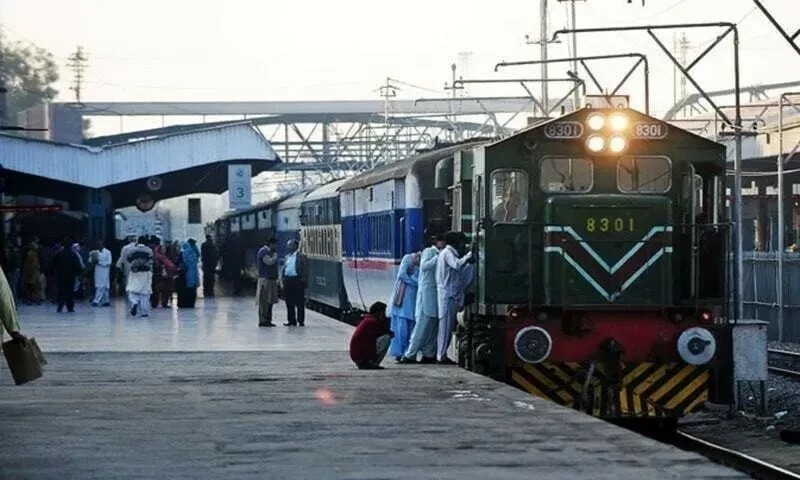
According to the statistics, there were 24 derailments of passenger trains, 20 of freight trains and 3 other accidents. The Jaffar Express train was also targeted for sabotage and many people were injured in these accidents. The infrastructure of Pakistan Railways also suffered losses worth crores of rupees due to the accidents. On May 21, the Shalimar Express train going from Karachi to Lahore met with an accident near Sianwala Darul Haasan. The train hit a brick trolley at an unmanned level crossing, causing all 15 coaches of the train to derail. Later, on May 30, the Rehman Baba Express train hit a trolley at an unmanned level crossing. On June 1, the Pakistan Express met with an accident near Mubarakpur, the entire trolley came out from under the dining car of the train, but the train narrowly escaped a major accident. Similarly, three train accidents occurred on June 14. Six bogies of the Khushhal Khan Khattak train going to Peshawar derailed at Kandhkot. On the same day, the Allama Iqbal Express train also escaped a major accident. The brake block malfunctioned while the train was running. In addition, the Thal Express train collided with a car. On June 18, the Jaffar Express was sabotaged near Jacobabad. The railway track was blown up with explosives. Five bogies of the train derailed. In addition, many trains had to be stopped during their journey due to faulty air conditioners and engine overheating. Despite all its efforts, Pakistan Railways could not stop the derailment of trains. This is mainly due to the dilapidated condition of the railway track. Some of the railway tracks are more than 100 years old and have been made usable after routine repairs and maintenance.