

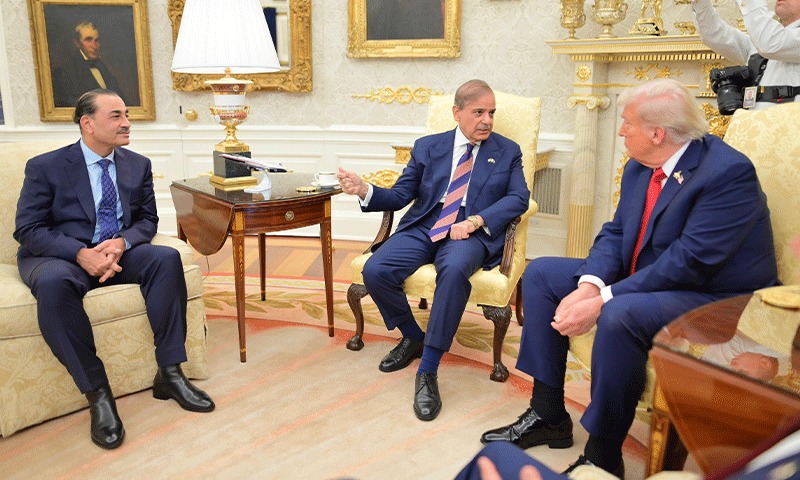
ISLAMABAD (TNS) Prime Minister of Pakistan Shahbaz Sharif vigorously raised the issue of Palestine in the General Assembly. The issue of Palestine is moving towards a solution and the Palestinian people have welcomed the Gaza peace plan. Pakistan was also specifically mentioned when Trump announced the plan, and Prime Minister Shahbaz Sharif welcomed this 20-point plan and emphasized the two-state solution. He said in a post that lasting peace between the Palestinian people and Israel is indispensable for political stability and economic development in the region. Since October 7, 2023, at least 66,055 people have been martyred and 168,346 injured in Israel’s war on Gaza. Thousands more are feared to be buried under the rubble, who are presumed dead. 1,139 people were killed in the attacks in Israel. The plan has been welcomed by many countries, including Saudi Arabia, Jordan, the United Arab Emirates, Qatar, Egypt, Italy, France and the United Kingdom, as well as the Palestinian Authority. It should be noted that during Trump’s first presidency, Under the Abraham Accords, four Muslim-majority countries agreed to establish diplomatic relations with Israel under the mediation of the United States. The Prime Minister’s statement has drawn strong reactions across the country, with politicians, experts, journalists and activists calling it a ‘surrender’. Speaking in the Senate, Federal Law Minister Azam Nazir Tarar said that the Palestinian issue is moving towards a solution, the Palestinian people have welcomed the Gaza peace plan. He is proud of the defense agreement to protect the Two Holy Mosques.
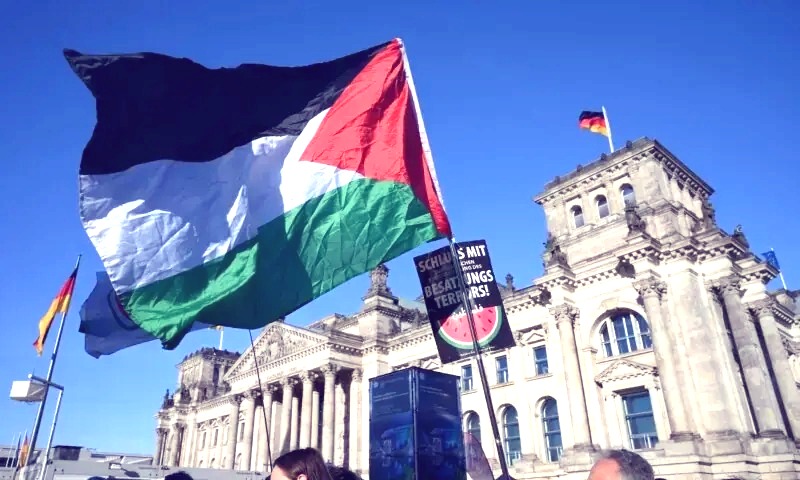
Trump Gaza Peace Plan; Greater Israel Plan is Failing Due to the Unity of Islamic Leaders Pakistan has always been a very strong voice on the Palestinian cause. The Trump plan for peace in Gaza is a manifestation of the unity of Islamic leaders In a recent fruitful meeting with the US President, the unity of Islamic leaders played an important role for peace in Gaza. The diplomacy of Pakistani Prime Minister Shehbaz Sharif was appreciated worldwide. Is Trump’s peace plan the end of the Gaza war or the starting point of a new era of negotiations? A joint statement by Pakistan, Saudi Arabia, Qatar, Jordan, Turkey, the United Arab Emirates, Egypt and Indonesia said they would play a “constructive” role in finalizing the deal. They welcomed Trump’s “sincere efforts” to end the war, which would allow Gaza to be rebuilt and Palestinian displacement to be halted. The statement also praised the US president’s refusal to allow the annexation of the West Bank. The foreign ministers’ statement said they wanted “peace based on a two-state solution” and that Gaza should be fully integrated into a Palestinian state alongside the West Bank. Then comes the question of the International Stabilization Force (ISF), which would act to some extent as a peacekeeping force in Gaza. The comprehensive plan states that this new force will take control and stabilize the situation when the Israeli army withdraws from Gaza. It sets certain goals that must be met for the army to withdraw. This shows that, at least in theory, the US expects the Israeli army and the new security force to work together. Last night, Benjamin Netanyahu said that Israel will remain responsible for security in Gaza and the surrounding areas for the foreseeable future.The proposed plan is likely a reference to the Gaza International Transitional Authority. The plan envisions a system in which billionaires and wealthy businessmen would hold top positions on the international board, while carefully selected “neutral” Palestinian administrators would hold lower positions, according to the Middle East Eye. According to the draft, presented by former British Prime Minister Tony Blair, the authority would be run by an international board that would have “the highest political and legal authority for Gaza during the transitional period.” The administration would work with the cooperation of Israel, Egypt and the United States, and, according to Israeli sources in Haaretz, would also have the support of the White House. The board would be responsible for all appointments and would oversee every aspect of the authority. This authority appears to be the same “Peace Board” that Donald Trump mentioned in his press conference last night, which he himself would head. The board would also include a senior UN official, while “leading international figures with executive and financial expertise” are also likely to be included. The board would include “at least one qualified Palestinian representative,” likely from “the business or security sector,” but it was not clear what “qualified” meant. The document said the board would include a “large number of Muslim members to ensure that the authority has regional and cultural support from Muslim members.” These Muslim members would ideally have the political support of their countries and “longstanding business reputation.” Although it is called the Palestinian Executive Authority, contrary to its name, it would be the lowest level in the new post-war Gaza regime and would have little real independent power. It is separate from the Palestinian Authority that governs the occupied West Bank. The Palestinian Executive Authority will consist of technocratic ministries that will oversee health, education, water supply and energy, labor market policies, housing, local criminal justice and welfare, among other policy areas. It will be headed by a ‘Palestinian Chief Executive Officer’ appointed by an international board. It is noteworthy that the language used throughout the document for all roles, such as board, chairman and CEO, makes it seem as if we are talking about a business structure rather than a country or region. The Palestinian CEO will head ‘directors’ for various areas such as health, education, infrastructure and planning, and the CEO will have the power to select these directors. The directors will have to ‘meet standards of technical competence, integrity and impartiality’. The international group of billionaires and business people will make the final decision on who is appointed, in order to ‘protect the institutional credibility and its autonomy.’ According to the document, ‘the performance of all department heads will be reviewed and they can be dismissed or replaced based on their interim governance mechanisms.’ The US president has made it clear that Muslim countries will deal with Hamas, indicating that Trump is putting the responsibility of ensuring compliance with the plan on the Muslim bloc, which was apparently briefed on the points of the proposal during a meeting with Trump on the sidelines of the UN General Assembly last week. However, the draft contains some elements that may cause dissatisfaction among the allies. Although Hamas is now under pressure from Qatar and other Arab countries to accept the points, real negotiations will now begin, where the two sides will discuss the ambiguous language used in the “comprehensive plan”. In this context, the latest development is not the end of the war, but rather a basis for the resumption of negotiations. Israeli Prime Minister Netanyahu apologized to the Qatari Prime Minister for the Doha attack in a phone call, while Israel and Qatar accepted the US President’s proposal to establish a “tripartite system” to promote harmony.
 The leaders accepted the president’s proposal to establish a tripartite system to promote coordination, improve communication, resolve mutual grievances, and strengthen collective efforts to prevent threats. They reaffirmed their commitment to working together constructively, dispelling misunderstandings, and building on their long-standing relationship with the United States. It should be noted that on September 9, Israel carried out an airstrike targeting senior Hamas leaders in the Qatari capital of Doha. However, Hamas leader Khalil al-Hayyah was unharmed in the attack, but six people, including his son and aide, were martyred. The attack came as Hamas negotiators were meeting to consider the latest ceasefire proposal presented by the United States.Hamas is the ruling Palestinian militant group in the Gaza Strip, which has fought several wars with Israel since it took power in 2007. In addition to these wars, Hamas has fired thousands of rockets into Israel and carried out several attacks. Israel has also repeatedly targeted Hamas with airstrikes. Israel, with the help of Egypt, has maintained a blockade of the Gaza Strip since 2007. Several world powers, including Israel, the United States, Britain and the European Union, have designated Hamas or its military wing as terrorist organizations. Hamas is supported by Iran. There are constant tensions between Hamas and Israel. In addition to the delay in the establishment of an independent Palestinian state, Israel’s construction of Jewish settlements in the West Bank and the construction of security barriers around them have made peace difficult. However, there are many other differences. Israel claims full control of Jerusalem and claims that it is its capital. However, this claim does not have international support. The Palestinians want East Jerusalem as their capital. The Palestinians demand that the borders of their future state be fixed to the conditions that existed before the 1967 war, but Israel does not accept this demand. Illegal settlements have been built in the territories that Israel occupied after the 1967 war, and about half a million Jews now live in the West Bank and East Jerusalem. Another issue is the Palestinian diaspora. The PLO claims that there are currently more than 10 million Palestinians worldwide, half of whom are registered with the United Nations. The Palestinians say that these people have the right to return to Israel, while Israel believes that doing so could jeopardize its Jewish identity. How can peace be achieved in such a situation? This will require several steps from both sides. Israel will have to recognize the right of the Palestinians to an independent state, lift the siege on the Gaza Strip, and remove the barriers in East Jerusalem and the West Bank. Pakistanis consider the pain of Palestine and Kashmir as their own. Allama Iqbal had said in a detailed statement on July 3, 1937 that the Arabs should not trust the advice of their kings while considering their national problems because these kings cannot reach any correct decision regarding Palestine in the light of their conscience and faith. Quaid-e-Azam, while speaking on the Palestine issue at the annual session of the Muslim League held in Lucknow on September 15, 1937, requested all Muslim countries through a resolution to formulate a common strategy to save Jerusalem from the occupation of non-Muslims. Then on March 23, 1940, a resolution was also passed on the Palestine issue at the annual session of the All India Muslim League held in Lahore.