
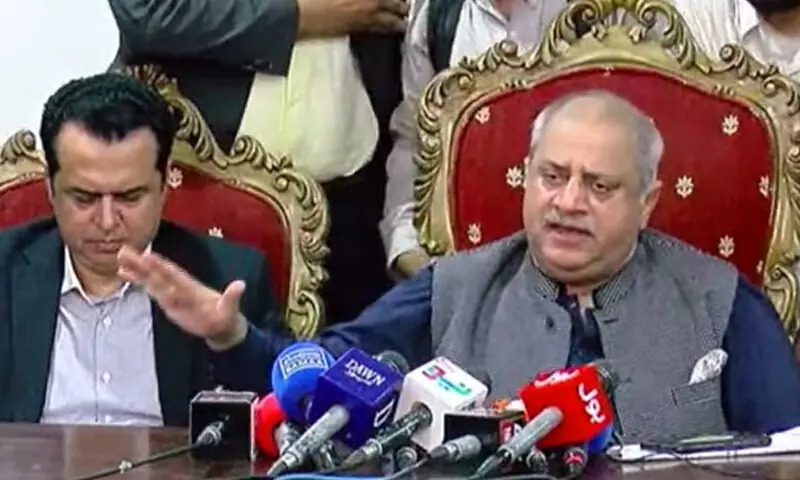
ISLAMABAD (TNS) Prime Minister of Pakistan Shahbaz Sharif announced the formation of a high-level negotiation committee in the context of the ongoing strike by the People’s Action Committee (AAC) in Azad Jammu and Kashmir, which includes representation from all major political parties. This move is a manifestation of his serious commitment and sincerity towards the Kashmiri people, because the solution to the problems is possible only through dialogue and not through confrontation. Is India behind the deadly protests in Azad Kashmir? According to sources, a confidential letter has revealed that some elements of the People’s Action Committee were briefed by Indian authorities in Geneva to create unrest in Azad Kashmir, over which the government has expressed serious reservations. Why is the agenda of the Joint Action Committee anti-Pakistan? 36 out of 38 demands of the Awami Action Committee have already been accepted, yet the AAC leadership is adamant on continuous protests and is rejecting repeated offers of talks by the governments of Pakistan and Azad Kashmir. This attitude is not only endangering the lives of innocent Kashmiri people but is also affecting law and order and may also damage the position of Kashmiris at the international level. Pashtun Tahafuz Movement (PTM): A movement that advocates for the rights of Pashtuns and PTM has faced criticism and controversies in Pakistan, with direct evidence of its links to anti-Pakistan agendas. The Indian-backed Baloch Unity Committee (BYC) and Balochistan Liberation Army (BLA) groups are involved in the ongoing insurgency in Balochistan, demanding autonomy and rights. Like the PTM, their activities are complex and multifaceted, driven by external influences. In the context of Pakistan, a Joint Action Committee (JAC) is a committee formed for protest or negotiations, as for example in Azad Jammu and Kashmir, the Joint Action Committee has been involved in protests and negotiations on issues such as economic relief, fair taxation and civil rights. The protests are ongoing due to grievances regarding economic relief, fair taxation and civil rights regarding the situation in Azad Jammu and Kashmir. The Public Action Committee presented a 38-point charter of demands to the Azad Jammu and Kashmir government, which resulted in violent clashes and deaths. The government is engaged in talks to resolve these issues. The PTM’s narrative often portrays the state in a negative light, which can erode public trust in state institutions and damage national unity. The PTM’s rhetoric often focuses on accusations of ethnic discrimination, alleging that the Pashtun community is marginalized and persecuted. The PTM’s narrative has been criticized for being anti-state, with some saying it fosters division and mistrust. The PTM has faced criticism for not openly condemning militant groups such as the Tehreek-e-Taliban Pakistan (TTP), which is responsible for numerous attacks on Pashtuns. The Pakistani government has launched programs to improve infrastructure, healthcare, and education in Khyber Pakhtunkhwa and the former FATA regions. The government emphasizes national unity and inclusive governance to address the grievances of all citizens, including Pashtuns. Baloch Unity Committee (BYC) and Balochistan Liberation Army (BLA): These groups are involved in the ongoing insurgency in Balochistan, which demands autonomy for the Baloch people. The Joint Action Committee Azad Jammu and Kashmir is involved in protests and negotiations on issues such as economic relief, fair taxation, and civil rights. In Azad Jammu and Kashmir, the Public Action Committee presented a 38-point charter of demands to the government, which resulted in violent clashes and deaths. The government is engaged in talks to resolve these issues. The Pakistani government has banned the PTM, citing threats to national peace and security. Amnesty International has demanded the lifting of this ban, arguing that it restricts the freedom of association and peaceful assembly. The anti-Pakistan Joint Action Committee is actually the same old face that spreads chaos in Pakistan on the Indian side in the name of the anti-Pakistan Pashtun Tahafuz Movement, (PTM), Baloch Unity Committee (BYC), Balochistan Liberation Army (BLA). The aim of these anti-Pakistan elements is to weaken Pakistan and sow hatred in the hearts of the people. Remember, Pakistan has never bowed down to such temptations and will not bow down. All these agendas will fail and be buried in the dustbin of history. Pakistan will emerge stronger and united than before. The closure of roads, closure of businesses and disruption in the supply of essential goods are directly affecting ordinary Kashmiri citizens, shopkeepers, daily wage earners, students and patients. The government of Pakistan says that it is ready for mature thinking, reconciliation and negotiations, but now the onus is on the Awami Action Committee to show seriousness and responsibility. Azad Kashmir needs peace, not chaos. The solution to problems lies in negotiations, not strikes. The government’s doors are open for talks. Therefore, the Public Action Committee should end its strike and take the path of negotiations.On the other hand, in Islamabad, the police entered the Press Club to arrest the Kashmir Action Committee protesters. Protesters were protesting outside the National Press Club against the violence in Azad Kashmir. When the police arrived there, some protesters went inside the Press Club, and the police also entered the National Press Club to arrest them. During this, the police not only arrested the protesters but also tortured the club employees. Meanwhile, the Council of Pakistan Newspaper Editors (CPNE), the Association of Electronic Media Editors and News Directors (AMEND) and the Pakistan Federal Union of Journalists (PFUJ) in their joint statement condemned the police raid on the Islamabad Press Club. The journalist organizations termed the police violence on the club employees, photographers and video journalists as terrorism and also demanded immediate action against the officials involved in the incident. The joint statement said that the raid on the Islamabad Press Club is a continuation of the ongoing actions against journalists. The series of assassinations of journalists, putting them under pressure and suppressing their expression of opinion should stop. Journalist organizations said that every option of resistance and constitutional and legal struggle will be used at every level of action against journalists. Addressing a press conference at the National Press Club along with Minister of State for Interior Talal Chaudhry against violence and vandalism against journalists by police personnel, President PFUJ Afzal Butt said that we saw martial law, emergency and emergency plus, such incidents did not happen even in that era. Today’s incident is not an ordinary one but the worst incident in the history of Pakistan. Federal police personnel entered the Press Club and damaged property, entered the kitchen and broke utensils, during which they continued to torture the photographers and video journalists present there. The PFUJ President further said that an emergency meeting has been called against the unfortunate incident, and that the future course of action will be discussed in consultation and government action against the police personnel involved in the violence. On this occasion, Federal Minister of State for Interior Talal Chaudhry said that we offer an unconditional apology for this incident. Interior Minister Mohsin Naqvi has ordered an internal inquiry in this regard. Talal Chaudhry further said that some people from the Kashmir Action Committee were protesting, and the police personnel chased them to the club to arrest them. It should be noted that today is the fourth day of the strike called by the Public Action Committee in Kashmir, while the communication system was also suspended during the shutter-down and wheel-jam strike in the region. This strike was called by the Jammu Kashmir Joint Public Action Committee (JKJAAC) for not accepting its demands. During this, different groups held simultaneous demonstrations and accused each other of inciting violence during peaceful protests. The deaths occurred near Neelum Bridge in the afternoon, when a peace rally led by Muslim Conference leader Raja Saqib Majeed clashed with JKJAAC protesters. The federal government and the Azad Jammu and Kashmir government later invited the protesters to resume talks to defuse the ongoing unrest, during which three policemen were killed on Wednesday. During the shutter-down strike, the communication blackout paralyzed Azad Kashmir as the Joint Public Action Committee (JPAC) remained adamant on its demands. Last week, during negotiations with the JPAC and federal ministers, a deadlock had emerged over the conditions related to elite privileges and reserved seats for refugees. Federal Interior Minister Mohsin Naqvi visited PIMS Hospital where he visited the injured personnel of Islamabad Police and Azad Kashmir Police in Azad Kashmir. 31 personnel of Islamabad Police and 12 personnel of Azad Kashmir Police are undergoing treatment at PIMS Hospital. Interior Minister Mohsin Naqvi also directed the Chief Commissioner and IG Islamabad to take special care of the personnel of Azad Kashmir Police. He said that peaceful protest is the right of everyone, but no one will be allowed to take the law into their own hands. He further said that some evil elements are trying to disrupt the peace of Azad Kashmir on the behest of the enemy, and their nefarious objectives will never be allowed to succeed. Mohsin Naqvi said that the hearts of Pakistanis beat with Kashmiris, the government is always ready to solve the problems of Kashmiri brothers. Earlier, Prime Minister Shehbaz Sharif, taking notice of the situation in Kashmir, had appealed to the citizens there to remain peaceful. He said that ‘the government is always ready to solve the problems of our Kashmiri brothers.’ The Prime Minister had also ordered a transparent investigation into the unpleasant incidents that took place during the protests. A high-level committee formed on the instructions of the Prime Minister of Pakistan held important consultations with the Public Action Committee in Muzaffarabad before the talks. The committee was attended by federal ministers and parliamentary leaders who stressed the need to resolve the current crisis and end the deadlock. Federal Minister Ahsan Iqbal said that the talks, which were stalled, have been resumed. According to him, most of the demands of the Public Action Committee have been accepted, while the remaining points will be resolved through talks. Former Prime Minister and Speaker of the National Assembly Raja Pervez Ashraf said that his heart is saddened by the situation in Azad Kashmir, we are trying to normalize the situation as soon as possible. The solution to the problems lies only in talks and negotiations, because the people of Azad Kashmir are our own. On this occasion, Rana Sanaullah said that violence further complicates matters, while the people of Azad Kashmir are our brothers and their problems should be resolved peacefully. The 7-member delegation that arrived from Islamabad to Muzaffarabad, the capital of Azad Jammu and Kashmir, for talks with the Action Committee on the special instructions of Prime Minister of Pakistan Shehbaz Sharif, consists of Rana Sanaullah, Federal Minister Sardar Yousaf, Ahsan Iqbal, Qamar Zaman Kaira and former President of Azad Jammu and Kashmir Masood Khan. The delegation that reached Muzaffarabad has formally started negotiations with the Action Committee, Minister of State Tariq Fazal Chaudhry announced this in a tweet on the social media platform ‘X’. Earlier, Prime Minister Muhammad Shehbaz Sharif expressed deep concern over the ongoing violent protests in Azad Jammu and Kashmir and appealed to the people to remain peaceful. Peaceful protests are the constitutional and democratic right of every citizen, but the public environment should not be disturbed. The Prime Minister directed the law enforcement agencies to show more patience and tolerance during the protests, respect the sentiments of the people and avoid taking a harsh approach. He also directed to provide assistance to the affected families and conduct a transparent investigation into the violent incidents. Shehbaz Sharif has also expanded the negotiation committee established to resolve the Kashmir issues, which has included Rana Sanaullah, Federal Minister Sardar Yousaf, Ahsan Iqbal, Qamar Zaman Kaira and former President Azad Jammu and Kashmir Masood Khan. In Muzaffarabad, Federal Ministers Tariq Fazal Chaudhry and Amir Muqam have said that The government fully recognizes the rights of the people, but demands beyond the constitution are unacceptable in any case. Federal Minister for Kashmir Affairs Engineer Amir Muqam said that on the instructions of Prime Minister Shahbaz Sharif, he came to Muzaffarabad and held talks with the Joint Public Action Committee. All the demands related to public rights that were within our jurisdiction have been accepted. We have made it clear that what was possible has been accepted, but we cannot promise anything that is outside the constitutional scope. Federal Minister for Parliamentary Affairs Dr. Tariq Fazal Chaudhry said that he came to Muzaffarabad on the instructions of the Prime Minister to facilitate the negotiation process. All the legitimate public demands of the Action Committee have been accepted, however, such demands that require constitutional amendment can only be made by the parliament. A few people cannot sit in a closed room and decide to amend the constitution of Azad Kashmir. The Kashmiri people have always fought Indian aggression together with the Pakistani forces and this unity should remain. The Action Committee is advised to work with the public and political parties to build a broader consensus. Earlier, the first day of talks between federal ministers and the Action Committee in Muzaffarabad ended in a deadlock. Despite a 12-hour long session, the talks failed to yield any results. The federal ministers said that all the demands of the Action Committee had been accepted, but the deadlock arose due to insistence on two demands. The ministers said that we are still ready for talks, but blocking the path of citizens or forcibly closing shops during the September 29 protest will not be allowed.