
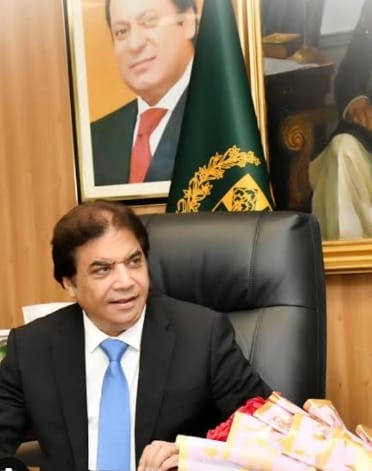
Islamabad (TNS) Khanewal — A wave of controversy has gripped the Pakistan Railways’ Khanewal Division after startling allegations surfaced within its labor union circles. Mehar Mumtaz Siyal, President of the Pakistan Railways Employees’ Movement (PREM Union), Multan Division, has issued a formal appeal to Federal Minister for Railways Hanif Abbasi, demanding an impartial inquiry into what he described as “institutional silence over open violations within Khanewal Railway Colony.”
In his statement, Siyal alleged that several office-bearers of a rival group — PREM Union led by Sheikh Anwar — are involved in what he termed as “a network of misuse and internal favoritism under the cover of official privilege.” Without naming departmental authorities directly, Siyal pointed out that irregularities have gone unchecked for months, despite repeated complaints from railway workers and residents of the colony.
According to details shared in his written communication, Siyal accused Rao Iqbal alias Balo Painter, a local employee and known figure in the division, of being “at the center of illegal timber activity within Khanewal Railway Colony.” He claimed that mature trees from railway property were being cut and sold for private benefit while the local administrative office “remained powerless or indifferent.”
Siyal further mentioned that Saqib Javed, serving as General Secretary of the same rival union, was allegedly found involved in electricity misuse within the Power House Railway Khanewal premises. He stated that Javed had been fined after an internal inquiry by the power section. However, despite these findings, he was later allotted a Class-III residence upgraded to Bungalow No. L-194, a facility designed for senior employees and capable of housing multiple families — an action that has raised questions about internal favoritism and misuse of discretionary authority within the Multan Division.
The PREM Union President added that the situation had reached a stage where “disciplinary silence” is being perceived as “institutional consent.” He warned that unchecked misuse of railway property — including timber from official green zones and unauthorized electrical consumption — not only undermines the department’s integrity but also creates an atmosphere of resentment among honest employees.
Local sources within the Railway Colony confirmed that several greenbelt trees had recently been felled under unclear circumstances, though no formal report has yet been registered against any individual employee. When contacted for clarification, residents stated that “complaints have been forwarded, but no visible action has followed.”
Mehar Mumtaz Siyal, while emphasizing that his intent was “not political rivalry but administrative reform,” appealed to Federal Minister Hanif Abbasi to “order an immediate fact-finding inquiry through an independent inspection team”. He urged the Ministry to physically verify power connections within all residential units and ensure that electricity meters are shifted to poles outside the houses, in order to restore transparent billing and prevent internal manipulation.
Siyal also highlighted the need for a Green Audit of the Railway Colony, suggesting that the department record the existing number of trees, verify recent removals, and document the value of any felled timber to assess the financial loss, if any. He maintained that such an audit would clear honest workers of suspicion while exposing those misusing departmental resources.
In response to queries regarding his statement, senior officials from the Multan Division opted for restraint, noting that the Ministry’s higher management “regularly monitors field-level issues” and that any allegations will be examined through “proper channels.” The spokesperson further added that disciplinary protocols will apply equally to all, and that no employee is above departmental accountability.
Political and labor observers believe this controversy — though presented as an internal union conflict — highlights a deeper systemic challenge within the railway administration: the blurred lines between union influence, administrative oversight, and resource control. A senior retired officer, when contacted, remarked, “Whenever performance oversight weakens, internal unions begin to fill that vacuum with their own power struggles. The real issue is not rivalry — it’s governance.”
Analysts argue that Khanewal, being one of the key logistical hubs of the Multan Division, demands cleaner administrative practices and strict monitoring. The ongoing tension, if not addressed transparently, could harm the reputation of a department already striving to modernize its operations under the “Reform and Efficiency Drive” initiated by the Federal Ministry of Railways earlier this year.
As of now, the Railway Colony remains a place of murmurs and speculation. No official suspension or inquiry notification has yet been issued, but internal sources confirm that “higher authorities are aware of the matter.”
Union leaders and residents alike await Federal Minister Hanif Abbasi’s response — a decision that may not only define the future of internal accountability within Pakistan Railways but also determine whether Khanewal will emerge as a model of transparency or another case study in silence.