
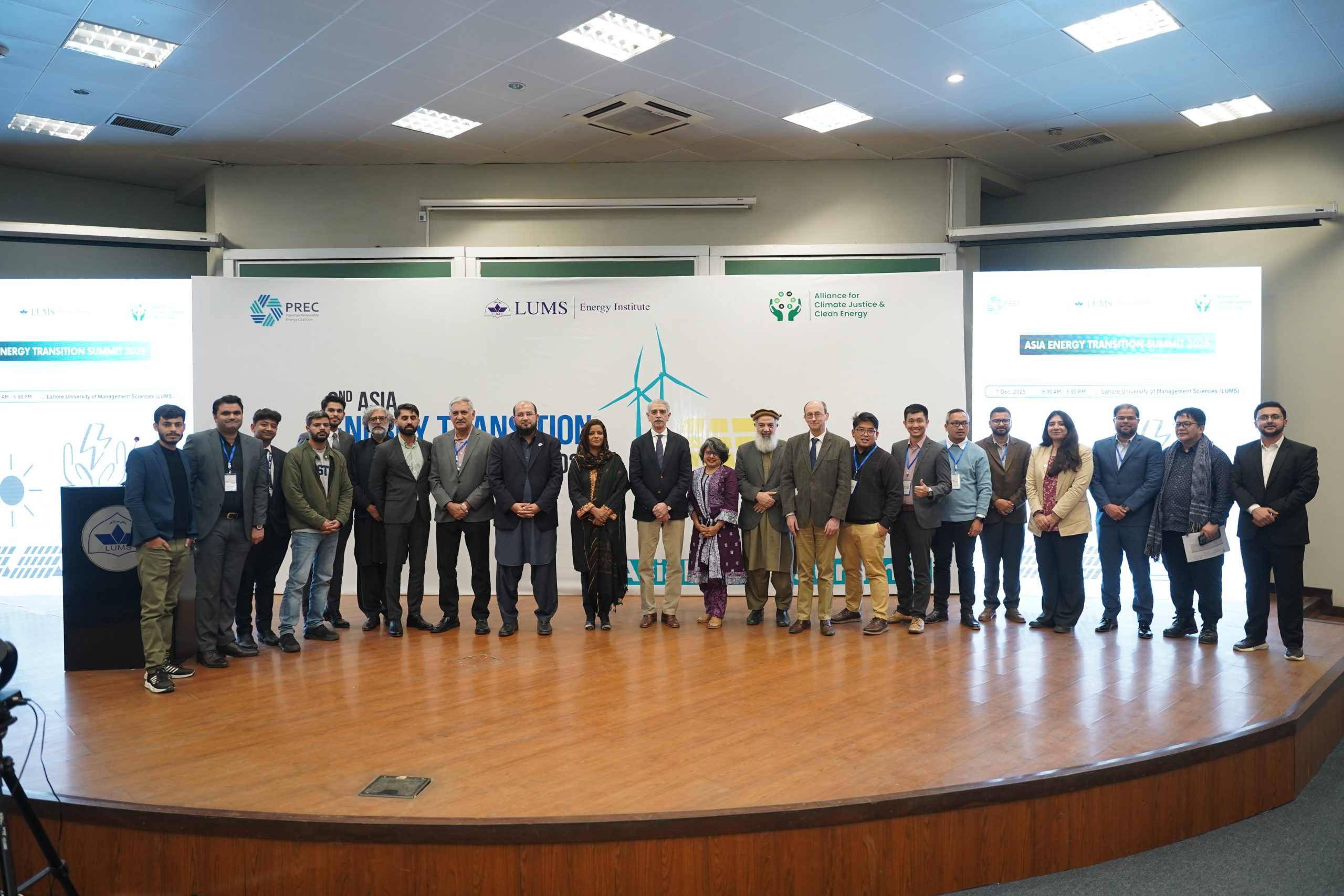
Lahore, December 8, 2025 (TNS): The second Asia Energy Transition Summit, jointly organised by the LUMS Energy Institute (LEI), the Alliance for Climate Justice and Clean Energy (ACJCE) and the Pakistan Renewable Energy Coalition (PREC), concluded at LUMS on December 7. The two-day event brought together federal ministers, parliamentarians, civil servants, climate and energy experts and practitioners, academics and activists from across South Asia and Southeast Asia. The summit reaffirmed Asia’s growing political, financial and technological role in shaping regional and global trends towards a clean and just energy transition. It also emphasised the need for stronger regional cooperation and collaboration within Asia to expedite and smoothen this transition.
The Summit featured plenary sessions, keynote addresses and thematic discussions focused on advancing a just, people-centred, and affordable energy transition across Asia. Its key themes included new and sustainable pathways for financing energy transition and climatic adaptation and mitigation, tariff and non-tariff barriers to renewable-energy trade, distributed and utility-scale renewable deployment, flexible and climate-resilient grids, governance reforms and the risks posed by inequitable or technologically misdirected ‘false solutions’.
Delivering his keynote address during the summit, Prof. Ahsan Iqbal, Federal Minister for Planning, Development and Special Initiatives, highlighted the central role of energy transition in Pakistan’s future development. “Clean, reliable and affordable energy is essential for our economic revival,” he said. “By bringing together regional experts, Asia Energy Transition Summit has also helped Pakistan determine its role and contribution in shaping an Asia-wide fair, future-oriented energy agenda.”
Speaking at the closing plenary, Dr. Musadik Malik, Federal Minister for Climate Change and Environmental Coordination, highlighted the financing challenges that developing economies face, particularly in the energy and climate sectors. “The energy transition must ease the already heavy financial burdens on the developing states, not create new ones,” he noted. He also emphasised that as storage costs fall, batteries can address renewable variability and make energy transition smooth.
Nafeesa Shah, Co-Convener, Parliamentary Forum on Energy & Economy, said, “Parliamentarians and policymakers are the missing link in the energy transition and climate diplomacy discourse. It is essential that we promote global and Asia level collaborations for an effective and just energy transition.”
Addressing a townhall session on Pakistan’s power sector, Sardar Awais Ahmed Leghari, Federal Minister for Energy (Power Division), emphasised the urgent need to modernise the national grid to ensure a smooth and speedy energy transition. “Pakistan must build a flexible and a renewables-driven power system,” he said. “The insights shared during the Asia Energy Transition Summit will certainly guide power sector reforms within Pakistan and help it expand its solar and wind resources for power generation while also ensuring their equitable and affordable access to the citizens.”
Reflecting on the summit’s outcomes, Dr. Fiaz Ahmed Chaudhry, Chairman National Grid Company of Pakistan and Senior Advisor at LEI, highlighted Asia’s shared responsibility for energy transition and climate finance. “The summit brought together individuals and institutions who recognise sustainability, affordability and technical credibility as foundations for Asia’s energy future,” he stated. “I hope the discussions among them will generate partnerships that help countries in the region pursue technologically practical, environmentally appropriate, financially viable and socially just transition pathways.”
Concluding the Summit, Dr. Tariq Jadoon, Provost of LUMS, reaffirmed the University’s commitment to advancing research-driven, evidence-based energy policy, while Dr. Fiaz Chaudhry noted that the discussions will inform practical and financially viable pathways for countries aligning development agendas with climate and energy imperatives.
The Asia Energy Transition Summit 2025 concluded with renewed commitments from government, private sector stakeholders and international partners to work collaboratively toward a resilient, sustainable and equitable energy future, highlighting Asia’s critical role in driving the global energy transition.