
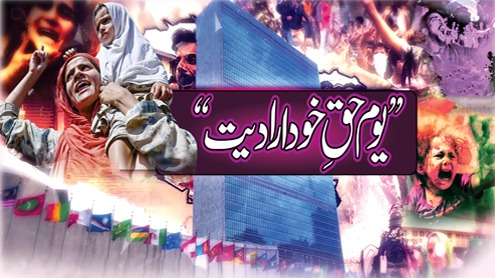
ISLAMABAD (TNS) Kashmiris around the world and on both sides of the Line of Control reiterated their resolve on Right to Self-Determination Day to continue their peaceful freedom struggle in accordance with UN resolutions. The day commemorates January 5, 1949, when the UN Security Council passed a resolution granting the people of Jammu and Kashmir the right to determine their future through a referendum under UN supervision. On the occasion of the Right to Self-Determination Day, Pakistan has once again reiterated its commitment to continue supporting the Kashmiri people at every forum at the political, moral, and diplomatic levels. It is worth remembering that on January 5, 1949, the United Nations Commission on Kashmir passed its comprehensive resolution on the Kashmir issue after a detailed hearing of the positions of Pakistani and Indian delegates, which was accepted unanimously by India and Pakistan. According to this resolution, both countries were obligated to organize a ceasefire in the state of Jammu and Kashmir, withdraw their forces, and cooperate with the proposed plebiscite commissioner to allow the Kashmiris to decide their future, thereby enabling the commission to hold an independent plebiscite in the state as soon as possible.
 The United Nations had also decided to appoint observers with the approval of both countries to monitor the ceasefire process.
Earlier, on August 13, 1948, a resolution was passed on this issue, in which an immediate ceasefire was demanded, and it was also decided that the future of the state would be decided by the will of the Kashmiri people, which they would express through a referendum organized by the United Nations.
Both these resolutions are such a strong and concrete reference regarding the Kashmir issue that neither the international community can ignore, nor can India save itself.
These resolutions were partially implemented, i.e.
A ceasefire was implemented,
A plebiscite was appointed,
UN observers were also deployed,
In the 50s, several efforts were made at the international level regarding the plebiscite, which unfortunately could not prove fruitful due to India’s non-cooperation. Since these resolutions were passed under the UN, they should be passed under the UN to ensure the role of the UN in implementing the resolutions. These resolutions have been partially implemented, and if there is any operational deficiency, it is the responsibility of the UN to remove it.
Kashmiris are right to demand that their right to self-determination be ensured in accordance with the spirit of these resolutions.
These resolutions give the people of occupied Kashmir the status of a fundamental party, because according to them, the fundamental decision is to be made by the Kashmiris.
The Kashmir issue is not just a land dispute, but a fundamental right of 20 million Kashmiris, which cannot be sabotaged.
India has been making every effort to get the people of occupied Kashmir or Pakistan to withdraw from these UN resolutions and declare their disapproval, especially after the Simla Agreement. It is trying to convince the international community that this issue is bilateral, and now these resolutions have become irrelevant. Unfortunately, some elements among the Kashmiris are also using these resolutions as a means of weakening their position. The position of the Kashmiris regarding the Simla Agreement is clear that Kashmiris are not parties to it and the UN Charter itself and its 1957 resolution on Kashmir clearly state that a bilateral agreement cannot affect the disputed status of the state and in the Simla Agreement too, the parties, while adhering to their respective positions, have taken the UN Charter as the basis for resolving the issues. Despite the Simla Agreement, during the current phase of the freedom movement after 1990, resolutions regarding the right to self-determination have also been passed in the light of UN resolutions on Pakistan’s movement in other international forums, including the OIC, and Pakistan has also expressed its position openly.
After the martyrdom of Burhan Muzaffar Wani, the sacrifices and steadfastness of the Kashmiris have attracted the attention of the public opinion of the whole world.
 Earlier, India kept on complaining that the freedom movement in occupied Kashmir was the result of infiltration from Pakistan, while the ongoing freedom movement in Kashmir was self-sustaining at every level and the people of occupied Kashmir correctly sent a message to India that no matter how unpleasant the conditions were for them, they would not accept India’s illegal occupation and would continue their struggle for freedom on every front.
The climax of this internal movement came in the form of a wave that arose after the martyrdom of Burhan Wani, and this clear and unequivocal message reached the world public opinion that this movement was the result of the Kashmiris’ own spirit of freedom and desire for martyrdom.
India, frightened, made every possible effort to crush this movement. The continuous imposition of curfew is a dark chapter of Indian colonialism that has no other example in history. Despite depriving thousands of youth of their sight and hearing through massacres, forced violence, and pellet guns, India could not cool the enthusiasm of the movement. If the situation remains as it is, the region may suffer great destruction due to India’s war madness. In such a case, not only South Asia but also the peace of the entire world may be in danger.The All Parties Hurriyat Conference called for observing this day. Protest demonstrations, rallies, seminars, and other programs were organized in occupied Jammu and Kashmir, Azad Jammu and Kashmir, Pakistan, and around the world to draw the world’s attention to the hardships and injustice faced by the Kashmiri people due to the failure to fulfill the promise of a plebiscite organized by the United Nations. On the occasion of the Right to Self-Determination Day, President of Pakistan Asif Ali Zardari said in his message that the people of Pakistan express their complete solidarity with the people of Jammu and Kashmir on this occasion. He said that the United Nations resolution recognized the disputed nature of Jammu and Kashmir and guaranteed the right of self-determination to the Kashmiri people through a free and impartial vote. The President of Pakistan said that despite the passage of more than seven decades, this promise of the international community has not been fulfilled. He stressed that the continued denial of this right is contrary to the UN Charter and the principles of international law. He expressed deep concern over restrictions on political activities, suppression of freedom of expression, prolonged detentions, and the use of draconian laws in Indian-occupied Jammu and Kashmir, and said that civilians continue to suffer due to violence, evictions, and loss of livelihood. President of Pakistan Asif Zardari also expressed concern over India’s control over the rivers of Jammu and Kashmir and termed the unilateral suspension of the Indus Waters Treaty as a dangerous move for regional stability, food security, and livelihood. He made it clear that the Jammu and Kashmir dispute can only be resolved through dialogue and implementation of UN Security Council resolutions, and Pakistan will continue to extend moral, political, and diplomatic support to the Kashmiri people. In a separate message, Prime Minister of Pakistan Shehbaz Sharif said that Pakistan stands by its stand for the right of the Kashmiri people to self-determination. He said that according to the resolution of January 5, 1949, the final fate of Jammu and Kashmir was to be decided through a free and impartial referendum under the supervision of the UN, but due to India’s illegal occupation, this promise has not been fulfilled to date. The Prime Minister of Pakistan said that the international community should immediately demand that India stop human rights violations, withdraw unilateral measures, abolish draconian laws, and provide the right of self-determination to the Kashmiri people. On the other hand, on the occasion of the Right to Self-Determination Day, the President of Azad Jammu and Kashmir, Barrister Sultan Mahmood Chaudhry, and the Prime Minister of Azad Jammu and Kashmir, Faisal Mumtaz Rathore, called on the United Nations and the international community to provide the right of self-determination to the Kashmiris. In his special message, the President of Azad Jammu and Kashmir said that despite all the tactics of oppression, coercion, and violence, the people of occupied Kashmir have never deviated from their position, and the Indian forces have crossed all limits of human rights violations. The President of Azad Kashmir called on the United Nations and the civilized international community to play their effective role in resolving the Kashmir issue in accordance with the wishes of the Kashmiri people and the resolutions of the United Nations. Azad Kashmir Prime Minister Faisal Mumtaz Rathore has said that the promise of the right of self-determination made by the United Nations to the Kashmiri people seven decades ago has not been fulfilled to this day, although this is the primary responsibility of the international organization. He demanded that the United Nations, international organizations, media, and human rights organizations ensure an independent investigation and monitoring in occupied Kashmir. On the other hand, Punjab Chief Minister Maryam Nawaz Sharif, in her message regarding the right of self-determination of the Kashmiri people, said that for 77 years, the Kashmiri people have been waiting for the fulfillment of the promise of the right of self-determination. She said that the right of self-determination is an important part of human dignity and deviation from it is tantamount to negation of human freedom, the Universal Declaration of Human Rights, and the Charter of the United Nations. Chief Minister Maryam Nawaz Sharif said that India is making a nefarious attempt to undermine the identity of the Kashmiri people by changing the demographic structure of occupied Jammu and Kashmir. She said that India has turned occupied Jammu and Kashmir into the largest military zone in the world. In his message, the Punjab Chief Minister said that India should know that no wall can stop the desire for freedom. Meanwhile, Federal Interior Minister Mohsin Naqvi expressed full solidarity with the oppressed people of occupied Jammu and Kashmir on the occasion of Right to Self-Determination Day and said that, despite the passage of 77 years, depriving the Kashmiri people of their legitimate rights is the worst injustice and oppression. In his statement, Mohsin Naqvi said that January 5 is a historical reminder of the United Nations, when the right of self-determination of the Kashmiri people was recognized at the international level. Despite the passage of 77 years, depriving the Kashmiri people of their legitimate rights is the worst injustice and oppression. Occupied Jammu and Kashmir is a disputed region and a global issue that has been unresolved for 7 decades. The Kashmiri people are looking to the United Nations to fulfill the international promise. This wait is shaking the consciences of the United Nations, the international community, and the countries that champion human rights. Occupied Kashmir is currently a picture of helplessness and oppression that questions the claims of international justice. Indian atrocities have turned occupied Kashmir into the world’s largest prison where freedom is denied. Indian efforts to crush the right to self-determination through force are a negation of international laws and democratic principles. The double-dealing policy and criminal silence of the international community on Indian atrocities have become clear to everyone. Pakistan has been a strong supporter of the right to self-determination of the Kashmiri people on a principled, moral, and diplomatic level and will always continue to support it.Remember that the purpose of celebrating the Right to Self-Determination Day is to remind the international community that, due to Indian aggression, the Kashmiri people have not yet been given the right to decide their future in accordance with United Nations resolutions. On the occasion of the Right to Self-Determination Day, ceremonies, rallies, and protests were held in Pakistan, Azad Kashmir, and various countries, in which solidarity with the Kashmiri people and human rights violations in occupied Kashmir were expressed, and human rights violations in occupied Kashmir were strongly condemned. A torchlight rally was held late at night at Azadi Chowk in Muzaffarabad, the capital of Azad Kashmir, in which participants protested against Indian atrocities and reiterated their support for the struggle of the Kashmiri people. It may be recalled that on January 5, 1949, the United Nations Security Council passed a historic resolution, under which the Kashmiri people were given the right to decide their own future, and the purpose of celebrating this day every year is to remind international organizations of their responsibilities on the Kashmir issue. On the occasion of the Right to Self-Determination Day, a rally was organized in Muzaffarabad under the auspices of the Azad Kashmir branch of the All Parties Hurriyat Conference. According to Kashmir Media Service, the rally started from Shaheed Afzal Guru Chowk, Dumail, in which people from different walks of life participated in large numbers. The participants of the rally raised slogans in favor of the freedom and right to self-determination of Kashmir and reiterated the resolve that the Kashmiri people will not give up their legitimate, recognized, and inalienable right to self-determination under any circumstances. Addressing the rally, the speakers said that on January 5, 1949, the United Nations, through its resolution, gave the people of the state of Jammu and Kashmir the right to determine their political future through a free, fair, and impartial plebiscite, but unfortunately, despite the passage of 78 years, the international organization has failed to fulfill this promise. The speakers strongly condemned the unconstitutional and illegal steps taken by India on August 5, 2019, saying that the abrogation of Articles 370 and 35-A, the division of the state of Jammu and Kashmir, and its conversion into a Union Territory was a systematic conspiracy to weaken the right of self-determination of the Kashmiri people. However, all these tactics have failed to weaken the courage, determination, and struggle of the Kashmiri people. In return for their demand for the right of self-determination, the Kashmiri people are facing the worst state repression. Millions of Kashmiris have been martyred, thousands have been maimed through violence, hundreds of children have been blinded by pellet guns, houses have been demolished, properties have been confiscated, and systematic efforts are being made to erase the Muslim identity of the state, which is a clear violation of international law and the UN Charter. The rally participants demanded that the UN and the international community fulfill the promises made to the Kashmiri people and ensure the immediate implementation of the resolutions of the international organization so that the Kashmiri people can freely decide their political future, like other nations of the world. At the end of the rally, a memorandum was submitted to the UN Observer Mission, which demanded full support for the right of the Kashmiri people to self-determination and an end to Indian atrocities. The participants reiterated their resolve that a peaceful, principled, and legal struggle will continue at all levels until the right to self-determination is achieved. The rally was attended by, among others, Speaker Legislative Assembly Azad Kashmir Chaudhry Latif Akbar, Secretary Information All Parties Hurriyat Conference Mushaq Ahmed Butt, Deputy Commissioner Muzaffarabad Munir Qureshi, Spokesperson Prime Minister Azad Kashmir Shaukat Javed Mir, Chairperson Women Wing All Jammu and Kashmir Muslim Conference Samia Sajid, Hurriyat leaders Syed Gulshan, Syed Mushtaq Hussain, Mushtaq-ul-Islam, Chairman Tehreek-e-Shabab-e-Muslimeen Jammu and Kashmir Munir Konshi, President APCA Muhammad Ramzan, Ameer Jamaat-e-Islami Muzaffarabad Engineer Abdul Hameed, Syed Karamat Sabzwari, Advocate Sardar Ramzan, Chaudhry Feroz Din, Asif Makhdoomi, President Seerat Committee Atiq Kiani, Naseer Mir, Tanzeer Iqbal, Syed Mahmood Shah, political and social figures, student organizations, lawyers, youth and civil society representatives. Meanwhile, a public rally was also held in Muzaffarabad on the occasion of the Right to Self-Determination Day under the auspices of the Pasban-e-Hurriyat Jammu and Kashmir. The rally, which was taken out from Burhan Wani Shaheed Chowk, was led by Speaker Legislative Assembly of Azad Jammu and Kashmir Chaudhry Latif Akbar, Chairman of Pasban-e-Hurriyat Uzair Ahmed Ghazali, Shaukat Javed Mir, Abdul Razak Razak Khan, Afghani, Azmat Hayat Kashmiri, Yasir Naqvi, and others. A large number of Kashmiri citizens, including women, youth, elders, and children, participated in the rally. The participants of the rally carried banners and placards on which slogans were written against Indian atrocities and military occupation. The protesters demanded the implementation of the resolution of January 5, 1949, from the United Nations Security Council and raised strong slogans against India’s illegal occupation of Jammu and Kashmir. Slogans like Kashmir that has been soaked in blood is ours, Indian occupiers leave our Kashmir, we will snatch away our freedom were continuously echoing. The protesters reached the UN observer office. March. On this occasion, the speakers said that the United Nations should ensure the implementation of its resolutions to resolve the Kashmir issue. The January 5 resolution is the best roadmap for resolving the Kashmir issue, and the Kashmiri people are waiting for its implementation. They said that the Kashmiri people appeal to the United Nations for immediate intervention to achieve freedom and the right to self-determination. The Kashmiri people want to decide their political future through the implementation of the January 5 resolution.The participants demanded that international human rights organizations play an effective role in the release of Kashmiri political prisoners imprisoned in Indian jails. Meanwhile, the Azad Jammu and Kashmir branch of the All Parties Hurriyat Conference has appealed to the United Nations Secretary General Antonio Guterres to resolve the Kashmir dispute by giving the Kashmiris their right to self-determination in accordance with the resolution approved by the world body. This appeal was made in a memorandum submitted to the United Nations office in Islamabad on the occasion of the Right to Self-Determination Day. The memorandum was presented by a delegation of the Azad Jammu and Kashmir branch of the All Parties Hurriyat Conference, which included senior Hurriyat leaders Syed Faiz Naqshbandi, Mir Tahir Masood, Hassan Al-Bannai, Syed Ijaz Rahmani, and Imtiaz Wani.
 The memorandum reminded the UN chief of the promises made to the Kashmiris in the resolutions adopted by the international organization. The memorandum stated that on January 5, 1949, the UN Commission on Pakistan and India adopted a very important resolution in which it was stated that the accession of the State of Jammu and Kashmir would be decided through a democratic process of free and impartial plebiscite. The memorandum said that due to India’s stubbornness, the Kashmir dispute is still unresolved, and the Kashmiri people have been making unprecedented sacrifices for the past seven decades to achieve the right to self-determination, while due to the silence of the United Nations and world powers, India is continuing its state terrorism in Jammu and Kashmir. The memorandum said that in order to ensure lasting peace in South Asia, it is imperative to resolve the Kashmir dispute in accordance with the aspirations of the Kashmiris. On the other hand, in illegally occupied Jammu and Kashmir, the All Parties Hurriyat Conference has demanded that the United Nations resolve the Kashmir dispute by implementing its resolutions on Jammu and Kashmir, including the resolution of January 5, 1949, which guaranteed the right of self-determination of the Kashmiris. Advocate Abdul Rashid Minhas, spokesperson of the All Parties Hurriyat Conference, said in a statement issued in Srinagar that the resolution passed by the United Nations Security Council on January 5, 1949, in favor of the right of self-determination of the Kashmiris. The lack of implementation is a big question mark on the existence of the international body. Kashmiris have been making unprecedented sacrifices for the past several decades to achieve this right. India’s stubbornness is the biggest obstacle to the implementation of the UN Security Council resolutions. According to Kashmir Media Service, the spokesperson said that on August 5, 2019, the BJP’s Hindutva government, in complete violation of the UN resolutions, illegally and unilaterally abolished the special status of the occupied territory, forcibly annexed it to India, and tried to change the disputed status of the territory. The disputed nature of Kashmir is a reality, and the BJP government cannot change this reality with its illegal moves because Kashmir is an unresolved dispute on the UN agenda. The Hurriyat spokesperson said that Pakistan is a strong supporter of the right of self-determination of the Kashmiris and is making strenuous efforts to achieve this right for them so that they can decide their own political future. He said that the oppressed people of occupied Jammu and Kashmir are extremely grateful to Pakistan for vigorously advocating their legitimate cause at all international forums. He said that it is the responsibility of the United Nations and the international community to take notice of India’s stubbornness and hold it accountable for not fulfilling its promises regarding Kashmir.

Meanwhile, Jammu and Kashmir Democratic Freedom Party, Tehreek-e-Hurriyat Jammu Kashmir, Muslim League, Tehreek-e-Kashmir Women’s Movement, and other parties in their separate statements in Srinagar demanded that the United Nations fulfill its legal and moral responsibilities to implement the historic resolution of January 5, 1949, which recognized the right of self-determination of the people of Jammu and Kashmir. It was said that the international community, especially the United Nations, should come forward and play its effective role in resolving the Kashmir dispute to save the Kashmiris from Indian atrocities.
The leaders of the Azad Kashmir branch of the All Parties Hurriyat Conference said that the unresolved Kashmir dispute has become a nuclear flashpoint and a threat to regional and international peace and security. The Kashmir issue can be resolved only by implementing the resolutions passed by the United Nations Security Council, but India’s stubbornness is the biggest obstacle in achieving this goal. In addition, the Chairman of the Kashmir Institute of International Relations, Altaf Hussain Wani, in a statement in Islamabad, urged the United Nations to play its role in resolving the Kashmir issue according to the wishes and aspirations of the Kashmiris. He reminded the United Nations of its legal and moral responsibilities regarding the Kashmir dispute and said that it is extremely unfortunate that the Kashmiri people are still victims of India’s illegal occupation despite the passage of several decades. He said that on both sides of the Line of Control, the Right to Self-Determination Day reminds the international community of its responsibility to resolve the long-standing Kashmir dispute in accordance with United Nations resolutions. He termed the resolution of the Kashmir issue as the key to peace and stability in South Asia and said that the establishment of lasting peace in the region depends on the resolution of the long-standing conflict. He said that the resolution of January 5, 1949, provides a peaceful and comprehensive roadmap for the resolution of the Kashmir issue.Remember that it was January 5, 1949, when the United Nations Security Council passed a historic resolution stating that the question of the accession of the State of Jammu and Kashmir to Pakistan or India would be decided through a free, fair, and impartial plebiscite in a democratic manner. Undoubtedly, this resolution provides the basis for the resolution of the long-standing Kashmir dispute. The only obstacle to the implementation of the aforementioned UN resolution is India’s negative attitude, stubbornness, and unrealistic approach. Due to the non-implementation of the resolution of January 5, 1949, by the world body, the Kashmiri people continue to suffer and face difficulties. More than 79 years have passed, but the resolutions adopted by the United Nations regarding the right of self-determination of the Kashmiri people could not be implemented. India itself took the Kashmir issue to the United Nations on January 1, 1948. On 15 January 1948, the Security Council began discussing the Kashmir issue. On 20 January, the Security Council appointed the India-Pakistan Commission, and on 28 January 1948, the President of the Security Council announced that Pakistan and India had agreed to hold a plebiscite to determine the future of the State of Jammu and Kashmir, which would be held impartially and independently under the supervision of the United Nations. On 1 January 1949, a ceasefire was declared in occupied Jammu and Kashmir, and on 5 January 1949, the Commission presented its second historic resolution with the consent of both sides. Its first part mentioned a ceasefire, which had already been implemented. The first war over the Kashmir issue began when India took the issue to the United Nations. When the UN Commission asked both countries for the required plan for the implementation of the resolution, India put forward two more demands. One was that it should be given control over the northern and northwestern areas by violating the ceasefire line, and the second was that the institutions already established in Azad Kashmir should not only be disarmed but also abolished, as Joseph Karbal admitted on page 157 of his book Danger in Kashmir. Joseph Karbal belonged to Czechoslovakia and was the chairman of the UN Commission, and he joined the Commission as an Indian representative. Joseph Karbal admitted that the Indian position was going beyond the UN resolution. Pakistan, while agreeing to withdraw its troops from Azad Kashmir, said that the number and location of the necessary forces that India would keep in occupied Jammu and Kashmir, according to the resolution, should be presented to the UN Commission. India refused this, too. On this, the Armistice Commission, on the proposal of US President Truman and British Prime Minister Clement Attlee, said that both countries should present their position, which should be placed before an arbitrator who would decide. According to UN documents, Pakistan also accepted this proposal, but India also rejected it. The Commission said that both countries would withdraw their troops simultaneously so that no one would be in danger. Pakistan also accepted this proposal. India also rejected this proposal. This proposal was approved by the Security Council in the form of a resolution on March 14, 1950. It is as if now the UN resolution is saying that both countries will start withdrawing troops simultaneously. The UN sent Owen Dickson, who was the Chief Justice of Australia, as its representative. He made many proposals for military withdrawal; Pakistan accepted all of them, but the Indian Prime Minister did not accept any of them. In 1951, India said that we are in danger, so we will not withdraw troops. Australian Prime Minister Gordon Menzies proposed a joint force, but India rejected that, too. He talked about forming a local force under the supervision of the United Nations, but India rejected that, too. He said we will send Commonwealth forces, but India rejected this proposal too. The matter went to the Security Council once again. On March 30, 1951, the Security Council appointed US Senator Frank P. Graham as the new representative and said that the troops should be withdrawn from occupied Jammu and Kashmir within three months, and if Pakistan and India could not agree on this, then the International Court of Justice should decide.
 Mr. Frank made six proposals, but India rejected all of them. Only India said that it would keep 21,000 troops in occupied Jammu and Kashmir, while Pakistan should withdraw its forces from Azad Kashmir; there should be only 4,000 local personnel, 2,000 of them civilians, and they should have no connection with the Azad Kashmir government. Half of them should also be unarmed. Graham made some changes to it, Pakistan said that this was wrong, but we agreed to it too; later, India also refused. The President of the Security Council once again suggested that we get arbitration done so that it is known which country is not cooperating in the matter of withdrawal. Pakistan agreed to this, too; India had also rejected this proposal. The Kashmiri people, who are fighting to end India’s usurping occupation in occupied Jammu and Kashmir, want an impartial plebiscite in the light of the resolutions passed by the United Nations, which is their fundamental right.