
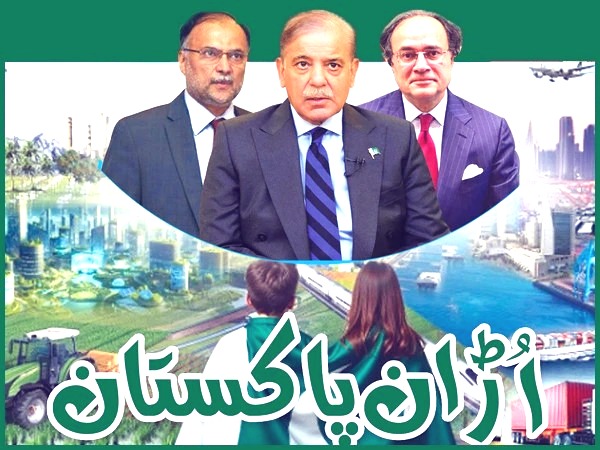
ISLAMABAD (TNS) National Economic Plan “Uraan Pakistan” is a revolutionary program that provides a strategy to make Pakistan strong, stable and prosperous under the (Five As). “Uraan Pakistan” is a comprehensive and balanced program for national development. It is hoped that the goals set under the leadership of Prime Minister Shehbaz Sharif will be achieved. Pakistan is a talented country with immense resources. There is a need to move forward united. The day is not far when Pakistan will stand in the ranks of global economies. The Prime Minister inaugurated the five-year national economic plan “Uraan Pakistan” for the country’s sustainable development last year. The plan aims to achieve economic growth through the promotion of sustainable exports, e-Pakistan, environmental protection, energy efficiency, equality, and empowerment (Five Es). According to the Uraan Pakistan document, the target has been set to increase the GDP rate to 6 percent by 2029, increase per capita income to $2405, create a current account surplus of 1.2 percent of GDP by 2029, increase IT exports to $10 billion by 2029, increase investment to 17 percent of GDP, increase exports to $10 billion by 2029, and increase exports to $10 billion. The target has been set to increase the tax-to-GDP ratio to 63 billion dollars and take remittances to 39.8 billion dollars. According to the document, the target has been set to increase the tax-to-GDP ratio to 13.5 per cent by 2029, keep government debt to 60 per cent of GDP and spend 4 per cent of GDP on education.

Increase IT exports to 10 billion dollars, increase water storage capacity to 23.54 million cubic feet and increase water use capacity from 40 per cent to 70 per cent. Provide 100 per cent of the population with improved drinking water, increase the use of electric vehicles to 25 per cent by 2029, and reduce the poverty rate from 21.4 per cent to 12 per cent. The target has been set to increase the primary school enrollment rate from 64 per cent to 72 per cent and increase toilet facilities from 68 per cent to 80 per cent by 2029. The goal is to make Pakistan’s economy a $1 trillion economy by 2035 and a $3 trillion economy by 2047. The program is based on five key pillars: Exports e-Pakistan, Environmental Protection, Energy and Infrastructure, Equity, Ethics and Empowerment. The goal is to take annual exports to $60 billion, promote IT, agriculture, creative industries, minerals, and the blue economy, take the ICT freelancing industry to $5 billion, produce 200,000 IT graduates annually, and create the first Pakistani startup unicorn. Its objectives are to reach 100 million mobile subscribers, improve artificial intelligence and cybersecurity capabilities, and the key goals include reducing greenhouse gas emissions by 50%, increasing water reserves by 10 million acre feet, increasing arable land by 20.3 million acres, restoring forests, and promoting resilient infrastructure against environmental disasters. The program includes increasing the share of renewable energy to 10%, reducing circular debt and improving the energy system, increasing the share of railways in passenger transport from 5% to 15% and in freight from 8% to 25%. It includes promoting regional connectivity. Increasing the Universal Health Coverage Index by 12% increasing the literacy rate to 10% are its objectives. The Prime Minister expressed his determination that “Uraan Pakistan” is a big journey and the beginning of a new dawn for economic growth and achieving a lost place in the world. National unity and harmony are indispensable for success. Federal Minister for Planning, Professor Ahsan Iqbal, termed Uraan Pakistan a ‘revolutionary’ step towards achieving sustainable economic development and said that the present government has taken effective, immediate steps to address economic challenges. Long-term planning is needed on a continuous basis to make the country prosperous and economically strong. The Pakistan Muslim League-Nawaz (PML-N) government, in its previous terms, launched Vision 2010 and Vision 2025, but due to political instability, they could not be fully implemented. Now the government has once again prepared a five-year plan, which will prove to be the basis for sustainable economic development. He has expressed hope that the fruits of the national economic plan will reach the common man, and better education, health, employment and business opportunities will increase. Under the “Uraan Pakistan” program, we aim to increase the GDP rate to 6% by 2028, create 1 million additional jobs annually and achieve exports of $60 billion. Export-led growth and sustainable growth led by the private sector are the most important points of the “Uraan Pakistan” program. We will move forward by completing the process of structural reforms. Default risk has decreased by 93%, and due to this, Pakistan’s sovereign rating has improved. After the stabilisation of the economy, we have to take it forward and move towards sustainable growth based on exports. In the past, we have been facing the problem of balance of payments along with growth. This time, we will move forward by completing the process of structural reforms.The program aims to grow Pakistan’s economy to $1 trillion by 2035 and $3 trillion by 2047. The program is based on five key pillars: Exports, e-Pakistan, Environmental Protection, Energy and Infrastructure, Equality, Ethics and Empowerment. The key goals under the 5Es framework are Exports: The Foundation of Growth Project: Transforming Pakistan into an export-led economy, taking annual exports to $60 billion, Promoting IT, agriculture, creative industries, minerals, and the blue economy, Making “Made in Pakistan” a sign of trust, Stabilizing the rupee, Reducing dependence on imports, Paving the way for sustainable development, e-Pakistan: Harnessing the power of technology Project: Transforming the economy through digital revolution. Taking the ICT freelancing industry to $5 billion, producing 200,000 IT graduates annually, creating the first Pakistani startup unicorn, reaching 100 million mobile subscribers, improving artificial intelligence and cybersecurity capabilities, creating employment opportunities for youth, and developing Pakistan as a global technology hub are also included.
 The government has introduced a National Economic Transformation Plan called “Uraan Pakistan” to increase the country’s Gross Domestic Product (GDP) rate to 9.8 per cent, increase the literacy rate to 70 per cent, and reduce poverty by 13 per cent. According to the report, under this plan approved by the Prime Minister, in addition to the above goals, efforts will be made to take the size of the Pakistani economy to $1 trillion by 2035 by 2035. The aim is to put Pakistan on the path of sustainable high economic growth. This plan will include the desired increase in exports and the completion of the ML-1 project of the Railways, as well as priorities such as the “Five As” framework, namely infrastructure, equity, ethics, empowerment (empowering people) and improvement of the environment. On the other hand, Federal Finance Minister Aurangzeb says that the country’s economy is moving towards sustainable economic growth. In recent years, economic challenges have been faced, but those problems have been resolved. Now we are moving in the right direction towards macroeconomic stability. The government is determined to transform the financial system according to Sharia principles. Pakistan has the potential to emerge as an important global centre for Islamic finance. 56% of market capitalisation of securities is held in the Pakistan Stock Exchange (PSX), 48% of assets under management of mutual funds in the investment sector, 66% of funds under management of voluntary pension funds and 95% in Real Estate Investment Trusts (REITs). The percentage of assets are Sharia compliant.The government has introduced a National Economic Transformation Plan called “Uraan Pakistan” to increase the country’s Gross Domestic Product (GDP) rate to 9.8 per cent, increase the literacy rate to 70 percent and reduce poverty by 13 per cent. According to the report, under this plan approved by the Prime Minister, in addition to the above-mentioned goals, efforts will be made to take the size of the Pakistani economy to one trillion dollars by 2035 by 2035. The aim is to put Pakistan on the path of sustainable high economic growth. This plan will include the desired increase in exports and the completion of the ML-1 project of the Railways, as well as priorities such as the “Five As” framework, namely infrastructure, equity, ethics, empowerment (empowering people) and improvement of the environment. On the other hand, Federal Finance Minister Aurangzeb says that the country’s economy is moving towards sustainable economic growth. In recent years, economic challenges have been faced, but those problems have been resolved. Now we are moving in the right direction towards macroeconomic stability. The government is determined to transform the financial system according to Sharia principles. Pakistan has the potential to emerge as an important global centre for Islamic finance. 56% of market capitalisation of securities is held in the Pakistan Stock Exchange (PSX), 48% of assets under management of mutual funds in the investment sector, 66% of funds under management of voluntary pension funds and 95% in Real Estate Investment Trusts (REITs). The percentage of assets is in accordance with Sharia. Signs of improvement are visible in the country’s economy, the current account deficit has decreased, the inflation rate in the country has fallen to a 78-month low of 4.9 percent, domestic income is increasing, foreign exchange reserves have increased from two weeks’ needs to meet two and a half months’ import needs, the interest rate has fallen below 13 percent and there are strong possibilities of it soon decreasing to single-digit levels, while remittances increased by 34 percent during the current fiscal year to $14.76 billion, which was $11 billion in the same period last year. Although the government is optimistic that the recent improvement in the economy will help meet revenue targets, the Asian Development Bank (ADB) has revised Pakistan’s GDP growth estimate for fiscal year 2025, increasing it from 2.8% to 3%, while reducing the inflation forecast for the current fiscal year to 10% from 15%. In view of the economic recovery, investor confidence is recovering. The stock market is setting new records. Its 100-share index is at a level of more than 187,000 points. The Overseas Investors Chamber of Commerce and Industry on Wednesday announced the results of the Comprehensive Business Confidence Index conducted across the country during October and November 2024, according to which business confidence in Pakistan has improved significantly by nine per cent. Although the business confidence index is still at a negative five points level, it has improved significantly in a short period of just two months, compared to the negative 14 in the previous survey.During a press conference, Federal Minister for Information Atta Tarar and Interior Minister Mohsin Naqvi took the position that the country’s economy is continuously moving towards stability and growth, and international financial institutions are also acknowledging that stability has been achieved. There is no doubt that the economic indicators reported by both ministers are a sign of stability and growth. As of January 2, 2026, Pakistan’s foreign exchange reserves have reached a high of $16,055.7 million (16 billion), which is the highest since January 21, 2022. At that time, the reserves held by the State Bank of Pakistan had increased to $16,190.1 million. However, a major part of these reserves consists of rollovers (extension of loan repayment period) of more than $12 billion provided by three friendly countries (China, Saudi Arabia and the United Arab Emirates). The rest has come from multilateral institutions (including the International Monetary Fund’s ongoing $7 billion 36-month program) and other bilateral loans. Nevertheless, aid agencies generally view this increase in reserves as a sign of economic stability, as their own lending programs also help build these reserves. In this context, it is noteworthy that two of the three major global rating agencies upgraded Pakistan’s ratings last year. Such an upgrade is usually associated with becoming part of an IMF program, as it creates a satisfactory situation with the authorities regarding the implementation of the reform agenda agreed upon, which in turn reduces the risk of a country defaulting.
 It is worth mentioning that no rating agency has included Pakistan in the investment category (safe investment grade), which Pakistan has never achieved in its entire history, but the country has been maintained in the ‘speculative grade’ (uncertain or risky grade). This grade indicates that there is a high risk in investing here, due to which the cost of borrowing from the commercial banking sector abroad also increases. Two observations are very important in this regard. The first observation is that if the country does not remain in the IMF program, that is, if the IMF does not approve the release of the next tranche due to non-implementation of the agreed conditions, or the government leaves the program in the middle, then in such a case, there is no possibility of getting ‘rollovers’ of loans (extension of payments) from friendly countries for the next fiscal year. Second, foreign investment during July-November 2025 decreased to $313.7 million (including $927.4 million in foreign direct investment and a negative $613.8 million in portfolio investment) compared to $1,391.1 million in the same period of the previous fiscal year (including $1,242.4 million in foreign direct investment and $148.7 million in portfolio investment). Remittances in each month of the current fiscal year (July-December 2025) have been better than the same period of the previous year, reaching a total of $19.7 billion, but this does not take into account the increase in the trade deficit during the first six months of the current year, which was $19,204 million, compared to $14,271 million in the same period last year. In other words, all the gains in remittances have been absorbed by the increase in the trade deficit (i.e., it has absorbed the additional deficit). There is no doubt that the growth rate of gross domestic product (GDP) has increased in the last one or two years, but considering the implementation of a very contractionary monetary policy and fiscal policy, this growth rate seems to be the result of the low level of previous years rather than a real increase in output. Although the discount rate has been reduced by more than half from 22 per cent to 10.5 per cent under monetary policy, it is still higher than the regional average of 5 to 6 per cent, which has led to continued poor performance of large-scale industry. On the other hand, the increased focus on audits in fiscal policy has forced many taxpayers to resort to legal action, and their negotiations with the Federal Board of Revenue are ongoing. This year, floods have affected the growth of the agricultural sector. Inflation continues to be a concern for the 93 per cent of people who are associated with the private sector, as their salaries have not increased for the last six to seven years, reflecting the sluggish economy. On the contrary, 7 per cent of state employees do not face this situation because the government has been increasing their salaries more than the inflation rate every year. This is not the time to be complacent or complacent, and instead of just criticising the cabinet members for achievements that the common man is neither seeing nor experiencing, the current economic situation in the country should be reviewed. At present, the indicators are positive. Political and economic stability and the geopolitical situation are improving slightly. Daily inflation is now under control. The rise in the dollar has also stopped; the stock market is making new records, which is positive in terms of the economy. All this goes to the government. Uraan Pakistan is a good brand. This is the 13th Five-Year Plan. It has 5E’s, which include Economy, Export, Environment and others.
The government has set a target of taking exports to 60 billion.