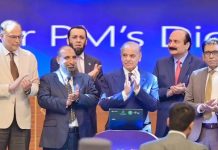

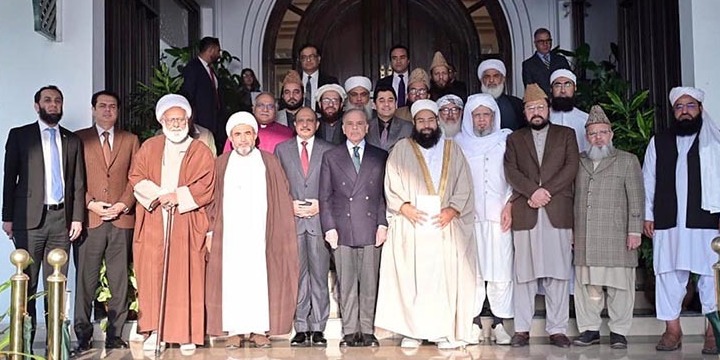
ISLAMABAD (TNS) Prime Minister of Pakistan Muhammad Shahbaz Sharif has given a clear message from the National Peace Committee that terrorists have no place in Pakistan.
Remember that the religious leadership has unanimously declared terrorism un-Islamic and declared the Pakistan Peace Committee as the strongest national consensus after the Constitution. The National Peace Committee declared that terrorism has nothing to do with Islam. Most of the incidents of terrorism are linked to the cross-border and demanded that Afghanistan ensure peace in Pakistan. The Pakistani army was declared the guardians of Islam and peace, Islam was declared the religion of peace and love, the killing of any innocent was declared forbidden, the struggle against sedition was declared Jihad-e-Akbar.
The Prime Minister says that Pakistan is more peaceful for all religions. Today, the biggest challenge is terrorism. One hundred thousand Pakistanis have been martyred in the war against terrorism, including ordinary citizens, mothers, sisters, children, doctors, engineers, traders and residents of all four provinces. The martyrs have nourished the country with their blood. Thousands of officers and soldiers of the Pakistan Army, Police, Rangers and other law enforcement agencies have also been martyred. The martyrs not only ended terrorism by making sacrifices but also saved other countries. Today, the scourge of terrorism has raised its head again. There is an alliance of Khawarij, TTP and TTA. All kinds of resources are reaching them through our enemies, just as terrorism was completely eradicated in 2018. I am fully confident that this time too, the head of terrorism will be crushed. Terrorism will be lifted from the borders of Pakistan and drowned in the Indian Ocean. Speaking on the occasion, Federal Minister for Information and Broadcasting Attaullah Tarar said that the National Peace Message Committee has played an active role in the formation of a national narrative, especially in matters related to terrorism, in a short period of time, and will travel throughout the country with the message of peace.
The Federal Minister for Information said that the National Peace Message Committee has been established with the permission and approval of the Prime Minister. The Peace Committee should include scholars of all schools of thought, great scholars and leading leaders of minorities. The Peace Committee has played a very active role in a very short period of time. The role of the committee in the formation of a national narrative, especially in matters related to terrorism, is commendable. Provincial committees and then district committees will be established under the mandate of the committee.
 It may be recalled that the National Peace Message Committee (NPAC) has assured full cooperation for the promotion of the national narrative. The National Peace Message Committee met with the Director General (DG) of the Inter-Services Public Relations (ISPR) of Pakistan Army, Lieutenant General Ahmed Sharif Chaudhry, at the General Headquarters on January 13, 2026. According to the ISPR, in the meeting, a comprehensive discussion was held on internal security in the context of the banned TTP and TTA. The common position was further strengthened. He said that unity in matters of national security, consensus on the narrative is the need of the hour and supporting the oppressed is the moral responsibility of Pakistan. The meeting assured full cooperation for the promotion of the national narrative and expressed unwavering solidarity with the Pakistani forces and a common resolve against anti-state narratives. The National Peace Message Committee condemned the Fitna al-Khawarij and the Afghan Taliban and said that there is no justification for terrorism. The Peace Committee announced to spread the message of unity of the nation, social harmony, and constitutional equality from the pulpit and mihrab nationwide, while also agreeing to adopt a zero-tolerance policy against hate speech, sectarianism, and Takfiri narratives. The Peace Committee suggested increasing awareness sessions in mosques, madrassas, and universities to promote the state narrative. According to the DG ISPR, public awareness and truth-based narratives are decisive weapons to counter the enemy’s psychological warfare. The Prime Minister, while reiterating his resolve to eradicate poverty, unemployment, get rid of debt and uproot terrorism from the country, said that the need for national unity and solidarity was greater than ever before. The scourge of terrorism has resurfaced in the country. The Khawarij are a nexus of TTP and TTA. They are getting resources through our enemies. They will lift terrorism from the borders of Pakistan and sink it in the Indian Ocean. Followers of all religions have every right to worship and celebrate festivals in their own ways. In the fight for justice, the Pakistani army taught the enemy a lesson that the world will never forget.Maulana Tahir Ashrafi, convener of the National Peace Message Committee, said that we will try to live up to the confidence expressed by the Prime Minister. After a detailed meeting with the Governor of Khyber Pakhtunkhwa in Peshawar, it has been decided that a two-day Ulema Mashaikh Conference of all the Ulemas of Khyber Pakhtunkhwa will be convened in which decisions will be taken through consultation and all their concerns will be addressed. The committee members will visit all areas of the province, spend time with the soldiers of the Pakistan Army and security agencies, and play a leading role in the narrative war. He said that the position of Prime Minister Muhammad Shahbaz Sharif and Field Marshal Syed Asim Munir is clear that Pakistan’s peace is more precious than anything else. At present, members of 11 out of 15 boards of madrasas are present here. In the circumstances in which the Peace Message Committee has been formed, we believe that this will strengthen the peace efforts in Pakistan. The role of scholars and thinkers is of utmost importance. Scholars are strengthening the ideological front. In 2018, the PML-N government launched the Pakistan Message, which we are taking forward. We hope that the efforts to establish peace will continue to be successful. The minority community has also been represented in the National Peace Message Committee. Meanwhile, Maulana Mufti Abdul Rahim, the chief of Jamiat-ul-Rashid, said that a strong national narrative from the state of Pakistan and the government should reach the people. The facilitation that is being done, whether it is at the political, religious level or by educational institutions, must be ended. Doubts and suspicions must be eliminated. The peace committee will reach everywhere with the message of peace.
In addition, Allama Arif Hussain Wahidi said that the formation of the committee is of utmost importance to spread the message of peace and love. Pakistan is a gift from Allah Almighty. Those with evil and negative mindsets will never be able to harm it. The Khawarij have no connection with Islam nor are they well-wishers of Pakistan. They are destroying the peace of the country and are playing into the hands of the enemy. We are all working together for the unity of the Ummah. We will stand together against all internal and external conspiracies and support the government in making the country a cradle of peace.
In addition, Allama Muhammad Hussain Akbar said that this committee will work actively to thwart the conspiracies of the Khawarij and the Hindustani. This committee includes representatives of all religions and is a manifestation of national unity. The message of Pakistan should be made part of the curriculum.
On this occasion, Allama Syed Ziaullah Shah Bukhari said that Pakistan is currently standing at the highest point in its history. The political and military leadership have the same stance for the development of the country. We have given the message that the scholars stand with the government to free Pakistan from terrorism.
Furthermore, Allama Raghib Naeemi said that the scholars appreciate the sacrifices of the Pakistan Army and will support the government to promote peace and unity in the country.
Speaking on this occasion, Maulana Zubair Fahim said that when the political, religious and military leadership work together, this country will become a cradle of peace.
Speaking on the occasion, Mufti Muhammad Yousaf Khan said that Allah Almighty has granted Pakistan great successes in the struggle for truth, and the National Peace Message Committee will fulfill its responsibility. In his speech, Allama Muhammad Asif Akbar said that the biggest problem in the country at present is combating intellectual terrorism. Scholars are standing alongside the political and military leadership for the peace of Pakistan. We are teaching the Peace Message of Pakistan as a curriculum in our madrasas. Maulana Muhammad Adil Attari said in his speech that we all stand with the Prime Minister and will support the government to eradicate terrorism. Pakistan’s respect in the world has increased after the struggle for truth. The establishment of the Peace Committee has discouraged extremist elements. Representing the Hindu community, Rajesh Kumar said in his speech that the Hindu community in Pakistan is living happily and prosperously. We pledge that we will not hesitate to make any sacrifice for the protection of this mother earth, tolerance, peace and harmony. The Hindu community stands with the Pakistani army to defend the country and is with the government to make Pakistan a cradle of peace.
Representing the Christian community, Bishop Azad Marshall said that we will be successful in creating a narrative that will spread the message of peace.
In his speech, Maulana Tayyab Panj Piri said that the Prime Minister has played an important role in the economic development of the country. We will stand with the Prime Minister in the efforts for peace.
Maulana Muhammad Tauqir Abbas said in his speech that the eminent scholars are with the government to protect the security of the country. The security agencies are protecting the borders of the dear country. It is the responsibility of the scholars to protect the ideological borders. This committee will thwart the elements spreading terrorism while protecting the ideological borders.

Director General Religious Education Dr. Ghulam Qamar said in his address that there are 36,000 madrasas in the country. Along with religious education, contemporary sciences are also being taught in registered madrasas, and technical and vocational training is being provided to children so that they can get good employment opportunities when they graduate from the madrasas. He said that teachers are also being trained on modern lines. Some quarters are spreading false propaganda that the teaching of Dars Nizami in madrasas is being affected, we are neither doing this nor will we do it.Remember that the National Peace Message Committee had announced to celebrate Friday as Peace Message across the country and statements in this regard were also issued in the Friday prayer sermon. In this regard, Governor Khyber Pakhtunkhwa Faisal Karim Kundi and the scholars of the National Peace Message Committee held a joint press conference at the Governor House, Peshawar. Governor Khyber Pakhtunkhwa Faisal Karim Kundi had thanked the committee members and said that the security forces and police personnel have made many sacrifices in the ongoing war against terrorism. The people have also been affected by terrorism. We stand with the Pakistan Army in this war. Allama Tahir Ashrafi, coordinator of the Paigham Aman Committee, had said that the National Paigham Aman Committee would go all over the country and the Peace Committee had started it from Peshawar because this province has been greatly affected by terrorism. In the light of Paigham Pakistan, the unanimous fatwa includes the signatures of all the Allamas, including the Imam of the Kaaba. The first fatwa against suicide bombings was also issued by a Pakistani Allama. Those who kill innocent people have nothing to do with Islam. My soldier prays to Allah for martyrdom every day. Their mothers also pray the same. We want peace. Allama Tahir Ashrafi had said that this is also the vision of Paigham Aman. Whatever happens against the country, we stand with the army. Sometimes the children of Cadet College and sometimes the children of APS are being martyred. The Afghan Taliban will have to consider the peace of Pakistan as their own peace. Allama Tahir Ashrafi said that for peace, what the Afghan Taliban have spoken about must be implemented. 70 percent of the attacks out of 100 come from Afghanistan. Are we getting this reward for our loyalty by giving Afghan refugees a home here? Our message is of peace. We will go to every city. We tell the provincial government the same. We tell the security agencies the same. We will go wherever the need arises. We will also win this terrorism. Pakistan’s army and the Pakistani nation are very strong. Mullah Omar’s stance on Kashmir was completely different. Whose lap are they sitting on today and talking against Pakistan? Scholars from all the madrasas of Pakistan are here. Not a single mosque is against Pakistan and will never be. If you can fight against the Soviets, you can fight for your country. Pakistan’s stance is very clear that Pakistan wants peace but cannot compromise on its national security. Prime Minister Shahbaz Sharif had given a two-pronged message to Afghanistan in the most important security meeting with Field Marshal Army Chief Asim Munir in Bannu that Afghanistan should choose between Fitna al-Kharij or Pakistan. Pakistan has told the Afghan leadership many times at major international forums and in the past that Afghan soil is being used against Pakistan, which has caused irreparable damage to Pakistan, including attacks on security forces and terrorist incidents in Khyber Pakhtunkhwa. The Afghan leadership has completely ignored all these reservations of Pakistan, after which Pakistan has now adopted a very tough stance. Because Afghanistan has become a center of terrorism, Pakistan has now made it clear that Afghanistan should decide whether to choose Fitna al-Kharij or Pakistan, and Afghanistan should consider it Pakistan’s final decision. Pakistan’s security needs are also our top priority and a red line on which there can be no compromise. Afghanistan has failed to maintain a relationship of trust with Pakistan since day one due to the Durand Line dispute.Pakistan is facing serious problems in both security and economic aspects due to border crossings, smuggling and illegal movement from the Durand Line. Pakistan had started fencing the Durand Line since 2017, in which significant progress has been made. Pakistan has convinced the international community and Afghanistan that Fitna-ul-Kharij (TTP, the banned Tehreek-e-Taliban Pakistan) and other terrorist groups attack Pakistan from Afghan soil and that attacks on Pakistan are planned there with Indian blessings. It has become very clear that the current Taliban government of Afghanistan is not only unable to stop these terrorist groups but is also taking a soft approach in this regard. It is also important and should be kept in mind that there are different factions within the Taliban government, some hardline groups that fuel the anti-Pakistan narrative. After the return of the Taliban in 2021 and their entry into the government setup, Pakistan was fully confident that border issues and incidents of terrorism would end now, but in reality nothing like this happened, rather, attacks by Fitna al-Khawarij and the banned TTP increased. Clashes took place at the border crossing and several incidents of border closure have been reported. Pakistan raised these issues with Afghanistan at the diplomatic level and political platform and government level, but the result was zero. Proxies and Indian influence in Afghanistan have always been a cause of concern for Pakistan. Islamabad has solid evidence and this has been told many times at the international level and evidence has also been shown to Kabul that India is using Afghan soil to carry out terrorism in Pakistan and is seeking peace in Pakistan. Pakistan has repeatedly raised this issue at forums such as the United Nations, OIC and the Shanghai Cooperation Organization (SCO), and has been demanding effective measures from the international community.