
ISLAMABAD (TNS) The central issue at hand is the completion of the deportation of illegal Afghans from across Pakistan. This is viewed by authorities as vital to disrupting the network of local facilitators and is being expedited by the government under the next phases of the “Illegal Migrant Return Plan.”
According to recent reports by the United Nations Refugee Agency and international human rights organizations Human Rights Watch, Pakistan has started arresting and deporting documented and undocumented Afghan citizens from various cities.
More than 146,000 Afghan citizens have been deported from Pakistan in the first months of 2026 alone.
The main details of this sudden acceleration and action before the stipulated dates are as follows:
1. Fixed Deadlines and Forced Returns: As per government policy, deadlines were fixed for different categories; however, security enforcement agencies have already started cracking down on the directives of the Home Ministry:
Afghan Citizen Card (ACC) holders:
Actions against them continued after the April 2025 deadline, but the pace of their expulsion was further accelerated in May 2026.
Proof of Registration (PoR) card holders:
The government had given a legal deadline of June 30, 2025, for PoR card holders and later extended it till September, but reports on the ground indicate that administrative actions have already started against them even before the stipulated framework.
Third-country Afghans:
Afghans whose cases were pending in Western countries (such as the US or Canada) and were given time till March/April are also being transferred to holding centers and deported.
2. Root causes of the recent acceleration;
The justification offered for Pakistan’s rapid acceleration of deportations stems from a mix of strategic, security, and internal motivations, all tied to the main argument: the government’s effort to ensure national security through the removal of illegal Afghan residents.
Border security and increased terrorism:
The government of Pakistan maintains that the fabric of recent terrorist attacks (including suicide bombings) in the country is traced back to Afghanistan across the border, and Pakistan has adopted this hardline stance in response to the Afghan Taliban’s failure to take action against the TTP (Fitna-al-Khawarij).
Reopening of Torkham Border:
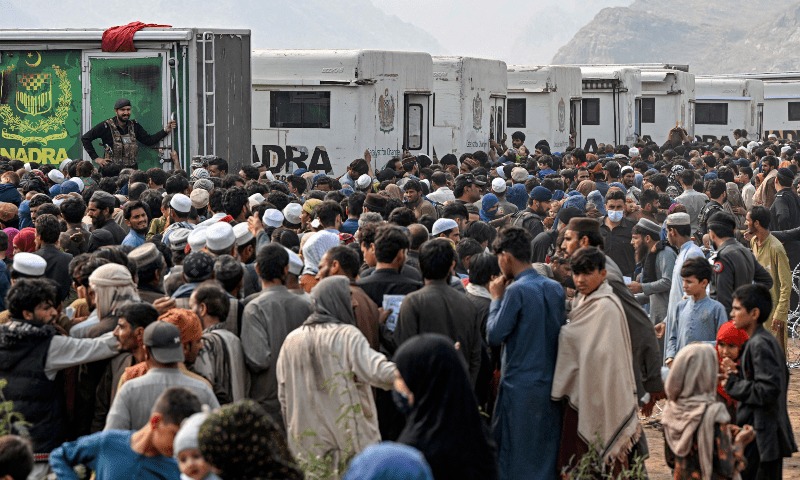
Since the formal opening of the Torkham border crossing on March 31, thousands of Afghan citizens have been sent back by trucks on a daily basis.
According to the Interior Ministry, more than 38 transit and holding points have been set up across the country to handle the return process.
3. Judicial Intervention and Court Stays: Pakistan’s higher courts have also issued some relief on humanitarian grounds against this rapid campaign by the government:
Peshawar High Court: The high court recently issued a stay order against the forcible deportation of Afghan siblings, Afghan musicians, and transgender women awaiting political asylum in Canada and other countries.
Sindh High Court and Azad Kashmir Courts: These courts have also ordered law enforcement agencies not to harass or deport Afghan nationals who have valid documents or are undergoing the asylum process without due process.
Pakistan currently hosts millions of Afghan refugees, divided into three main categories:
Registered refugees (PoR card holders), Afghan citizen card holders, and illegally residing Afghan citizens. The Pakistani government continues to deport illegal immigrants
Population and registration of refugees;
Pakistan has been among the countries in the world that have hosted the largest number of Afghan refugees for decades.
According to statistics:Total number:
A total of more than 2.5 million Afghan refugees reside in Pakistan.
Registered refugees: More than 1.4 million of them have Proof of Registration (PoR) cards.
Afghan citizen card: In addition, about 800,000 people have Afghan citizen cards.
Location: The majority of these refugees live in camps and cities in the provinces of Khyber Pakhtunkhwa and Balochistan.
Recent policies and the eviction process;
The Pakistani government has adopted strict policies due to national security, economic burden, and the presence of illegal immigrants:
The process of expelling illegally residing foreigners is ongoing from time to time, in which Afghan citizen cardholders and undocumented persons are being sent back.
This campaign was carried out in two phases, under which millions of Afghan refugees have returned to their homeland.
However, the legal status of regularly registered (PoR card holders) refugees remains intact, and their period of stay has been extended in consultation with international organizations.
Socio-economic situation;
The second and third generations of Afghan refugees in Pakistan have become young. They face many difficulties in obtaining employment and education, while sometimes they also face fears of arrest and harassment due to their illegal residence. According to recent official statements and intelligence reports from the Pakistani government and military leadership, the recent terrorist attacks (including suicide bombings) in Pakistan clearly have a pattern of cross-border Afghanistan.
Investigations by the Counter-Terrorism Department (CTD) and NACTA have shown that the bloodthirsty terrorist groups in Pakistan, especially the Tehreek-e-Taliban Pakistan (TTP/Fatna al-Khwarizmi), are using Afghan soil as a base area for attacks against Pakistan.
The latest details on this sensitive issue and Pakistan’s official position are as follows:
1. Involvement of Afghan nationals in suicide bombings;
The following facts have emerged from the investigative reports issued by the security forces:
Afghan suicide bombers:
The terrorists involved in several recent suicide attacks in Balochistan and Khyber Pakhtunkhwa have been identified as Afghan nationals who had illegally crossed the border and entered Pakistan.
Use of the latest American weapons:
The weapons recovered from the terrorists are the same ones that were left behind by the US forces when they withdrew from Afghanistan, and these weapons are now being smuggled across the border into Pakistan.
2. Role of the Kabul Interim Government (Afghan Taliban) and Pakistan’s position;
According to a spokesperson for the Ministry of Foreign Affairs (MoFA), Pakistan has raised this issue with the Afghan Interim Government several times:
Violation of the Doha Agreement:
Pakistan maintains that the Afghan Taliban are bound under the Doha Agreement not to allow their territory to be used for terrorism against any other country, but they have failed to take action against the TTP.
Safe havens and funding:
Intelligence reports show that key commanders of Fitna al-Khawarij are not only roaming freely in Afghanistan but are also receiving safe havens and financial support there.
3. Pakistan’s countermeasures and security measures;
To deal with this cross-border threat, Pakistan has made clear changes to its strategy: Tight Border Management: A “one document regime” (passport and visa only) has been strictly enforced at all crossing points, including Torkham and Chaman borders, and movement without documents is completely banned.
Surgical Strikes and Intelligence Operations:
Pakistani security forces have intensified Intelligence-Based Operations (IBOs) in areas close to the border, and the military leadership has made it clear that Pakistan reserves the right to target terrorist hideouts across the border within its defensive boundaries if attacks from Afghan soil do not stop.
According to the latest official intelligence reports of Pakistan’s Ministry of Foreign Affairs (FO) and Inter-Services Public Relations (ISPR), the recent devastating suicide attacks on Bannu’s Fateh Khel Police Post and Islamabad’s Jamia Masjid are directly linked to the command and masterminds of the Kharijites based in Afghanistan. Following these attacks, Pakistan has summoned the Afghan Charge d’Affaires to the Foreign Office in light of the evidence and lodged the strongest diplomatic protest.
The main contents of the detailed investigation reports of the security forces of the recent major attacks are as follows:
1. Bannu (Fath Khel) Suicide Attack Case Report; On May 9, 2026, a suicide attack was carried out on a police post in Bannu’s Fateh Khel area using a vehicle-borne improvised explosive device (VBIED), in which 15 police personnel were martyred.
Mastermind on Afghan soil: Technical intelligence and geo-fencing reports have proven that the attack was fully planned and funded by commanders of the Afghanistan-based “Fitna al-Kharij” (TTP).
Cross-border vehicle transfer: The vehicle and explosives were transferred to Bannu through an organized network from safe havens across the border.
2. Islamabad Mosque Suicide Attack Case Report;
On February 6, 2026, a major suicide attack took place during Friday prayers at the “Khadija al-Kubra” mosque in the Tarlai Kalan area of Islamabad, in which 31 worshippers were martyred, and more than 169 were injured. Afghan ISIS network: According to a joint investigation report by the Pakistan Army and the Counter-Terrorism Department (CTD), the mastermind of this attack was the ISIS (ISKP) network in Afghanistan.
Training and Brainwashing:
The ISPR revealed that the training, ideological brainwashing, and explosives supply of the attacker (identified as Yasir Khan Shinwari) were done inside Afghanistan.
Arrest of Facilitators:
Security forces busted their network by arresting four local facilitators of the attack red-handed during an Intelligence-Based Operation (IBO) in the federal capital.
Shocking revelations by DG ISPR;
DG ISPR Lt. Gen. Ahmed Sharif Chaudhry, while presenting a joint report on the war on terror in his recent briefing, clarified important strategic facts:
Citizenship of the attackers: DNA and documents from the bodies of most of the terrorists involved in recent high-impact terrorist acts and suicide bombings have proven that they were Afghan citizens.
Afghanistan “Centre Point”:
According to the ISPR, around 2,500 foreign terrorists from Syria and other countries have moved to Afghanistan, where they are being reorganized under the auspices of the Afghan Taliban. Operation “Wrath of the Fury”: Pakistan has launched airstrikes on terrorist hideouts in areas close to the Afghan border within its defensive perimeter in response to the growing cross-border aggression. The details of the shocking confessional statements of the arrested facilitators and terrorists of the recent attacks have come to light through the Counter Terrorism Department (CTD) and intelligence agencies. The confessional statements have made it clear how the terror network in Pakistan is being operated from across the border in Afghanistan through both manual and digital methods.
The main contents of the formal confessional statements of the arrested facilitators and attackers are as follows:
1. Confession of the facilitator of the Islamabad mosque suicide attack;
Sajidullah, the facilitator of the attack on the mosque in the Tarlai Kalan area of Islamabad, confessed to the judge and the investigation team: Command from Afghanistan: “We were receiving instructions for this attack directly from Saeed-ur-Rehman alias Dadullah, the intelligence chief of the Khawarij (TTP) based in Afghanistan.” Use of Telegram: “Dadullah used the Telegram app to communicate with his operatives in Pakistan and us so that the security agencies could not trace him.”
Transfer of the attacker: “The Afghan suicide bomber (who belonged to the Shinwari tribe of Nangarhar, Afghanistan) was brought across the border, and I kept him in a secret safehouse on the outskirts of Islamabad.”
Supply of the suicide vest: “On the day of the attack, the suicide vest was obtained from the Akhoon Baba graveyard in Peshawar, and I myself went and handed it over to the bomber.”
2. Confessional statement of the Afghan terrorist (Habibullah) arrested from Balochistan (Kuchlak);
In recent days, the Afghan citizen Habibullah, who was re-arrested by security forces from the Kuchlak area of Balochistan, has exposed the cross-border nexus in a video statement:Re-arrest and network: Habibullah was first arrested on suspicion, but was released on the grounds that he was a citizen. Solid evidence came to light on his re-arrest.
TTP and Afghan Taliban nexus:
The accused confessed that he was involved in attacks on security forces in Pakistan and that he was working for a joint network of both TTP and the Afghan Taliban.
Commander’s name: He revealed that his entire group operates under a military commander inside Afghanistan, codenamed “Muslim,” and that his own brother is also part of the same terrorist network.
3. Statements of Afghan terrorists arrested at the Chaman border;
The operatives of Fitna-ul-Kharij who entered Pakistan from Kandahar via the Chaman border during April and May 2026 have recorded statements:
Training camps in Afghanistan: “We were given regular training in the war against Pakistan by trainers like Maulvi Sadiq and Commander Rashid in special military camps established inside Afghanistan (like the Shunkra camp).”Objectives and tasks:
According to the confession, they are made to cross the border in groups of 10, and their sole goal is to ambush and attack Pakistani law enforcement agencies, police posts, and sensitive installations.
Pakistan’s diplomatic action on confessions. According to the Foreign Office, all these confessions, DNA reports, and strong evidence of geo-fencing have been handed over to the Afghan government in the form of a regular dossier.
Pakistan has made it clear that if immediate action is not taken against these masterminds and commanders present on Afghan soil, Pakistan reserves the right to go to any extent in defense of its sovereignty.
The Counter-Terrorism Department (CTD) and the Anti-Terrorism Courts (ATC) have intensified the nationwide crackdown to punish the facilitators of Fitna-ul-Kharij (TTP), BLA, and foreign-funded networks by May 2026 and to choke off terrorist financing. According to the report, due to effective investigation and solid evidence, 287 terrorists and their facilitators have been convicted and sentenced by the courts of Khyber Pakhtunkhwa province alone. The specific details of the recent court decisions and operations against Terra financing are as follows:
1. Recent Court Sentences of Arrested Facilitators The Anti-Terrorism Courts (ATCs) have given a clear message that any kind of assistance to terrorists is an unforgivable crime by giving the harshest sentences to the facilitators:
Death and Life Imprisonment: Five high-profile facilitators who harboured, requisitioned, and supplied arms or ammunition to terrorists have recently been sentenced to life imprisonment and forfeiture of property under the Anti-Terrorism Act. Improvement in Prosecution:
After the appointment of Dedicated Prosecutors for CTD cases by the Sindh and Punjab governments, the conviction rate has increased to a record high, under which several criminals were also convicted in Karachi and Hyderabad.
Strict action against digital terrorism:
In January 2026, the Islamabad Anti-Terrorism Court sentenced two absconding accused involved in the crime of digital terrorism against state institutions, spreading hatred and facilitating networks online to life imprisonment.
2. CTD’s crackdown on terrorist financing. Large-scale operations are underway in collaboration with Financial Investigation Units (FIUs) to root out terrorism: Large-scale Intelligence Operations (IBOs): CTD Punjab has recently conducted more than 286 operations in different districts, including Lahore, Gujranwala, Sargodha, and Sahiwal. Among them, the networks providing financial support and collecting funds were arrested.
Monitoring of illegal funding and NGOs:
Under the Financial Action Task Force (FATF) Sustainable Framework and the National Counter-Terrorism Authority (NACTA), suspicious transactions are being closely monitored across the country.
The assets and bank accounts of dozens of inactive or suspicious charitable organizations (NGOs) used for funding banned organizations have been frozen.
Bank accounts blocked under the Fourth Schedule:
With the support of the State Bank of Pakistan (SBP), the accounts of more than 2,000 suspicious individuals and their networks included in the Fourth Schedule have been blocked, and all types of financial transfers have been stopped so that they cannot send money for terrorist activities.
Dismantling of the foreign funding nexus:
CTD has also arrested groups from Bahawalpur and other areas who were receiving huge funds from across the border and Indian agencies ‘RAW’ through Facebook IDs and cryptocurrency/hawala hundi.
3. Seizure of funds and assets in government custody;
Under court orders, all movable and immovable properties used for terrorist purposes and terror financing are being seized in the name of the state as per law. Additional funds worth billions of rupees are being released by the government to equip security agencies with state-of-the-art anti-drone units, AI-based software, and GPS monitoring devices to permanently crush this network.
The principled position of Pakistan and the military leadership is that the Afghan Taliban are bound under the “Doha Agreement” signed in February 2020 and international laws not to allow their territory to be used against any country, but they have completely failed to rein in the TTP (Fitna al-Kharij). The basic points of Pakistan’s position and ground realities on this important diplomatic and strategic issue are as follows:
1. Violation of the Doha Agreement and international commitments;
The Foreign Office of Pakistan is constantly making it clear to the international community and the Afghan interim government that: The ultimate responsibility lies with Kabul: The Afghan Taliban had promised the world (especially the US and neighboring countries) that Afghan soil would not become a base area for terrorism.
UN reports confirm:
Reports from UN monitoring teams also support Pakistan’s position that since the change of government in Kabul, the Tehreek-e-Taliban Pakistan (TTP) has been given greater freedom, advanced US weapons and safe havens in Afghanistan.
2. Pakistan’s diplomatic and military patience has paid off;
In the past, Pakistan also tried to negotiate with the TTP under the mediation of the Afghan Taliban, but the Khawarij took advantage of this respite to re-establish a network in Pakistan and intensify attacks.
Recent tough stance: Pakistan has now “completely closed the chapter of negotiations,” and the military leadership has made it clear that it will only talk to the terrorists with the language of guns.
Right to Surgical Strikes:
Pakistan has drawn the strategic line that if the Afghan government does not eliminate the terrorist camps on its soil, then Pakistan reserves the full right to target these locations across the border within its defensive boundaries under international law.
3. Other measures to increase pressure;
Instead of being limited to diplomatic statements, Pakistan has adopted a multi-pronged strategy to increase pressure on the Afghan government:
Expulsion of illegal Afghan residents:
The process of returning illegal immigrants from across the country has been accelerated to break the network of local facilitators.
Strict border rules, movement without visas and passports at border crossings has been completely prohibited to stop the movement of terrorists.