
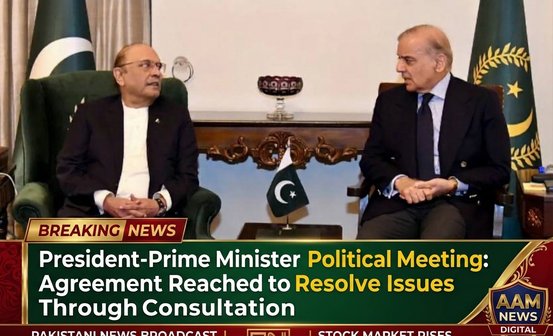
ISLAMABAD (TNS) In a highly significant and decisive political meeting held at the Presidency in the federal capital, Islamabad, President Asif Ali Zardari and Prime Minister Mian Muhammad Shehbaz Sharif engaged in a detailed discussion regarding the country’s overall political landscape, internal matters within the ruling coalition, and the rapidly evolving geopolitical situation in the Middle East. Federal Interior Minister Mohsin Naqvi also participated in this extraordinary meeting; his presence not only underscored the importance of the session but also lent it particular significance, especially given the recent political heat.
According to an official statement issued by the Presidency, both leaders reached a complete consensus that all political, administrative, and constitutional challenges facing the country should be addressed through dialogue, mutual understanding, and consultation, rather than through confrontation or unilateral statements. During the discussion, past constitutional amendments were specifically highlighted, with the emphasis that these amendments were not enacted at the behest of any single party, but rather through the collective consultation, prudence, and consensus of all allied parties. Both leaders reaffirmed their commitment to continue moving forward by taking all coalition partners into full confidence and engaging in joint deliberations on all future matters of national and constitutional importance. In political circles, this meeting is being deemed extraordinary, not least because it took place at a delicate juncture—shortly after Pakistan’s Interior Minister, Mohsin Naqvi, proposed holding a referendum on the creation of new provinces. This suggestion drew sharp criticism from Pakistan Peoples Party (PPP) Chairman Bilawal Bhutto Zardari. The discourse surrounding new provinces and a potential referendum ignited a fresh debate in national politics and sparked serious concerns within the PPP. Consequently, the fact that President Asif Ali Zardari and Prime Minister Shehbaz Sharif sat down for consultations—in the presence of Interior Minister Mohsin Naqvi—clearly indicates that the leadership has decided to promptly de-escalate this political tension and root out any misunderstandings that may have arisen among the coalition partners.
A careful examination of Pakistan’s parliamentary history reveals a stark reality: whenever coalition governments have been formed, their survival, stability, and performance have hinged upon continuous communication, mutual trust, and ongoing consultation among the allied parties. The current government setup—in which the Pakistan Muslim League (N) and the Pakistan Peoples Party serve as the two primary, foundational pillars—has, from its very inception, relied on a delicate balance: both parties must navigate the governance of the state while simultaneously upholding their respective ideological and political stances. However, it is only natural for a stir to arise within coalition politics whenever an unexpected statement is made regarding sensitive issues such as the status of federal units, provincial autonomy, or constitutional boundaries. A careful examination of Pakistan’s parliamentary history reveals a clear reality: the survival, stability, and performance of any coalition government in the country have always depended on continuous communication, mutual trust, and ongoing consultation among the allied parties. The current government setup—in which the Pakistan Muslim League (N) and the Pakistan Peoples Party (PPP) serve as the two primary pillars—has, from its very inception, relied on a delicate balance: both parties must advance the governance of the state while upholding their respective ideological and political stances. Yet, as noted, any unexpected remark on sensitive matters like federal units, provincial autonomy, or constitutional limits is bound to cause a stir within the coalition.
From the outset, the Pakistan Peoples Party has maintained a clear and unequivocal position: the Constitution of Pakistan provides a formal, comprehensive, and democratic procedure for the creation of new provinces, a key requirement of which is the approval of a two-thirds majority in the relevant provincial assembly. In this context, the sharp reaction from Chairman Bilawal Bhutto Zardari to the proposal for a referendum was, in essence, a reflection of this fundamental constitutional stance held by the PPP. Meanwhile, during the meeting at the Presidency—by citing the precedent of past constitutional amendments—it was conveyed that any matter concerning the Constitution or the federal structure would be addressed exclusively through parliamentary procedures and in full consultation with all the allied parties. President Asif Ali Zardari is recognized as a seasoned player in Pakistani politics and a champion of reconciliation—someone who has ensured that the doors to dialogue remained open, even during the most difficult and adverse circumstances. The core philosophy of his approach to politics is that in a democracy, nothing is ever the final word, and the only way out of a dead end is to sit at the negotiating table. Meanwhile, Prime Minister Shehbaz Sharif—leveraging his administrative acumen, tireless dedication, and a commitment to keeping his coalition partners aligned—is actively working to steer the country out of its economic and diplomatic crises. When these two leaders sit at the same table and declare that all matters will be addressed through mutual consultation, the impact resonates far beyond the corridors of power; it influences the national economy, the stock market, and the confidence of international investors.The core philosophy of President Zardari’s politics has always been that in a democracy, nothing is ever the final word, and the only way out of a dead end is to sit at the negotiating table. Meanwhile, Prime Minister Shehbaz Sharif—leveraging his administrative acumen, tireless work ethic, and a commitment to keeping his allies on board—is striving to steer the country out of its economic and diplomatic crises. When these two leaders sit at the same table and declare that all matters will be addressed through mutual consultation, the impact resonates far beyond the corridors of power; it influences the national economy, the stock market, and the confidence of international investors.
The presence of Federal Interior Minister Mohsin Naqvi at this meeting has effectively put an end to all speculation. Mohsin Naqvi is not only responsible for the country’s internal security and law and order, but he is also viewed as an effective liaison between the Federal Government, the Presidency, and other state institutions. Following Bilawal Bhutto Zardari’s sharp criticism of his remarks regarding the creation of new provinces, some quarters feared a major deadlock between the government and the Pakistan Peoples Party (PPP). However, Mohsin Naqvi’s presence at the Presidency—coupled with the commitment to resolve all issues through consultation—has successfully averted this political storm. Given the current state of law and order and ongoing counter-terrorism operations, the alignment of internal security with political stability is of critical importance at this juncture.
If we examine another significant aspect of this meeting—the discussions concerning the situation in the Middle East—the gravity and sensitivity of the matter become readily apparent. The Middle East is currently navigating an exceptionally delicate and perilous turning point in its history. The ongoing tension in the region, the looming threat of war, and the alignment of global powers have engulfed not only the countries of the Middle East but the entire Islamic world and South Asia. Pakistan maintains deep historical, religious, fraternal, and economic ties with all Middle Eastern nations—most notably Saudi Arabia, the United Arab Emirates, Qatar, Iran, and Turkey. Any instability in the Middle East directly impacts Pakistan’s economy, oil imports, foreign exchange reserves, and the livelihoods of the millions of Pakistani workers residing there.
Furthermore, Pakistan recently opened a new chapter in regional connectivity and diplomatic engagement by successfully hosting the 30th meeting of the Council of Foreign Ministers of the Economic Cooperation Organization (ECO) in Islamabad. At a time when Pakistan is positioning itself as a responsible hub for peace, stability, and regional cooperation, the consultations between the President and the Prime Minister regarding the situation in the Middle East were both highly timely and essential. Both leaders reaffirmed Pakistan’s commitment to playing a constructive and balanced role in de-escalating regional tensions, providing diplomatic and moral support to oppressed Muslims, and fostering global peace. The alignment between the President and the Prime Minister on foreign policy sends a clear message to the world that, regardless of internal political differences or rhetoric, Pakistan’s leadership remains united on matters of national security and foreign affairs.
It is also worth noting that a meeting took place a few days ago in Lahore between President Asif Ali Zardari and Prime Minister Shehbaz Sharif, during which the country’s political and economic situation was discussed. The meeting in Islamabad, following the one in Lahore, indicates that both leaders have decided to formalize the continuity of their engagement. It has been observed in the past that a lack of communication between the leadership often leads to statements from ministers or other figures that spark misunderstandings, eventually escalating into major political crises. These successive meetings—in Lahore and Islamabad—have bridged this gap, sending a clear message to the leaders of the allied parties: consultative forums should be utilized instead of engaging in unnecessary rhetoric regarding sensitive national and constitutional issues.
The country’s economic situation also demands that political tensions be kept to a minimum. Pakistan is currently navigating a delicate phase of economic recovery. To gradually reduce inflation, attract foreign investment, advance the privatization process, and implement reforms in the energy sector, the government must take difficult and far-reaching decisions. No government can effectively implement economic reforms without a solid majority in Parliament and the unconditional support of its allies. If doubts and suspicions persist among the allied parties, not only is the legislative process hindered, but it also conveys a sense of uncertainty to international financial institutions and friendly nations. Therefore, the decision to resolve all matters through mutual consultation is, in effect, a step toward bolstering the national economy.
However, beyond mere meetings and declarations, the real test lies in the practical implementation of these decisions. It is essential that the consensus reached at the Presidency level is effectively cascaded down to the lower tiers of the political structure. The working relationship between the two major parties—within the federal cabinet, parliamentary committees, and at the provincial level (particularly in Punjab and Sindh)—must be further improved. It is essential to ensure the strict implementation of the terms agreed upon under the power-sharing formula, thereby leaving no room for grievances from either side in the future. Similarly, efforts should be made to lower the political temperature in relation to opposition parties and to create space for a broader dialogue on national issues….because the challenges facing the country are so immense that they require the insight and cooperation of the entire political class to address.
Ultimately, this political gathering at the Presidency was a crucial necessity of the hour. Following the bitterness that arose over sensitive issues—such as the creation of new provinces and the prospect of a referendum—recalling the consultative spirit that underpinned previous constitutional amendments, and pledging to resolve all matters through dialogue, is a positive and prudent step. History bears witness that the politics of confrontation and obstinacy have always harmed the nation, whereas consultation, prudence, and reconciliation have paved the way through even the most arduous paths. If the commitment reiterated by President Asif Ali Zardari and Prime Minister Shehbaz Sharif—to resolve all issues through mutual consultation—is pursued with sincerity, it will not only strengthen the ruling coalition but also enable the country to advance rapidly toward political stability, economic prosperity, and diplomatic stature. Prior to this, the last meeting between President Asif Ali Zardari and Prime Minister Shehbaz Sharif took place on Saturday, November 14, 2026, at the Prime Minister’s residence in Model Town, Lahore. President Asif Ali Zardari was in Lahore to attend a private family wedding (an event also attended by Faryal Talpur, President of the Pakistan Peoples Party Women’s Wing). On that occasion, President Zardari visited Prime Minister Shehbaz Sharif’s residence in Model Town, where he was warmly welcomed by the Prime Minister. National Assembly Speaker Sardar Ayaz Sadiq and other representatives from the ruling coalition parties also participated in this significant political consultative meeting. The meeting took place against the backdrop of a fresh debate in national politics, sparked by a proposal from Federal Interior Minister Mohsin Naqvi—supported by certain leaders of the Pakistan Muslim League (N)—to hold a referendum on the creation of new provinces in the country. The two leaders held a detailed discussion on the overall political situation and sensitive matters concerning the federal units. According to identical statements issued by the Presidency and the Prime Minister’s Office, both leaders agreed to further strengthen cooperation among the coalition parties and to maintain a continuous consultative process regarding all key national priorities. The President and the Prime Minister conducted a comprehensive review of the country’s economic and internal security situation, reiterating their commitment to work together to ensure economic stability and accelerate the development process. Progress on ongoing public welfare projects was also reviewed.
Prime Minister Shehbaz Sharif provided President Asif Ali Zardari with a detailed briefing on his visit to Turkey, as well as Pakistan’s participation and diplomatic engagements regarding the 31st Conference of the Parties (COP31) on climate change. Exactly five days after this meeting in Lahore, the two leaders held another major meeting—their second within a week—at the Presidency in Islamabad. Interior Minister Mohsin Naqvi also participated in this session, which aimed to address concerns among the coalition partners and finalize a framework for resolving all issues through mutual consultation and constitutional means. The debate regarding a proposed referendum for the creation of new provinces in Pakistan began following a suggestion by Federal Interior Minister Mohsin Naqvi. However, the government has yet to announce a definitive date for holding such a referendum, and constitutional experts note that new provinces cannot be established solely through this process. During a press conference in Lahore on November 12, 2026, Federal Interior Minister Mohsin Naqvi stated that a nationwide referendum should be conducted to gauge public opinion on the creation of new provinces or administrative units. He argued that if the public desires new provinces, they should certainly be established; otherwise, the matter should be laid to rest.
Federal Information Minister Attaullah Tarar, Health Minister Mustafa Kamal (MQM), and Istehkam-e-Pakistan Party (IPP) leader Abdul Aleem Khan also supported the proposal for a referendum to ascertain public opinion. According to officials from the Prime Minister’s Office, Prime Minister Shehbaz Sharif has not yet issued any formal directives regarding preparations for or the scheduling of such a referendum. Constitutional experts point out that the Constitution of Pakistan contains clear provisions in this regard:
Referendum under Article 48(6): The Prime Minister may hold a referendum on any matter of national importance, subject to the approval of a joint sitting of Parliament. However, experts clarify that such a referendum would serve merely as a means to gauge public opinion or exert political pressure; it carries no direct constitutional mandate that would automatically result in the creation of a new province. • Mandatory Requirement under Article 239(4): Under the Constitution, altering the boundaries of any province or creating a new province necessitates the following three stages:
Approval by a two-thirds majority (64 votes) in the Senate, followed by the President’s signature. Pakistan Peoples Party (PPP) Chairman Bilawal Bhutto Zardari and the Sindh government have categorically rejected the proposal for a referendum, terming it a deviation from the established constitutional procedure. Opposing the division of Sindh, Bilawal Bhutto further demanded that, instead of a referendum, new general elections should be held within six months following electoral reforms. Leaders of the MQM have advocated for the creation of new provinces on administrative grounds—including the establishment of Karachi as a separate administrative unit—while Khawaja Asif and Ahsan Iqbal have previously spoken in favor of creating 12 to 15 smaller provinces for the sake of administrative convenience.
Following this growing tension among the allied parties, President Asif Ali Zardari and Prime Minister Shehbaz Sharif have agreed that all constitutional and political matters should be resolved—as has been the practice in the past—through mutual consultation among the allies and strictly in accordance with the constitutional path.