
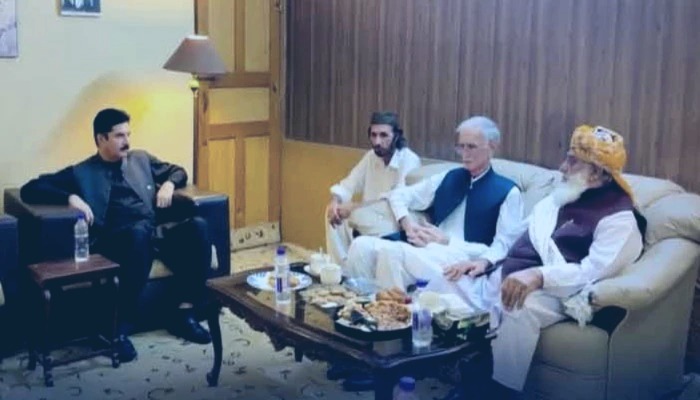
Khyber Pakhtunkhwa (TNS) I have been in Khyber Pakhtunkhwa for the past few days. During this time, I attended the Grand Tribal Jirga organized by Maulana Fazlur Rehman’s Jamiat Ulema-e-Islam (JUI-F) in Peshawar and also visited the Governor House and spoke to him about the political changes in KPK. In which the possibility of political change is being expressed. Echoing the big change in Khyber Pakhtunkhwa politics, the important consultation of the opposition parties of the province has entered its final stage. An informal meeting was held between Khyber Pakhtunkhwa Governor Faisal Karim Kundi, Federal Minister Amir Muqam, Advisor to the Prime Minister Pervez Khattak and JUI chief Maulana Fazlur Rehman. The meeting took place at Pervez Khattak’s residence after condoling the death of his sister, in which detailed discussions were held on the provincial political situation, issues of merged districts and the law and order situation.
According to sources, the opposition leadership has decided in principle to adopt a common strategy in the upcoming Senate elections and contest the elections under a unified plan of action. The meeting also discussed the unrest in the merged districts, public concern and the role of the committee formed by the Prime Minister. The Grand Tribal Jirga expressed concern over the incidents of terrorism and target killings in the tribes and demanded effective measures to restore peace and protect the lives and property of the people. The participants of the jirga expressed reservations about the committee established to restore the jirga system in the tribes. The participants said that no decision will be accepted without the representation and opinion of the tribal people. In addition, during this time, the Election Commission of Pakistan issued a decision regarding the reserved seats of the Khyber Pakhtunkhwa Assembly. The Election Commission approved the request of the PML-N regarding reserved seats in Khyber Pakhtunkhwa. The decision states that a toss will be held between the PML-N and JUI-F on the minority seat. In the KP Assembly, PML-N 9, JUI-F 9, PP 5, PTIP and ANP have got one additional seat each. PML-N also got a minority seat in the Khyber Pakhtunkhwa Assembly, while a women’s reserved seat will be contested between ANP and PTIP. It should be noted that a letter issued by the Secretariat of KP Governor Faisal Karim Kundi from Peshawar states that the Election Commission has issued written instructions to convene a session of the provincial assembly. The letter states that according to the Supreme Court’s decision, the oath-taking of elected members on reserved seats should be ensured. The letter from the Principal Secretary to the Governor KP states that according to the law, the matter of convening a session of the provincial assembly must be sent to the Governor through the Chief Minister. The letter demands that a session of the provincial assembly be convened immediately under Article 109A of the Constitution. Meanwhile, the people of Khyber Pakhtunkhwa have raised questions about the performance of the Pakistan Tehreek-e-Insaf (PTI) provincial government. In a public opinion survey conducted by Gallup, 58 percent of the people said that in their opinion, corruption is being committed in the development funds of the provincial government. In response to a related question, 40 percent of citizens also claimed that there is more corruption in Khyber Pakhtunkhwa than in Punjab. According to the survey, 73 percent of citizens believe that government jobs are not awarded on merit, while 59 percent pointed to an increase in unemployment. 60 percent of citizens opined that the Khyber Pakhtunkhwa government is wasting time in protests instead of working. 73 percent of citizens complained about the growth of a patronage culture in the province, while 66 percent of voters complained about the broken promises of elected representatives. During the survey, 58 percent of voters expressed satisfaction with the law and order situation in Khyber Pakhtunkhwa. In the survey, the majority of the people described the performance of the previous PTI governments of Mahmood Khan and Pervez Khattak in the transport sector as better than the current Gandapur government. The report was prepared between April and June and involved interviews with 3,000 people. Moreover, last week, the court formally ruled to give reserved seats from the Pakistan Tehreek-e-Insaf (PTI) to the ruling coalition and others. Some quarters pointed out that the newly-constituted Supreme Court bench had given the expected verdict. However, people wondered how political parties could get additional seats in parliament when they had not even achieved significant success in the elections. Reserved seats are allocated based on the number of seats won directly by any political party in parliament, but the PTI is not counted. Now that the ruling coalition has a strong majority, there is a long list of laws that are said to be under consideration for change. These could include providing legal protection to the current ‘hybrid’ system, strengthening control through government powers or repealing parts of the 18th Amendment. This is not just about getting new laws passed quickly. The canal project may also return, while after the no-confidence vote in 2022, there is talk of sending the PTI government home in Khyber Pakhtunkhwa in the same manner. Decisions will be made now because they have the authority to make decisions while public reaction is not an obstacle. Political parties have lost courage long ago. On the other hand,All this is happening at a time when terrorist attacks are on the rise again, while deaths are being reported in these terrorist attacks, the effects of climate change are being felt, and even poverty is increasing. When power becomes strong, its journey towards weakness also slowly begins. Talking about the country, after the PML-N stopped the PTI sit-in, it seemed that no one would challenge the PML-N’s rule in Punjab. But then Panama came. Until some time ago, the PPP’s rule in Sindh seemed strong, but then the canal project was announced. In 2006, when the Supreme Court annulled the privatization of steel mills, Pervez Musharraf was also in a similar position. So no one knows what problems he might suddenly face. Remember that the federal government’s proposal to restore the jirga system in the newly merged districts is being seen as the first step towards restoring the semi-autonomous status of the erstwhile tribal agencies. There may not be any specific plans yet to bring back the old system, but the Prime Minister’s decision to form a committee on the issue, headed by the Federal Minister for Kashmir Affairs and Gilgit-Baltistan, has raised serious concerns.
The recent meeting of the committee members, mostly federal government officials, stressed the need to restore the jirga system in the districts. According to the report, ways to promote an effective alternative justice system in the former tribal districts were discussed. The jirga system, a traditional method of resolving disputes, was abolished in 2018 after the merger of seven tribal agencies through the 25th Constitutional Amendment. The Khyber Pakhtunkhwa government has rejected the formation of the committee, calling it federal interference in provincial affairs. Thus, the standoff between Islamabad and Peshawar has intensified. In the wake of rising militancy in 2018, the merger of FATA with Khyber Pakhtunkhwa was seen as a major step towards ending lawlessness in the semi-autonomous regions, bringing them into the mainstream and providing better governance and development to its population. But even after 7 years, these promises could not be fulfilled. The merged districts faced several challenges due to limited financial resources to develop basic infrastructure and improve the lives of the people. During the last 7 years, the federal government neither provided the merged districts with Rs100 billion in annual development funds nor provided them with three percent of its share in the National Finance Commission award. The situation has been further worsened by the ongoing confrontation between the federal government and the Pakistan Tehreek-e-Insaf (PTI) provincial administration. The resurgence of militancy in the region has completely destroyed the governance system in the merged districts. Instead of addressing these issues, the federal government seems to be trying to revert to the old colonial system that was the root cause of the backwardness of the Federally Administered Tribal Areas (FATA). FATA was governed by the controversial Frontier Crimes Regulation and political agents. Disputes were settled by local jirgas consisting of tribal elders and ‘mallik’ appointed by the federal government. The courts had no jurisdiction in the area, as it was directly under the federal government. The provisions of the constitution and laws did not apply there. The semi-autonomous status of FATA allowed the government to remain indifferent when the region became a training ground for militants and then sent militants from within and outside the country to Afghanistan to fight against Soviet forces. But this situation also resulted in FATA becoming a hotbed of militancy, which threatened the security of Pakistan itself. It also led to the complete abolition of the state writ over the strategically important area. This vacuum was filled by terrorist groups like the banned Tehreek-e-Taliban Pakistan (TTP) who took control of the areas. While successive military operations cleared the area of militants on a large scale, it also created a major humanitarian crisis as millions of local residents were forced to leave their homes and businesses to escape the conflict. Most of them may have returned to their devastated lands, but many have migrated to other areas in search of employment. One of the reasons for integrating the tribal areas into the mainstream was to establish a statehood there and carry out development work in the conflict-ravaged areas, but even after 7 years, the plight of the people of the districts has not improved. The administration and justice system have collapsed due to lack of financial resources. This has also increased public discontent. The worrying thing is the return of militancy in the merged districts, which has been caused by the weakening of the administration and the justice system. The army is busy in operations against extremists. The problem is that military operations alone cannot bring peace and stability to the troubled areas. There is a need to accelerate the reform program. There is an urgent need to strengthen the civil law enforcement services and accelerate development works.Moreover, a high-level meeting was held in Islamabad regarding the restoration of the jirga system and other issues in the merged districts of Khyber Pakhtunkhwa (formerly FATA). The meeting was chaired by Federal Minister for Planning and Development Amir Muqam, and Faisal Karim Kundi was a special guest. Amir Muqam had said that tribal elders and legal experts would be included in this consultative process. There was a broad consensus among political parties, except for a few parties, on the inclusion of the former tribal areas in the mainstream. But now the ruling party’s review of the merger reforms is quite interesting. Reports suggest that steps are being taken to bring the former FATA back under the federal government. In fact, the Khyber Pakhtunkhwa Assembly has not enacted legislation related to mines and minerals, through which the federal government would have gained some control over the mines. The former tribal areas have large reserves of rare and other minerals. Some doubts have certainly arisen regarding the federal government’s review of the previous FATA reforms and the restoration of the jirga system there. Unconfirmed reports suggest that one of the reasons for the move to backtrack on reforms is security concerns regarding the growing insurgency in the region. In addition, the inside story of the meeting between Pakistan Tehreek-e-Insaf founder Chairman Imran Khan and Khyber Pakhtunkhwa Information Advisor Barrister Saif has come to light. The names of the candidates for the Senate elections were finalized in the meeting. Barrister Saif briefed the former prime minister about the Khyber Pakhtunkhwa budget, while detailed consultations were also held on the nominations for the Senate. Imran Khan issued instructions to make Mashal Yousafzai a senator, following which Mashal Yousafzai’s name was finalized on Sania Nishtar’s seat. According to sources, Murad Saeed, Faisal Javed, Mirza Afridi and Pir Noor-ul-Haq Qadri are candidates for the general seats in the approved list, while Azam Swati has been selected for the technocrat seat and Rubina Naz has been selected for the women’s seat.