
ISLAMABAD (TNS) The sacrifices of the martyrs of Jammu Kashmir will never go in vain and neither can the Indian army reduce the spirit of freedom of the Kashmiris.The Pakistan Army has always expressed its support for the Kashmiri people on the issue of Kashmir. According to the Pakistan Army, Indian aggression, provocative statements and belligerent behavior continue to pose a threat to peace and stability in the region. The Pakistan Army expressed its unwavering solidarity with the Kashmiri people on Kashmir Liberation Day. This day is observed to commemorate the illegal move by India to abolish the special constitutional status of occupied Jammu and Kashmir. The Pakistan Army has vowed to stand by the Kashmiris in their struggle for their right to self-determination against Indian aggression. The Pakistan Army is ready to respond to any aggression by India. The Pakistan Army is fully committed to defending the homeland and will respond to any external aggression with a strong and fierce response. The Pakistan Army has taken steps to enlighten the youth with the principles of national security and the spirit of patriotism.
6 November 1947 is the day of martyrdom of the Mujahideen and Pakistan Army soldiers who were martyred while fighting against India in Kashmir. This day is celebrated as Martyrs’ Day, where the sacrifices of these martyrs are remembered who sacrificed their lives for the freedom and defense of Kashmir. This day holds great significance in the memory of the martyrs and their sacrifices will always be remembered.
In the month of November 1947, the army and armed groups of the Dogra ruler Hari Singh massacred about 4 lakh Kashmiri Muslims in the Jammu and Kashmir region. A major reason for this incident was to eliminate the Muslim majority from Jammu. These were the nefarious intentions of Hari Singh. In this incident, a large number of Muslims, about four lakh, were martyred and about 5 lakh Muslims were forced to migrate from Jammu.
In memory of the brutal massacre of November 1947, Kashmiri Muslims continue to celebrate Jammu Martyrs’ Day on November 6 every year and express solidarity with the martyrs of Jammu. As a result of this incident, Muslims became a minority in Jammu, who were 61% of the total population before the incident, but unfortunately, the massacre of Kashmiri Muslims has not stopped and now Modi’s conspiracy is going on to convert the Muslim majority of the Kashmir Valley into a minority. It seems that this chain continues from Hari Singh to Modi. Today, Kashmiris all over the world are celebrating Jammu Martyrs’ Day on November 6 like every year to remember those who were brutally killed by the Dogra forces in 1947. The younger generation should be told that after Hari Singh came from Srinagar, the Maharaja and his administration played an important role in instigating communal riots. The Muslims in Jammu city were then under the influence of the Muslim Conference, which was a representative party of Kashmiri Muslims at that time. If we look into the windows of history, it is known that the Maharaja played an important role in promoting the communal RSS in Jammu. Important RSS leaders like Balraj Madhok, Kedarnath Sahni, Vijay Malhotra and Madan Lal Khurana were posted in Jammu as RSS in-charge during the 1940s. Governor Chet Ram Chopra and DIG Police Bakshi Udhay Chand also played an important role in this, then the administration also participated in this massacre. Organized armed Hindu groups had reached Bhambar, but even after seven decades, the suffering of Kashmiris has not ended. Kashmiris are no longer living under the Dogra Raj, but due to Indian illegal occupation, their conditions have become worse than bad. At present, India has deployed about 1 million soldiers in Kashmir, due to which it is the most militarized area in the world that has been involved in crimes against humanity. Today, India is following the same policy of demographic change in occupied Kashmir that Hari Singh had adopted. Even worse, the situation is getting worse. Today, rape of Kashmiri women is being used as a weapon of war by the Indian armed forces. The Indian government has changed the property rights of the locals, which has led the Kashmiri leadership to fear that the new laws will change the demography of India’s only Muslim-majority region. India’s attempt to bring about demographic change in Kashmir is a violation of the Geneva Convention. Article 85 (4) (a) of Additional Protocol 1 of 1977 provides that the transfer of parts of its civilian population by an occupying power to an area it occupies is a grave violation of the Protocol. India has consistently ignored UN resolutions on Kashmir. On November 6, 1947, in the Jammu province of occupied Kashmir, Dogra soldiers, Hindu rioters and Sikh mobs martyred millions of Muslims in terrorist attacks on Muslim settlements. Millions of Muslims were forced to leave their homes and migrate to Pakistan. Before the November 6 tragedy, the Muslim population in Jammu city was 61 percent, which decreased to 38 percent after the martyrdoms and migrations. In the November 6 tragedy, thousands of Muslim women were abducted by Hindu and Sikh terrorists. Indian rulers had carried out a massacre in Jammu under an organized conspiracy. Under the same conspiracy, India’s anti-Islam and anti-Muslim rulers have martyred 1.2 million Muslims since 1989. The massacre of youth is still going on in occupied Kashmir. India is embarking on a heinous plan to destroy the Muslim identity of Jammu and Kashmir through an organized genocide. The Kashmiri people have vowed that our struggle will continue until India’s usurping military occupation ends. India cannot break the morale of the Kashmiri people through coercion and tyranny. The Kashmiri people are in the field against Indian imperialist occupation with full determination and independence.It should be noted that the rebellion in favor of accession to Pakistan began in October 1947. On the night of October 21 and 22, the Poonch fighters, with the help of tribesmen coming from Pakistan and a few officers of the Pakistan Army, defeated the Dogra regiment assigned to defend the bridge over the Jhelum River at Domail and opened the road to Srinagar. Srinagar was now only 100 miles away, but the Muslim fighters did not have the means to reach Srinagar quickly. By October 24, 1947, Raja Hari Singh was convinced that the situation was now out of his hands. Therefore, on October 24, the Deputy Prime Minister of the State of Kashmir was sent to Delhi so that he could request the dispatch of troops from India. On 25 October 1947, Indian Prime Minister Pandit Nehru wrote a letter to British Prime Minister Clement Attlee on 25 October, stating: “We have received a request for immediate military assistance from the Kashmir Government. It is incumbent upon us to respond positively to this request because the security of India depends on the internal peace and order of Kashmir. I would like to make it clear that providing assistance to Kashmir in this emergency does not mean that we are in any way forcing Kashmir to accede to India. The matter of Kashmir’s accession will be decided in accordance with the wishes of the Kashmiri people.” Two days later, the British Prime Minister’s reply was received, stating that no military intervention should be made as it would worsen the situation, but India had already sent troops into Kashmir. On 27 October 1947, the Governor General of India, Lord Mountbatten, wrote to the Raja accepting the request for military intervention in the state of Kashmir, saying, “We are committed to our policy that any state whose accession is in dispute will be decided in accordance with the wishes of the people of that state. It is the desire of my Government that as soon as peace and order is restored in Kashmir and the invaders have withdrawn, the issue of Kashmir’s accession should be decided in accordance with the wishes of the people of that state.” On 2 November 1947, Nehru addressed the nation on All India Radio, saying, “We have given a pledge to decide the issue of Kashmir’s accession in accordance with the wishes of the people of that state. We will not and cannot break this pledge.”
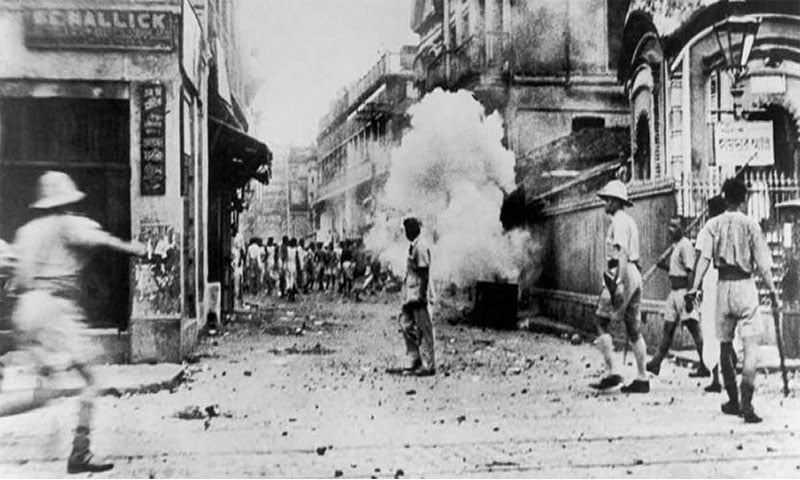
On the night between 5 and 6 November, the Dogra soldiers removed 5,000 Muslims living in Jammu city from their homes and sent them away in a convoy. Arrangements had already been made to attack them on the way. The Dogra soldiers took the convoy straight to the place where the assassins were ambushing. They martyred all these people. When the subcontinent was divided, the state of Jammu and Kashmir had assumed extraordinary importance in this region. Because now its borders were not only connected with Pakistan and India but also with Afghanistan and China. Eminent author Alistair Lamb has written in his book. If the British decision-makers had applied the logic of the division of Bengal and Punjab in the case of Kashmir, a border could have been drawn here too in which the Muslim-majority areas in the west of the state would have been included in Pakistan, while the Buddhist and Hindu-majority areas in the east would have been included in India. “On the orders of the Dogra Raja, the work of expelling Muslims from Jammu was started in full swing. But it soon became clear that the complete elimination of Muslims was not possible. It is not possible to turn Muslims into a minority through oppression and tyranny. According to an estimate, in a short period of just two months in August and September 1947, more than five hundred thousand Muslims were expelled from the state while more than two hundred thousand were martyred. This is only the number that has been confirmed, there is no count of those who suffered oppression before and after. India continued to take such steps that were completely contrary to the internationally disputed status of Kashmir. Pakistan and India are the two main parties to the Kashmir issue. In this regard, it is the responsibility of both these countries to uphold the promises made before the international community, but India has never fulfilled its responsibilities in this regard. In fact, India, through its irresponsible actions, had forced Pakistan to try to stop India from its objectives. One of the most important aspects of this issue is that India was taking constitutional steps to end the disputed status of Kashmir and make occupied Kashmir a part of India. Despite Pakistan’s repeated requests, the international organization did not take any action. Earlier, India had attacked Pakistani territory in the Run of Kutch. After being defeated there, it incorporated occupied Kashmir into the Indian federal structure and started calling Kashmir an integral part of India, although India had recently promised a plebiscite in Kashmir to the international community. In such a situation, it was not logical for Pakistan to sit idly by. Russell Bryans, a prominent military expert, has written a book on the September War, which is considered a very authoritative work in military circles. Commenting on this move by India, he says, “The move to declare occupied Kashmir a province of India was exactly the same as what Congress had done 20 years before the September War.Due to the negative politics of the Congress, even a wise politician like Quaid-e-Azam was forced to take direct action. As a result, riots broke out in Calcutta. At the end of his analysis, Russell writes, “This extreme step by India created a reasonable justification for Pakistan to achieve political objectives through force. By announcing that Kashmir would become a part of India, India itself had made war inevitable. Under the implementation of the report of India’s Nanda Commission, occupied Kashmir was declared a part of India. In this war, the Pakistan Army created stories of bravery, courage and valor that are difficult to cite as examples. In particular, the Pakistan Air Force performed brilliantly in its air battles and ground operations to support the ground army. The struggle of the Kashmiri people is for accession to Pakistan and they have been making sacrifices for this purpose since the establishment of Pakistan till today. Kashmiris living on both sides of the Line of Control and around the world celebrate Jammu Martyrs’ Day with a renewed resolve that the mission of the martyrs will be continued until the right to self-determination is achieved. November 6 is observed as the blackest day in the history of Jammu and Kashmir, when the blood of the oppressed, helpless and oppressed Kashmiris was shed. Since then, this day is observed as Black Day not only on both sides of the Line of Control, but also by Kashmiris living in Pakistan and around the world, in order to remember and pay tribute to those who lost their lives in this tragedy and to draw the attention of the civilized world to this heinous and inhuman act. The armies of Maharaja Hari Singh, Indian forces and Hindutva goons massacred lakhs of Kashmiris in different areas of Jammu when they were migrating towards Pakistan in the first week of November 1947. The Jammu massacre was certainly the first mass genocide on such a large scale after World War II. The Kashmiri people celebrate Jammu Martyrs’ Day every year to remember the sacrifices of the Muslims of Jammu. The aim of the brutal massacre of the Muslims of Jammu was to change the population ratio in occupied Jammu and Kashmir, because in the areas where the Muslims were massacred, the population of Muslims was 66 percent, which decreased to 33 percent after the massacre. Undoubtedly, the sacrifices made by the Muslims of Jammu have been written in golden letters in the history of occupied Jammu and Kashmir. The Jammu massacre in 1947 reminds us of the criminal face of the Hindutva forces. The series of sacrifices that started in Jammu in 1947 is still ongoing in occupied Jammu and Kashmir. November 6, 1947, a bloody tragedy in human history that cannot be forgotten under any circumstances. The massacre of millions of innocent and helpless Muslims is a black spot on the face of India that cannot be washed away under any circumstances. Although the criminal silence of the great powers and international organizations on this genocide is a matter of concern, the Kashmiri people, despite this worst human tragedy in history, have resolved to continue their great and eternal struggle until they achieve their goal. This is the reason why, in the struggle launched after 1989 to end India’s oppressive occupation, nearly one lakh Kashmiris, including men, women and children, have sacrificed their lives so far. These sacrifices of the people of Kashmir demand that they be loyal to them at all times, which are being made to end India’s oppressive occupation of occupied Jammu and Kashmir.
The unparalleled sacrifices of the oppressed Muslims of Jammu will not go in vain. Modi and his henchmen must be held accountable for war crimes against humanity in occupied Jammu and Kashmir. The international community must take immediate steps to stop the brutal massacre of the Kashmiri people. The Kashmiri people are determined to continue to confront Indian brutality with courage and bravery. The Modi government must be held accountable for its war crimes and crimes against humanity in occupied Jammu and Kashmir.