

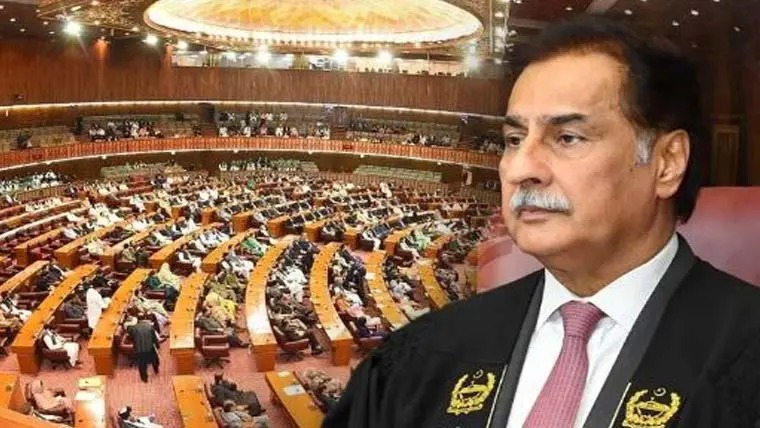
ISLAMABAD (TNS) Echoes of the 27th Amendment in the Shadow of the Inter-Parliamentary Speakers Conference are proof of Pakistan’s leadership in parliamentary diplomacy. Chairman Senate Pakistan and Founding Chairman of the Inter-Parliamentary Speakers Conference Syed Yousaf Raza Gilani has said that the Inter-Parliamentary Speakers Conference for Peace, Security and Development is a great and historic occasion in Pakistan’s parliamentary history, which is being held in Islamabad on November 11 and 12, 2025.
Addressing the Senate meeting, Chairman Senate Pakistan said that this extraordinary conference will bring together a total of 174 delegates in Pakistan, including speakers of ten parliaments from around the world, fifteen deputy speakers, thirty-seven members of parliament and representatives of various international and regional organizations.
The Chairman Senate said that two former presidents will also participate to represent their countries, which is proof of Pakistan’s growing international role and leadership in parliamentary diplomacy. Chairman Senate Syed Yousaf Raza Gilani said that hosting the distinguished guests is not only an achievement of the Senate but also a national honor that elevates the prestige of Pakistan on the global stage.
This conference provides a rare opportunity for Pakistan to present its vision of parliamentary diplomacy, peace, security and development to the world.
The Chairman Senate said that when we welcome our guests from the South and North, we will not be just participants in a conference, but will be ambassadors of our nation’s spirit of peace, tolerance and cooperation.
The Chairman Senate expressed special gratitude to President Asif Ali Zardari, Prime Minister Muhammad Shehbaz Sharif, Speaker National Assembly Sardar Ayaz Sadiq and Deputy Prime Minister and Foreign Minister Senator Ishaq Dar and appreciated their cooperation. He paid tribute to Senator Ishaq Dar for chairing the curtain-raiser session of the conference and his ongoing support.
He also appreciated the role of the Speaker of the National Assembly and said that the mutual cooperation of the country’s top leadership is the best example of national unity and solidarity.
The Chairman Senate further said that the role of the Ministry of Interior, Ministry of Foreign Affairs, Ministry of Information and Broadcasting and Capital Development Authority (CDA) in the preparations for this historic event is commendable, who played a full role in implementing this national goal with their hard work day and night. The spirit with which all these departments are working is a bright symbol of national unity and cooperation,
He urged the senators to consider this conference as their collective responsibility and play the role of host in a full manner so that the positive image of Pakistan is highlighted before the international community. This project is not only of the Senate Secretariat but of all of us.
Every member of parliament should be a part of it so that we can make it a successful and historic event. Chairman Senate Syed Yousaf Raza Gilani expressed the hope that this Inter-Parliamentary Speakers Conference will become a message of hope, peace and cooperation for Pakistan and will further strengthen the country’s parliamentary role at the global level.
We all have to work together to make it a memorable event that proves Pakistan a leader in parliamentary diplomacy. The struggle for peace, security and development is not just an individual goal but a shared mission of states. The Islamabad Inter-Parliamentary Speakers’ Conference is a historic milestone for “Peace, Security and Development”.
Reinforcing the idea that cooperative solutions to security, development and societal challenges should be developed through inter-parliamentary dialogue, the conference aims to provide a high-level platform for global parliamentary leadership to reaffirm their tripartite commitment to peace, security and development.
Toward this end, the upcoming ISC session in Islamabad seeks deeper coordination, partnership-building, and ground-breaking work for ongoing and future cooperation to address urgent global challenges through legislative action and conflict resolution frameworks.
The Inter-Parliamentary Speakers’ Conference to be held in Islamabad from 10 to 12 November 2025, against the backdrop of security challenges and sustainable development models, marks a historic milestone for translating the principles of the Seoul Declaration on Peace and Prosperity.
The Inter-Parliamentary Speakers Conference (ISC) was established in Seoul, South Korea in April 2025, under the visionary leadership of the founding Chairman of ISC and Chairman Senate of Pakistan, Syed Yousaf Raza Gilani, dedicated to promoting parliamentary processes and collective dialogue.
Parliaments serve as the bedrock of democratic governance, playing a critical role in policy formulation and ensuring accountability. Despite their unique position to shape policies across borders and to address existential threats, national parliaments often have limited opportunities for coordination at the international level. Fragmented approaches to crises prove ineffective, calling for unified legislative leadership from national parliaments.Many global challenges, from armed conflict and terrorism to unequal development, require parliaments to exchange information, legislate and learn from each other.
The Inter-Parliamentary Speakers’ Conference (ISC) fills this critical gap by providing a dedicated forum for speakers to share perspectives, build consensus and catalyze solutions, with the ultimate goal of advancing interdependence, mutual prosperity and shared values at the global level.
The world is currently gripped by growing global conflicts, regional tensions and widening development disparities. Therefore, it is increasingly incumbent on parliaments and their leaders to play a more active role in conflict prevention and resolution, good governance and inclusive development.
This is imperative given the undeniable fact that peace and development are interdependent and interdependent. In this regard, the ISC, with its founding Chairman Syed Yousaf Raza Gilani, represents a strong commitment to reimagine, reshape and reframe active international cooperation through parliament’s active diplomatic engagement.
It will provide an opportunity to discuss ways and means to further strengthen parliamentary capacities in oversight, representation, and ethical governance to address inequality gaps and emerging security threats. Answers Speakers can share best practices for drafting laws and policies that address security threats and reduce inequality.
What are the most pressing peace, security and development challenges facing our societies today?
How can parliaments leverage legislative tools and international cooperation to mitigate security threats and development challenges?
What role can parliamentary diplomacy play in bridging geopolitical divides and upholding human rights?
These reflections can guide the deliberations during the conference and help shape strategies to enhance the legislative, oversight and representative role of parliaments in a fractured world.
Participants will work towards concrete outcomes that strengthen the role of the ISC and set forward an agenda.
The conference will adopt the Islamabad Declaration, which will build on the foundation of the Seoul Declaration, outlining shared commitments and recommendations to strengthen peacebuilding, good governance and inclusive development through lawmaking. The Inter-Parliamentary Speakers’ Conference Islamabad 2025 will be accompanied by a clear statement of the programme and roadmap for future cooperation, engagement with the United Nations and development agencies, and joint legislative initiatives. The proposed 27th Constitutional Amendment Bill was further considered in the meeting of the Joint Parliamentary Committees on Law and Justice of the Senate and the National Assembly.
The 27th Amendment Act 2025 bill was introduced in the Senate hours after it was approved by the federal cabinet, prompting the opposition to raise eyebrows over the pace and scope of the proposed changes. The bill includes proposals to establish a federal constitutional court, change the process of appointing high court judges, increase the size of provincial cabinets, and reform the military leadership structure.
The meeting is being co-chaired by Senator Farooq H. Naik, Chairman of the Senate Standing Committee on Law and Justice, and Chaudhry Mahmood Bashir, Head of the National Assembly Standing Committee. The meeting of the standing committees is also likely to finalize the procedure for transferring high court judges, which will be carried out through the Judicial Commission of Pakistan (JCP) and is likely to not require the consent of the judges being transferred. Yesterday, during the Senate session itself, the committees also held an in-camera joint meeting to consider the bill, but Pakistan Tehreek-e-Insaf members, Jamiat Ulema-e-Islam (F) MNA Alia Kamran and Senator Kamran Murtaza boycotted the meeting. The standing committees approved about 80 percent of the proposed bill, which included most of the provisions of the judicial reforms package.
However, consideration of the status of the post of Field Marshal under Article 243 (Command of the Armed Forces) of the Constitution was postponed until today’s session. Before the meeting, Senator Farooq H. Naik said while talking to reporters that all the provisions of the bill will be considered in detail today and we are hopeful that we will complete this process today itself. When asked about the proposals of various government coalition parties and whether the two parties have come face to face on the issue of granting immunity to the President and Prime Minister, the PPP senator said that all parties have the right to express their opinions.The proposals of the PML-N and the Muttahida Qaumi Movement (Pakistan) will be considered in today’s meeting while decisions will be taken on the basis of what the majority opinion is. The chairman of the committee expressed hope that the draft bill will be finalized by 5 pm today. Federal Law Minister Azam Nazir Tarar and Minister of State for Law and Justice Brister Aqeel Malik and other members are participating in the meeting. Apart from this, PML-N Senator Khalil Tahir Sindhu, Awami National Party’s Hidayatullah Khan, and PPP’s National Assembly Members Qasim Gilani and Syed Abrar Ali Shah were also part of the joint meeting, while PML-N MNA Shamila Rana participated through video link. Qasim Gilani wrote on the X, ‘Second day of the Parliamentary Committee on Law and Justice’. In another post, he summarized that the 27th Constitutional Amendment mainly focuses on 5 important points:
Establishment of Federal Constitutional Court
Transfer of judges (Article 200)
End of irregularities related to Senate elections in Khyber Pakhtunkhwa
2% increase in cabinet size on the demand of small provinces
Amendments related to defense services and presidential immunity in Article 243
The PPP MLA further said that all other changes are only consequential amendments. After yesterday’s meeting, Law Minister Azam Nazir Tarar said that all parliamentary parties are participating in this process and the government has also requested the opposition to participate constructively. The talks will continue until a consensus is reached between all members of both houses. The Senate has been summoned for a one-point agenda today, to consider the 27th Amendment Bill, which is a sign that the government is showing unusual urgency to pass constitutional amendments. PTI parliamentary leader Barrister Ali Zafar has taken the stand that discussing the bill in the absence of the opposition leader is inappropriate, as it undermines the independence of the judiciary, and undermines the delicate balance of powers carefully established by the 1973 Constitution. However, the PML-N and the PPP have rejected the impression that the 27th Constitutional Amendment Bill was rushed through without proper debate, saying that the draft has been thoroughly scrutinized. The opposition leader nominated in the National Assembly and Senate and head of the Movement for the Protection of the Constitution of Pakistan, Mahmood Khan Achakzai, and Vice Chairman Allama Nasir Abbas have announced a nationwide protest movement. Earlier, Prime Minister Shehbaz Sharif had ordered the withdrawal of the PML-N’s proposed clause in the 27th Constitutional Amendment regarding the immunity of the Prime Minister, saying that the Prime Minister must be held fully accountable. In a statement released on the social networking website X, the Prime Minister had said that upon his return from Azerbaijan, I came to know that some senators from our party have submitted an amendment regarding the immunity of the Prime Minister. He further wrote that ‘I respect their good intentions, but this proposal was not part of the draft approved by the cabinet, I have directed it to be withdrawn immediately.’ ‘In principle, an elected prime minister should be fully accountable to both the court of law and the people.’ This statement has come at a time when the Senate and National Assembly committees are continuing to deliberate on the proposed 27th Constitutional Amendment Bill. On the other hand, the amendment to the proposed exemption for the post of Prime Minister was withdrawn on the instructions of Prime Minister Shehbaz Sharif. In the parliamentary committee meeting, Senator Anusha Rehman and Tahir Khalil Sandhu had submitted a proposal to grant exemption to the Prime Minister. According to sources, Senator Anusha Rehman withdrew the proposed exemption proposal on the instructions of the Prime Minister, while Committee Chairman Farooq H. Naik appreciated the withdrawal of the amendment. In the committee meeting, the amendment to grant immunity to the Prime Minister was submitted by Senator Anusha Rehman and Tahir Khalil Sindhu. Talking to the media, Law Minister Azam Nazir Tarar said that the Prime Minister directed to withdraw the amendment to grant immunity, the exemptions being given to other positions are not administrative in nature, consultations have been held on 80 to 85 percent of the amendments, the proposals of MQM, ANP and Balochistan Awami Party are yet to be considered. The proposal to increase the seats of the Balochistan Assembly will be considered now, JUI asked for 3 days’ time, which was not possible to give, if there is any opposition, then it should be done through votes, not politics, it is the power of Parliament to present private amendments. The proposed bill of the 27th Constitutional Amendment includes proposals for the establishment of the Federal Constitutional Court (FCC), changes in the procedure for appointing judges of the High Court, increasing the limit of provincial cabinet members and amendments to the structure of the military leadership. Some provisions of the bill also propose to provide lifelong constitutional protection to officers who are promoted to the five-star rank of Field Marshal, Marshal of the Air Force or Admiral of the Fleet. These officers will be “entitled to retain their rank, privileges and uniform for life”, and can only be removed by an action such as impeachment under Article 47 of the Constitution. Such officers will enjoy the same immunity as is granted to the President under Article 248 of the Constitution.On Saturday afternoon, the federal cabinet approved the 27th Constitutional Amendment Bill and declared it a complete welcome. Later, the bill was presented in the Senate, where the opposition strongly protested the scope and speed of the proposed amendments. Details of the proposed draft of the 27th Constitutional Amendment presented in the Senate have come to light, in which amendments have been proposed in 48 articles of the Constitution of Pakistan. The post of Chairman Joint Chiefs of Staff has been dissolved from Article 243 of the Constitution and the post of Chief of Defence Forces has been created. According to one proposal, the post of Field Marshal will be for life. It has also been proposed to entrust the transfer of judges to the Judicial Commission of Pakistan. The Chief Justice of the High Court from which the judge has to transfer and the High Court to which he has to go will also be part of the transfer process. The 27th Constitutional Amendment also proposes to increase the number of seats in the provincial assembly in Balochistan, a proposal to increase the size of the provincial cabinet is also under consideration, and the number of advisors to the provincial cabinet will be increased. Amendments have also been proposed to hold elections for the entire Senate at one time, and according to one proposal, the post of Field Marshal has also been proposed to be kept for life. Earlier, Prime Minister Shehbaz Sharif, who was in Baku, chaired a meeting of the federal cabinet via video link. The 27th Constitutional Amendment was approved in the federal cabinet meeting. Law Minister Azam Nazir Tarar had said that according to the Charter of Democracy, an amendment to Article 243 of the Constitution has been approved, according to which a Constitutional Court will be formed. Now the parliament will take the final decision on its approval after discussing the amendment to the Constitution. In addition, Prime Minister Muhammad Shehbaz Sharif has said that he took Quaid Mian Nawaz Sharif into confidence on the 27th Constitutional Amendment, and everyone has to work together for the development and prosperity of the country. The Prime Minister welcomed the cabinet members and thanked the coalition parties and said that everyone worked together for the 27th Constitutional Amendment in the interests of the country and the strengthening of the relationship between the federation and the provinces, for which the Ministry of Law and Justice, the Attorney General and their team are commendable. I have taken my leader Mian Muhammad Nawaz Sharif into confidence on the 27th Constitutional Amendment and have sought his guidance on it, for which I am deeply grateful. I have also taken President Asif Ali Zardari into confidence regarding the amendment and am deeply grateful for his consent. The Prime Minister said that I am grateful to the heads of all the coalition parties, especially Bilawal Bhutto Zardari, Dr. Khalid Maqbool Siddiqui, Abdul Aleem Khan, Khalid Hussain Magsi and Chaudhry Salik Hussain, with whom I personally consulted along with the delegations of their parties and they fully supported this draft. He said that I have also consulted Aimal Wali Khan, Ijazul Haq and other political leaders and have taken them into confidence regarding the constitutional amendment. By the grace of Allah, the direction of the country has been right due to political and economic stability in the country. Everyone has to work together for the development and prosperity of the country.