
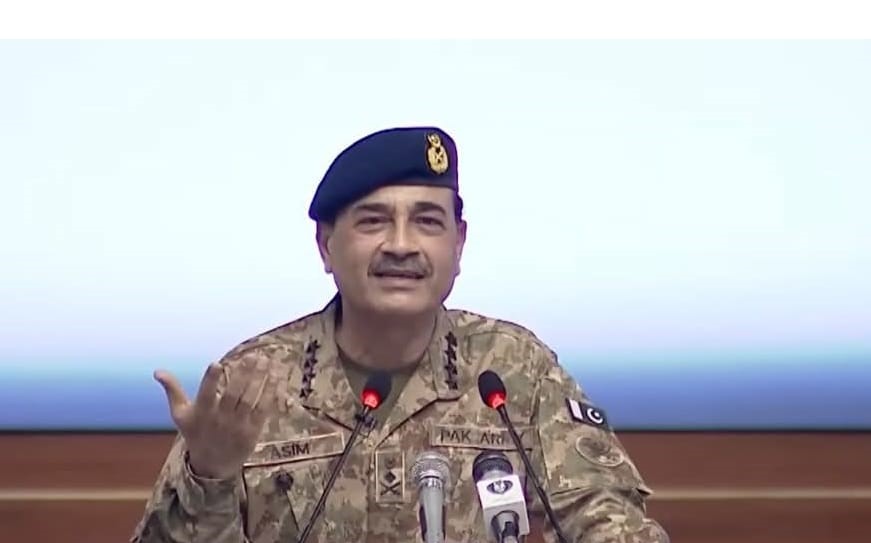
ISLAMABAD (TNS) In Pakistan’s military and political history, only a handful of leaders rise beyond their formal designations to occupy the nation’s collective imagination. Field Marshal General Syed Asim Munir Ahmed Shah is one of those rare figures—yet his story diverges from all who came before him. He is the first serving Army Chief in decades to be elevated to the honorary rank of Field Marshal, joining a list previously reserved only for General Ayub Khan and General Yahya Khan. But unlike his predecessors, this title is not symbolic of personal rule; rather, it represents the nation’s confidence in a leader who stabilized Pakistan at one of the most uncertain periods in its modern history.
The world today is once again drifting toward cold-war polarity. Great powers are regrouping, regions are hardening, and Asia has emerged as a pivotal axis of global realignment. At this critical juncture—stretching from the mountains of Kashmir to the Gulf of Oman, from Kabul to the Arabian Sea—Pakistan’s geopolitical relevance has multiplied. In this expanding shadow of uncertainty, General Asim Munir has become an anchor of continuity, discipline, and balance.
Born in 1968 into a respected Syed family in Rawalpindi, Asim Munir’s upbringing was shaped by the rhythms of military life in Mangla and Faisalabad. He earned his commission from the Officers Training School in 1986, joining the historic Frontier Force Regiment. Early in his career, he spent formative years in Saudi Arabia training the Royal Guards—an assignment that quietly laid the foundation for the deep defence and diplomatic partnerships that today bind Pakistan with the Gulf states.
General Munir first gained national attention not through politics, but through integrity. In 2017, while serving as commander of the Force Command Northern Areas, he ordered the arrest of an influential political figure’s son who had illegally entered a restricted military zone. The decision reflected his uncompromising belief in legality over influence. A year later, he became Director General of the ISI. His tenure was short, politically turbulent, and marked by tensions with the newly elected Imran Khan government. Reports suggested he pursued sensitive matters involving the premier’s inner circle—a move that cost him his position but strengthened his image as a principled officer who did not bow to political pressures.
The institution, however, recognized his capability. He was entrusted with commanding the Gujranwala Corps and later appointed Quartermaster General—key roles that ensured his seat at the senior-most decision-making table.
His appointment as Army Chief in November 2022 came at a moment of profound national fragility. Political polarization was at its peak, the economy was collapsing, and terrorism was resurging. Some political factions rejected his elevation, branding it partisan. The events of the following years would disprove that narrative entirely.
When violent mobs attacked military installations on 9 May 2023 after the arrest of Imran Khan, General Munir faced a defining choice: assert direct military dominance or uphold constitutional order by letting civilian institutions lead. He chose the latter. The military’s response was firm yet restrained—sending a clear signal that the Army would protect itself and the state, but would not re-enter the political arena. This approach redefined civil-military dynamics in Pakistan.
As terrorism re-emerged in the wake of the Taliban takeover of Afghanistan, General Munir recalibrated Pakistan’s security doctrine. He drew two red lines: no militant group would operate on Pakistani soil, and no one would use Pakistan to destabilize Afghanistan. When dialogue with the Afghan Taliban failed, intelligence-based operations were launched in Khyber Pakhtunkhwa and Balochistan. By 2024–25, terrorism had significantly declined, reflecting a sharp resurgence of operational efficiency.
But perhaps his most transformative insight was recognizing that economic instability—not militancy—was Pakistan’s gravest existential threat. This strategic diagnosis led to the creation of the Special Investment Facilitation Council (SIFC)—a unique civil-military platform designed to revive investor confidence and fast-track foreign capital. Under General Munir’s stewardship, Pakistan secured unprecedented investment commitments from Saudi Arabia, the UAE, Qatar, China, and Türkiye. Projects in minerals, agriculture, IT, and energy began to move after years of stagnation. Global lenders and rating agencies cautiously upgraded Pakistan’s outlook—crediting the institutional stability SIFC delivered.
In foreign affairs, General Munir revived attention to Kashmir, strengthened Pakistan–China ties, reinvigorated CPEC’s second phase, and rebalanced relations with Washington—neither confrontational nor compliant, but pragmatic and sovereign.
In 2025, the Parliament and government jointly awarded him the rank of Field Marshal—a rare national endorsement, and a recognition of his ability to unite the armed forces, steer clear of political entanglement, and modernize Pakistan’s security and economic architecture simultaneously.
Field Marshal Asim Munir embodies a new model of Pakistani leadership—quiet, disciplined, strategic, and deeply rooted in institutional loyalty rather than personal ambition. Under his watch, Pakistan has regained a sense of direction, self-belief, and geopolitical relevance.
As the global order shifts, Pakistan finds itself once again acknowledged in Riyadh, Beijing, Washington, Ankara, Doha, and beyond. Behind this reclaimed respect is a commander who restored national confidence—not through grand speeches or political theatrics, but through discipline, clarity, and the unspoken power of restraint.
Long live Field Marshal General Syed Asim Munir Ahmed Shah.
Long live the Pakistan Army.
Long live Pakistan.