
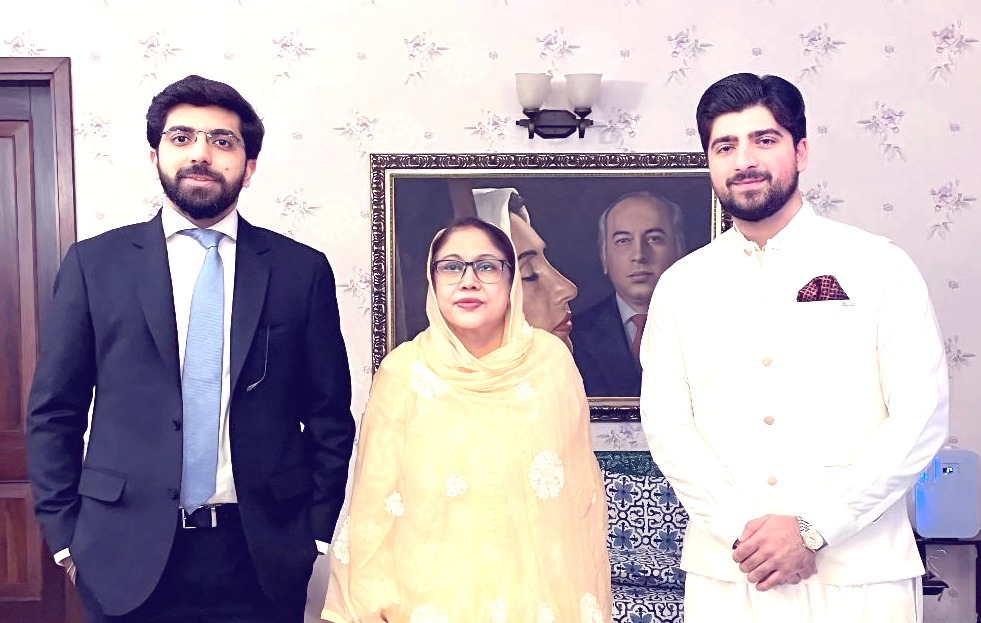
ISLAMABAD (TNS) Faryal Talpur, The Iron Lady Who Stood Firm in the Face of Challenges Malik Saahil Sarmad Khan Many predicted her political eclipse. Investigations, incarceration, and sustained criticism were expected to erode her relevance and authority. They did not. Today, Faryal Talpur remains firmly entrenched within the Pakistan Peoples Party, resilient, influential, and structurally indispensable.
In Pakistan’s unforgiving political landscape, survival is never accidental. It is earned through patience, strategic intelligence, organizational discipline, and the rare ability to remain composed under pressure. Faryal Talpur’s political journey exemplifies this form of leadership, quiet but enduring, rooted not in spectacle or populist rhetoric, but in permanence, trust, and institutional control.
Often reduced to political lineage, Talpur has consistently demonstrated electoral strength in her own right. From local government leadership in Nawabshah to successive victories in Larkana, she converted legacy into votes. In Sindh, where political loyalty is tested relentlessly at the ballot box, her sustained success reflects organizational depth, grassroots authority, and disciplined political management rather than symbolism alone.
Her national prominence intensified following the assassination of Benazir Bhutto, a moment of existential uncertainty for the PPP. As the party stood at risk of fragmentation, Faryal Talpur emerged as a stabilizing force. Entrusted by President Asif Ali Zardari with safeguarding the Bhutto political legacy, she played a pivotal role in managing the transition, maintaining internal cohesion, and ensuring continuity. The responsibility demanded discretion, loyalty, and resolve qualities she exercised without theatrics or public dramatization.
Political pressure inevitably followed. When electoral competition failed to marginalize her, accountability mechanisms became the preferred instrument. Arrests, prolonged investigations, and media trials were deployed to redefine her image and weaken her standing. Talpur responded with restraint, choosing courts over confrontation, patience over provocation. She endured incarceration, secured legal relief, and returned to parliament without apology or retreat. That outcome unsettled her critics far more than open defiance ever could.
Her organizational acumen was most visibly demonstrated beyond Sindh, particularly in Azad Jammu and Kashmir. Under the joint political stewardship of Bibi Faryal Talpur and Chaudhry Riaz, the PPP underwent deep structural reforms. The results were historic. The party expanded its parliamentary strength dramatically, transforming from a marginal presence into the ruling party and successfully installing a committed Jiyala as Prime Minister of Azad Kashmir.
This achievement was not an accident of circumstance, but the product of deliberate restructuring—disciplined candidate selection, reactivation of dormant workers, and the restoration of confidence among local leadership. These reforms revived the PPP’s relevance in Kashmir and reaffirmed a long-standing political truth: when organized seriously, the Pakistan Peoples Party remains an electorally formidable force.
As President of the PPP Women’s Wing, Talpur’s approach to empowerment has remained substantive rather than symbolic. Her advocacy for women-centric legislation, welfare initiatives for widows and working women, and economic inclusion programs reflects a belief that empowerment must be institutional, sustainable, and measurable, not performative.
Critics often accuse her of exercising influence behind the scenes. Yet informal authority only exists where formal control remains intact. Sindh continues to be the PPP’s political stronghold because its machinery functions with discipline and coherence. Faryal Talpur’s influence within that structure is neither accidental nor invisible; it is structural.
Today, a similar demand is emerging from Central Punjab. Party workers, silent stakeholders, and seasoned ticket holders, many disillusioned with fragmented and non-serious provincial leadership, are increasingly calling for Bibi Faryal Talpur and her trusted team to oversee organizational restructuring in Punjab. They believe that the model successfully applied in Sindh and Kashmir can revive the party’s fortunes in Central Punjab, where organizational decay has long undermined electoral prospects.
What distinguishes Faryal Talpur is her relative distance from factional politics. She is widely trusted across internal divides. Workers believe that under her leadership, responsibilities would be assigned on merit, experience, and local credibility—restoring confidence, discipline, and political momentum. Faryal Talpur does not chase headlines or court controversy. She absorbs pressure and remains. In a political culture that often rewards noise and consumes the fragile, her endurance, discipline, and organizational clarity explain her power far more convincingly than rhetoric ever could.