

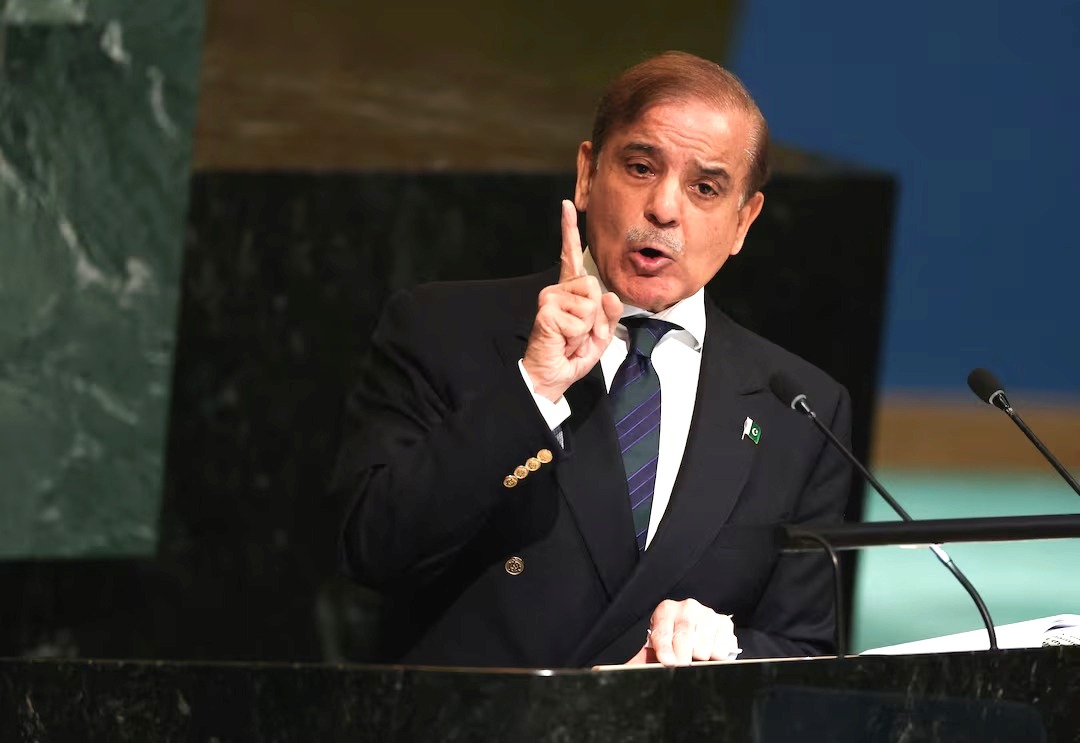
ISLAMABAD (TNS) Prime Minister Muhammad Shahbaz Sharif has vowed to achieve a decisive victory against terrorism and said that the threat of terrorism will be completely eliminated. He said this at a meeting on law and order in Pakistan. Prime Minister Shehbaz Sharif says that the entire nation is with its brave armed forces, and no harm will be done to Pakistan’s sovereignty, integrity, and dignity. The support of the Khawarij by neighboring countries is regrettable. Field Marshal is leading the army in the war against terrorism. It may be recalled that Prime Minister Muhammad Shahbaz Sharif had said in Ashgabat, the capital of Turkmenistan, that a new threat of terrorism is emerging from Afghan soil, and the international community should press the Afghan government to fulfill its responsibilities. Pakistan’s counter-terrorism strategy is very comprehensive, which includes increasing cooperation and coordination among all national institutions. Strengthening the rule of law and maintaining peace and order. Taking steps for the economic well-being of the people so that the tendency to join terrorist groups can be stopped. Increasing cooperation with the Afghan government in the joint struggle against terrorism. Playing Pakistan’s role in the global struggle against terrorism. The International Crisis Group (ICG) says that Pakistan is the most affected country since the Taliban took power in Afghanistan in 2021. According to the organization, although a ceasefire is currently in place, Pakistan could attack again if militant operations continue. The Brussels-based independent and non-profit think tank of international figures said in its latest report that relations between the two countries have deteriorated sharply, the main reason for which is the Afghan Taliban’s refusal to take action against the Tehreek-e-Taliban Pakistan. Violence in Pakistan has increased significantly since 2022. In 2025 alone, militants martyred more than 600 Pakistani army and police personnel, most of whom died in Khyber Pakhtunkhwa and Balochistan, provinces bordering Afghanistan.

Pakistan blames the attacks on the outlawed TTP and Baloch militant groups, which it says are supported by Pakistan’s rival India, according to evidence. The Brussels-based think tank said Pakistan could once again launch operations in Afghanistan if militant attacks continue. The report said UN monitors say the TTP is supported by the Taliban, but the Taliban deny this, claiming that Pakistani militants are not present in Afghanistan, while calling the violence an internal Pakistani problem. Pakistan launched cross-border airstrikes after the TTP killed 11 Pakistani soldiers in an attack on the western border on October 8, including the first attack on Kabul, apparently targeting TTP chief Noor Wali Mehsud.
Afghanistan responded by attacking Pakistani military installations. The ongoing clashes have resulted in casualties on both sides, both military and civilian. The report warned that Pakistan could respond strongly if another attack is traced to Afghanistan. Although the Taliban government is militarily weak, its response could be deadly. Kabul claims to have missiles that can reach Pakistani cities, the use of which would be expected to provoke a much harsher response from Pakistan. Pakistan’s foreign relations in South Asia have become quite complicated. After short wars with both Afghanistan and India in 2025, the temporary peace between Pakistan and its two neighbors cannot be maintained in the event of a major militant attack.
The report lists 10 conflicts to watch for 2026 as Afghanistan-Pakistan, Myanmar, Israel-US vs. Iran, Israel-Palestine, Syria, Ukraine, Mali-Burkina Faso, Ethiopia-Eritrea, Sudan, and Venezuela.
According to the report, the world had already entered a dangerous period before Donald Trump returned to the White House. So far, his second term has accelerated things rather than slowed them down. 2025 has proven to be a bloody year, and 2026 shows no signs of getting much better. Last year, the British Broadcasting Corporation claimed that 500,000 weapons acquired by the Taliban in Afghanistan had been lost, sold, or smuggled to militant groups, saying that the Taliban had taken control of about 1 million weapons and military equipment after regaining control of Afghanistan in 2021. When the Taliban advanced in Afghanistan in 2021, many Afghan soldiers surrendered or fled, abandoning their weapons and vehicles; some of the equipment was left behind by US forces. The stockpile of these weapons included US-made weapons, such as M4 and M16 rifles, as well as other old weapons in Afghan possession that were left there after decades of fighting. At a closed-door meeting of the UN Security Council sanctions committee in Doha, the Taliban admitted that at least half of this equipment had now disappeared. The UN had said in a report that the Tehreek-e-Taliban Pakistan, the Islamic Movement of Uzbekistan, the East Turkestan Islamic Movement, and Yemen’s Al-Qaeda-affiliated groups, including the Ansarullah movement, are gaining access to weapons captured by the Taliban or buying them on the black market. A 2023 United Nations report said that the Taliban allowed local commanders to keep 20 percent of seized American weapons, and as a result, the black market is flourishing. These commanders are affiliated with the Taliban but often enjoy autonomy in their own areas. The United Nations noted that “there is a widespread practice of gifting weapons among local commanders and fighters to consolidate power, and the black market is still a rich source of weapons for the Taliban.” It said that there was an open arms market there for a year after the Taliban took over, but it was then driven underground through the messaging service WhatsApp, where wealthy individuals and local commanders trade new weapons and use American weapons and equipment, most of which are abandoned by US-backed forces. SIGAR, the US agency overseeing Afghanistan’s reconstruction projects, the number of weapons recorded by the US is lower than the number recorded, but a 2022 report acknowledged that it had failed to obtain accurate information, citing that the equipment was funded and supplied by various US departments and organizations. SIGAR added that there were flaws and problems in the Defense Department’s methodology for tracking equipment in Afghanistan for more than a decade. The statement also criticized the State Department, saying that “the state provided us with limited, inaccurate, and untimely information about the equipment and funds it left behind.” The department denied that this was the case. US President Donald Trump has repeatedly said that he would withdraw weapons from Afghanistan, saying that $85 billion worth of modern weapons remained there. Afghanistan is one of the world’s largest sellers of military equipment. After the withdrawal in 2021, the Pentagon claimed that the US equipment in Afghanistan had become ineffective, but since then, the Taliban have built a capable army using American weapons. Warehouses in Kandahar contain hundreds of unused Humvees, mine-resistant armored vehicles (MRAPs), and Black Hawk helicopters.Earlier, an investigation by UN monitoring teams revealed that some of these weapons have already reached the outlawed Tehreek-e-Taliban Pakistan (TTP), which has intensified attacks in Pakistan. The 137-page report was released by the ‘Special Inspector General for Afghanistan Reconstruction’, which details the US plan in Afghanistan for two decades. It has been reported that Congress provided about $144.7 billion for the reconstruction and democratic transition of Afghanistan from 2002 to 2021, but in the end, neither reconstruction nor democratic transition took place. A UN panel has reported that the Afghan Taliban are still providing logistical and operational support to the Tehreek-e-Taliban Pakistan (TTP), while the Washington Post has documented that dozens of US-made weapons are now in the hands of terrorists in Pakistan, who are targeting the state. One reason for the proliferation of weapons is the lack of oversight in Afghanistan since the Taliban takeover. It was said that due to the Taliban takeover, SIGAR did not have the opportunity to inspect any equipment provided to the Afghan National Defense and Security Forces (ANDSF) or facilities built. The US Department of Defense has confirmed that approximately $7.1 billion worth of US-supplied equipment was left behind, including thousands of vehicles, millions of small arms, night vision devices, and more than 160 aircraft. The effects of this transfer are now being felt in Pakistan. According to the Washington Post, at least 63 weapons seized in Pakistan have serial numbers that match those supplied to Afghan forces.
 The Washington Post quoted officials as saying that some of these rifles and carbines are “far better” than those used by TTP fighters before 2021. UN monitoring reports also echo this concern, with the 36th Monitoring Report (2025) estimating that around 6,000 TTP fighters are spread across Afghanistan’s Ghazni, Helmand, Kandahar, Kunar, Uruzgan, and Zabul provinces and share training facilities with al-Qaeda. Speaking to the UN Security Council, Denmark’s deputy permanent representative, Sandra Jensen Landy, said that the TTP is receiving logistical and critical support from authorities in Kabul. UN reports have detailed arrangements by the Taliban for TTP leaders, such as providing them with guesthouses, weapons permits, freedom of movement, and immunity from arrest, which have helped the group gain deeper influence in Afghan territory. The 2025 report also mentions cross-border attacks, including one in South Waziristan that killed 16 Pakistani security personnel. The report also offers a reassessment of the volume of US investment and its ineffectiveness in Afghanistan’s security sector. From 2002 to June 2025, Washington allocated $13.2 billion for the infrastructure, transportation, and equipment of the ANDSF. The US had purchased 96,000 ground vehicles, more than 427,000 weapons, 17,400 night vision devices, and at least 162 aircraft for Afghan forces. By July 2021 (when the Afghan government fell), the Afghan Air Force had 131 operational US-supplied aircraft, almost all of which are now under the control of the Taliban. Another $11.5 billion was spent on building Afghan bases, headquarters, and training facilities, most of which were either. The report concludes that the US’s desire to build a stable and democratic government in Afghanistan was doomed from the start by faulty assumptions and mismatched partnerships. Early US decisions supported “corrupt, rights-abusing powerful individuals,” undermining governance, fueling recruitment by insurgent groups, and ultimately weakening the institutions the US had sought to build. The watchdog estimates that $29 billion was lost to waste, fraud, and corruption. The human cost was far greater, with tens of thousands of Afghans and more than 2,450 US troops killed, yet the Taliban returned to power, now using the same equipment the US had purchased for its rivals. Despite this failure, the United States has remained Afghanistan’s largest donor, providing more than $3.83 billion in humanitarian and development assistance since August 2021, an indication that Washington is still struggling to balance humanitarian responsibilities with security concerns. As SIGAR concludes its mission, this final report provides a sobering warning that the Afghan experience should serve as a cautionary lesson for any future reconstruction of fragile states, a failure whose repercussions are now reshaping the security landscape of the wider region.It should be noted that last year, a report in the American newspaper Washington Post said that the terrorists who attacked the Jafar Express train in Balochistan used weapons left behind after the withdrawal of American forces from Afghanistan. According to the report, an ‘M4A carbine rifle’ made by American manufacturer Colt was found at the site of the attack, with the rifle’s serial number indicating that it was part of billions of dollars’ worth of weapons sent to American forces in Afghanistan, who left most of their equipment behind when they withdrew in 2021. The Washington Post wrote that many of the weapons ended up across the border in Pakistan, in arms markets and in the hands of insurgents, reflecting how the dire consequences of America’s failed war are still being felt years after the fall of Kabul to the Taliban. According to the report, Pakistan is trying to control terrorism in Khyber Pakhtunkhwa and Balochistan, where militants are armed with American weapons and equipment. The Washington Post reported, citing arms dealers, that the original purpose of the American rifles, machine guns, and night vision goggles was to help stabilize Afghanistan, but they are now being used to carry out attacks by the banned Tehreek-e-Taliban Pakistan (TTP) and other groups. “They (the terrorists) have the most advanced American-made weapons,” Ahmed Hussain, a 35-year-old Special Forces constable who was seriously injured in the nighttime attack in Khyber Pakhtunkhwa, told The Washington Post. “They could see us, but we couldn’t see them,” he added. The Washington Post further wrote that in May 2024, Pakistani authorities granted access to documents, under which dozens of American weapons were recovered from the possession of captured or killed terrorists. After months of inquiries, the U.S. military and the Pentagon confirmed to The Post that 63 of the weapons shown to reporters were provided by the U.S. government to the Afghan National Forces, most of which were M16 rifles as well as modern M4 carbines. Officials also showed PVS-14 night vision devices, which are widely used by the U.S. military, but The Washington Post could not independently verify that they were owned by the former U.S. government. The Washington Post wrote that “after the Jafar Express attack, Pakistani authorities provided the serial numbers of three U.S. rifles allegedly used by the attackers.” The newspaper added, citing records obtained through the Freedom of Information Act, that at least two came from U.S. stocks and were provided to Afghan forces. The Pakistani Foreign Office said in a statement in January 2024 that “the presence of advanced American weapons in Afghanistan is a concern for Pakistan’s security.” The Washington Post added that US President Donald Trump threatened to permanently halt aid to Afghanistan if the Taliban did not return the military equipment. Donald Trump had said during the first cabinet meeting in February that we had left billions of dollars worth of equipment, all the latest stuff, and I think we should get the equipment back. According to the Washington Post, his comments revived hopes in Pakistan that the US would move more decisively in response to its military equipment, but most believe it is already too late to stop the flow of illegal weapons.
It should be noted that on March 11, 2024, Balochistan Liberation Army (BLA) terrorists ambushed the Peshawar-bound Jaffar Express carrying 440 passengers and took people hostage, as a result of which the security forces launched an operation that lasted for two days. Director General of the Inter-Services Public Relations (ISPR) of the Pakistan Army, Lieutenant General Ahmed Sharif Chaudhry, had said on March 12 that the Jaffar Express clearance operation had been completed, adding that all 33 terrorists were killed at the scene of the attack. On March 14, when asked about the casualties in the attack on the Jaffar Express, Lieutenant General Ahmed Sharif had said that a total of 26 passengers were martyred in the incident, and 354 hostages were rescued alive. He had said that 18 martyrs belonged to the Army and FC, 3 martyrs belonged to the Railways and other departments, while 5 were civilians.