
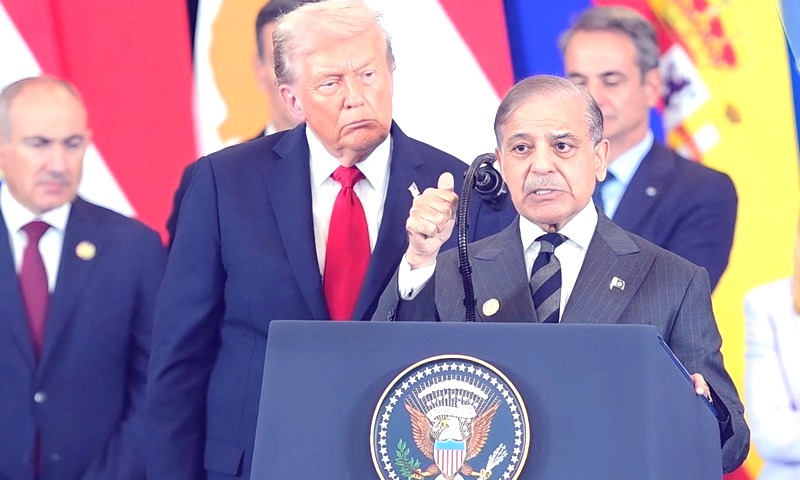
ISLAMABAD (TNS) Pakistan has accepted US President Donald Trump’s invitation to join the Peace Board for lasting peace in Gaza. Pakistan’s strategic autonomy has been further strengthened by joining the Gaza Peace Board, while Turkey and several countries have also agreed to this move. Confirming Pakistan’s decision to join the Gaza Peace Board, the Foreign Office spokesperson said that the decision to join the Peace Board has been taken at the invitation of US President Donald Trump. This move has been taken under the framework of United Nations Security Council Resolution 2803 to support the implementation of the Gaza Peace Plan. Pakistan has expressed the hope that through the establishment of this framework, concrete steps will be taken to implement a permanent ceasefire, increase humanitarian assistance to the Palestinian people, and make possible the reconstruction of Gaza. Pakistan has expressed the expectation that these efforts will also prove to be a positive step towards the realization of the right of the Palestinian people to self-determination, which will lead to the establishment of an independent, sovereign, and contiguous Palestinian State in accordance with United Nations resolutions, based on the 1967 borders and with Jerusalem as its capital. Pakistan has made it clear that it is determined to continue its constructive role as a member of the Peace Board to achieve these goals and alleviate the suffering of Palestinian brothers and sisters. The main objectives of the ‘Peace Board’ include a permanent solution to the Gaza issue in accordance with United Nations Security Council resolutions, a permanent ceasefire, and the reconstruction of Gaza, the protection of Palestinian rights, and the establishment of an independent Palestinian State, as well as ensuring the achievement of lasting peace in the region. Joining the Peace Board is an important step towards stopping the ongoing massacre in Gaza and protecting the rights of the Palestinian people by Islamic countries. It should be noted that despite the ceasefire that came into effect in October last year, Israel has violated it nearly 1,200 times, resulting in the martyrdom of more than 400 Palestinians.

Pakistan’s joining the Peace Board highlights its diplomatic importance, and in the context of the current international divisions and factions, joining such forums has become a necessary step for Pakistan’s foreign policy. Pakistan is among the few countries in the world that have strong relations with all powerful centers such as the United States, China, and Russia, and this is why Pakistan’s role in global affairs is unique and important. By joining the Peace Board, Pakistan will maintain its neutral stance and maintain contacts with all international stakeholders, which will strengthen its strategic autonomy.
Pakistan has always adopted a principled and balanced foreign policy, in which decisions were taken on issues such as China, India, Kashmir, and Palestine, keeping in mind the national interest.
Pakistan has always maintained the principled position of not recognizing Israel, resolving the Palestinian conflict in accordance with UN resolutions, making Al-Quds Sharif the capital of an independent Palestinian state, and protecting the right of self-determination of the people of occupied Kashmir.
According to analysts, ignoring new forums is dangerous for the global importance of any state, while Pakistan has played a positive role through effective measures for international peace and prosperity. This dynamic role is necessary to protect national interests in the context of daily changes in the axis of global power. The government of Pakistan has adopted a clear and unambiguous position regarding its participation in the International Stabilization Force (ISF). The decision to join the International Stabilization Force will take into account Pakistan’s national interest, the UN mandate, and the wishes of the Pakistani and Palestinian people. Establishing any similarity between the Board of Peace and the ISF is illogical and amounts to a misleading attempt by some elements. It should be noted that US President Donald Trump’s special envoy for the Middle East, Steve Witkoff, has announced the start of the second phase of the plan developed for the ongoing ceasefire in Gaza. In his statement released on social media, the special envoy said that President Trump’s 20-point Gaza plan is no longer limited to a ceasefire, but its next phase includes demilitarization, the establishment of an interim technocratic government, and the process of reconstruction. In the second phase, an interim administration will be established to manage Gaza, under which the area will be completely demilitarized, and reconstruction will begin formally. He clarified that the aim of this phase is to disarm unauthorized armed elements in Gaza. The US envoy said that the US expects Hamas to fulfill all its obligations, including the immediate return of the body of the last killed hostage. He warned that if it is not implemented, serious consequences could result. President Trump is officially announcing the second phase of his 20-point plan to end the Gaza conflict. Under this phase, an interim technocratic Palestinian administration will be established, called the National Committee for the Administration of Gaza (NCAG). During the first phase of the ceasefire, extraordinary humanitarian assistance was provided, the ceasefire was maintained, all living hostages were released, and the bodies of 27 of the 28 dead hostages were also returned.
He thanked Egypt, Turkey, and Qatar for their mediation efforts, describing them as very important in this progress.
US President Donald Trump has invited Pakistan to join the “Board of Peace” established for Gaza, which aims to ensure management, peace, and reconstruction after the Gaza war. This international organization is part of Trump’s 20-point peace plan, which is committed to resolving the Gaza conflict as well as dealing with other global conflicts in the future.

The new “Board of Peace” will provide leadership, coordination, and financial resources to countries joining, while a $1 billion contribution from some countries has also been set for a permanent seat. Invitations have also been sent to several countries, including India, Pakistan, Hungary, Vietnam, and Jordan, while some have responded positively and others are taking a cautious approach. According to the White House, the plan will operate under three basic structures, including a central board chaired by President Trump himself. In addition, a committee of Palestinian technocrats has been established to govern Gaza, while a second executive board will play an advisory role. The Gaza issue is no longer just a regional dispute, but a test of global conscience. Initiatives like the Gaza Peace Board can only succeed when they are based on justice. Pakistan has to join this board and not only become an advocate for the Palestinians, but also convince the world powers that peace is possible only when the occupation is ended, and the oppressed get their rights. Hamas lost its leadership in the Gaza war; the organization is fighting for its survival. The current leadership of Hamas knows very well that the entire Gaza Strip has been reduced to ruins due to the war it started. Millions of people have been displaced from their lands. It is also clear that Hamas will not be willing to easily trust any external power. The presence of Pakistan and Turkey in the Peace Board will provide Hamas with an opportunity to trust the leadership of Muslim countries. Instead of making Gaza another testing ground, it will now have to move towards a solid and just solution; history will never forgive those who remained silent on this bloodbath. Lasting peace lies only in the provision of justice and the complete liberation of the Palestinians. Quaid-e-Azam Muhammad Ali Jinnah strongly supported Palestine, saw it as a symbol of justice and Islamic solidarity, opposed partition and the Balfour Declaration, advocated for Arab rights, and established the Palestine Fund, laying the foundation for a principled foreign policy for Pakistan that emphasized supporting the oppressed and opposing injustice. Even today, Pakistan emphasizes supporting an oppressed state. It should be remembered that the two most important parties for the establishment of lasting peace in Gaza are Hamas and Israel, but there are serious reservations from both sides about this proposed board. In the global context, two important strategies are currently under discussion. One option is to boycott any such action that is under the influence of major powers, but the other option is for Muslim countries like Pakistan and Turkey to become part of this platform and fight for the rights of the Palestinians there. Criticizing from outside the field never yields positive results. Therefore, it is important to be present at international forums to stop Israel’s aggressive intentions and not allow the freedom of the Palestinians to be traded in the name of reconstruction. The presence of Pakistan and Turkey on this board can be a guarantee that human rights and Islamic values will be taken into account in the rehabilitation of Gaza, and fair access to aid will be possible. The fact is that Gaza is currently going through the worst humanitarian tragedy in history, where severe cold, rain, and food shortages have made life unbearable. Millions of people are forced to live in the open air, and humanity is suffering. The highest priority at this time should not be politics but humanitarianism. Emergency measures are needed to provide immediate medical assistance, food, and shelter to the victims. At the same time, the main parties in Gaza must be persuaded to agree to a permanent ceasefire guaranteed by world powers. Any attempt at reconstruction without a ceasefire will prove to be a wall of sand. The international community must now move beyond expediency and find a solution that permanently grants the Palestinians the right to live in their own land with dignity and respect. It should be remembered that Quaid-e-Azam saw the Palestinian cause as central to Muslim identity and justice, raised it in the All India Muslim League, and demanded that Britain uphold the Arabs’ promises of self-determination.
Quaid-e-Azam condemned the United Nations Partition Plan and the Balfour Declaration of 1917, calling it unjust and a threat to peace, warning of conflict if implemented.
Quaid-e-Azam pressured the British government, threatened Muslim ministries in India, and advocated internationally for Palestinian rights, considering British pro-Jewish policies as anti-Islamic.
Quaid-e-Azam believed that supporting Palestine was a moral duty, a cornerstone of Pakistan’s identity, and a commitment to supporting the oppressed, not just a political interest.
Quaid-e-Azam had predicted that a state like Israel would become a wedge in the Arab world and a source of conflict in the future, a position Pakistan maintains by not recognizing Israel.
Quaid-e-Azam’s principled stance on Palestine serves as a guiding principle for Pakistan’s foreign policy, which emphasizes solidarity with the Palestinian people and supports an independent Palestinian state with Al-Quds (Jerusalem) as its capital, a policy consistent with his vision.