

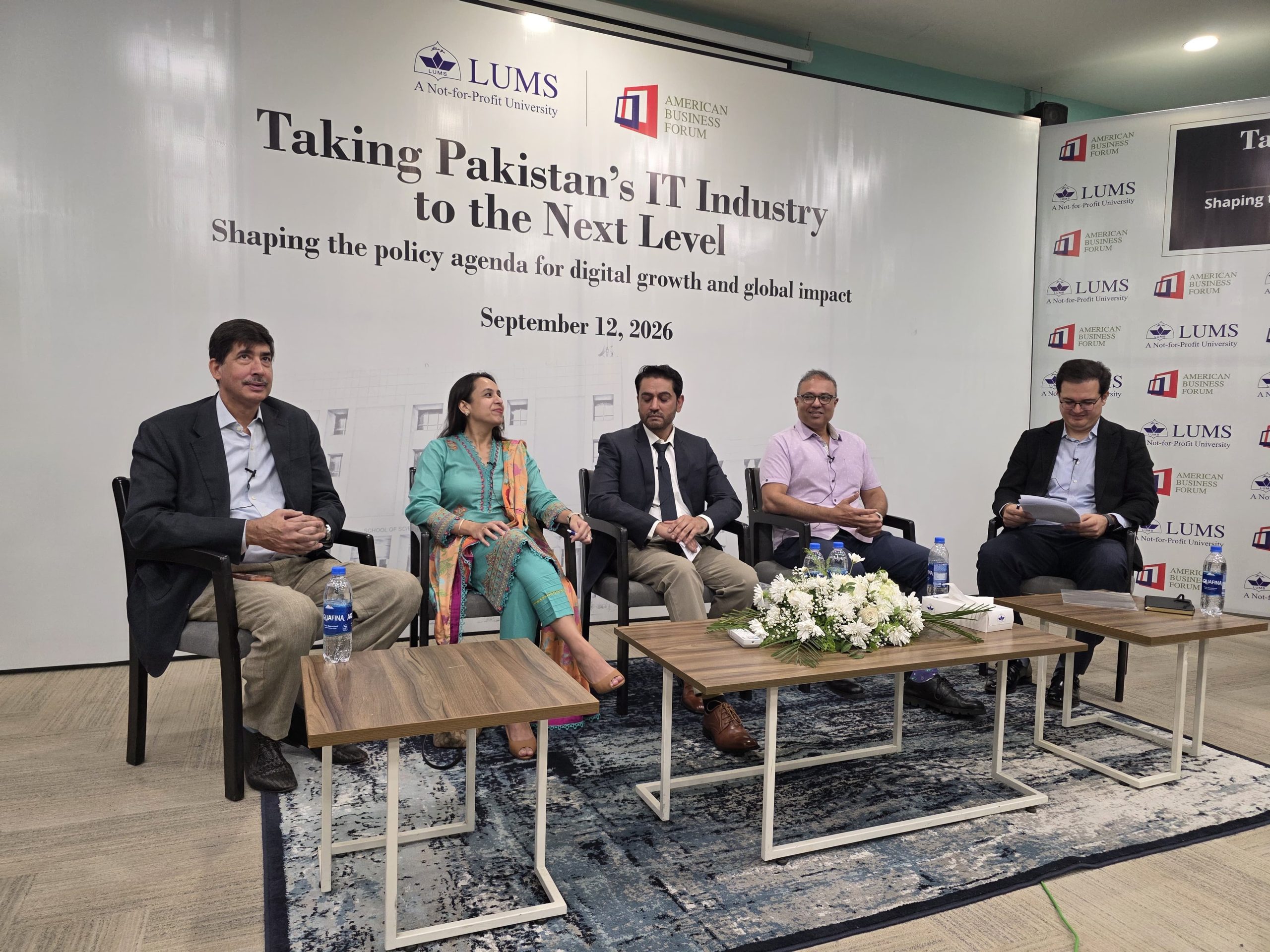
LAHORE (TNS): The government is preparing a concrete plan to ensure zero nationwide internet outages for Pakistan’s IT industry, Federal Minister for IT and Telecommunication Shaza Fatima Khawaja said on Saturday, as government, academia and industry leaders called for urgent reforms to help the country build a globally competitive technology sector.
The minister was speaking at the American Business Forum (ABF) – LUMS Thought Leadership Session, titled “Taking Pakistan’s IT Industry to the Next Level,” held at the Lahore University of Management Sciences (LUMS). The session brought together representatives from the government, technology industry and academia to discuss Pakistan’s IT exports, digital connectivity, skills development, taxation, education, women’s participation and the growth of technology companies.
“We have a very concrete plan which will be announced that there’s going to be a zero outage of internet, at least, for the industry,” Shaza Fatima said, adding that IT industry connections would be whitelisted to ensure uninterrupted connectivity during critical times.
She said the government was also working on fibre connectivity, mobile broadband, spectrum availability and satellite regulations, with an “absolute focus” on achieving Pakistan’s $15 billion IT exports target.
The minister said human resources remained critical to achieving the target, but the availability of employable technology talent was a major challenge.
She disclosed that around 33,000 seventh- and eighth-semester computer science students had taken a national baseline test, but only 0.4 per cent scored above 80 per cent, while around 4 per cent scored above 68 per cent across 10 employability competencies.
“The jobs are there. The opportunity is there. But the right people with the right skills are not there,” she said, stressing the need for structural changes in curricula, teaching and the K-12 education system.
Speaking on the need to build globally competitive Pakistani technology companies, Umair Khan, Co-founder and Chairman of Folio3 and Founding Partner of Mentors Fund, said Pakistan needed to move beyond its dependence on freelancing and develop companies capable of scaling in international markets.
He called for significant improvements in K-12 education, a stable taxation regime and stronger public-private partnerships to create an environment in which technology companies could grow and compete globally.
Ahmed Azmat, Director Operations at Stewart Pakistan, said Pakistan was already producing technology products, although many were being developed for international companies. He said Stewart had been operating in Pakistan for more than 15 years and was continuing to expand, with $1.3 million invested in a new office at the National NSTEP facility.
Dr Hadia Majid, Faculty of Economics at LUMS, highlighted the potential of technology and freelancing to increase women’s participation in the workforce. She said remote work could provide women with greater flexibility and economic agency, while also cautioning that it could reinforce existing social norms surrounding women’s employment.
Dr Syed Sohail H. Naqvi, Chairperson of Knowledge Streams and Director, EdTech, TMC, challenged the idea that universities alone were responsible for Pakistan’s technology skills gap.
“We are saying that the logjam is in the universities, and I’m saying hell no. I’m saying the logjam is in the jobs,” he said, arguing that greater government procurement and more opportunities for local technology companies were needed to create demand for skilled professionals.
The discussion was moderated by Dr. Ihsan Ayyub Qazi, Faculty of Computer Science at LUMS, and brought together government, academia and industry representatives to examine the structural barriers limiting Pakistan’s technology sector and the measures required to expand its global competitiveness.
The speakers stressed that reliable digital connectivity, industry-ready skills, predictable taxation, stronger education systems, government support and greater opportunities for local technology companies would be essential if Pakistan is to translate its growing IT and freelancing potential into sustainable technology businesses and higher exports.