
(Asghar Ali Mubarak).. Pakistan’s counter-terrorism effort is focused on terrorists without discrimination. Terrorists have become the biggest threat to every state today.
No region of the world is far from the reach of these evil elements, terrorists are not only equipped with technology and advanced weapons, but also dull minded human puppets with special ideas are actively working to fulfill the nefarious goals of these terrorists who are innocent. attacking humans,
It is a fact that it is impossible to catch these extremists with violent ideologies, but Pakistan has been playing the role of a frontline state in this war against terrorism for the last decade.
Pakistan has suffered immense loss of life and money in this war, but still it is determined to eradicate terrorism from the world, Pakistan itself is facing terrorism internally and externally.
Anti-terrorism requires trust and joint efforts, Pakistanis have always rejected and defeated terrorism and extremism.
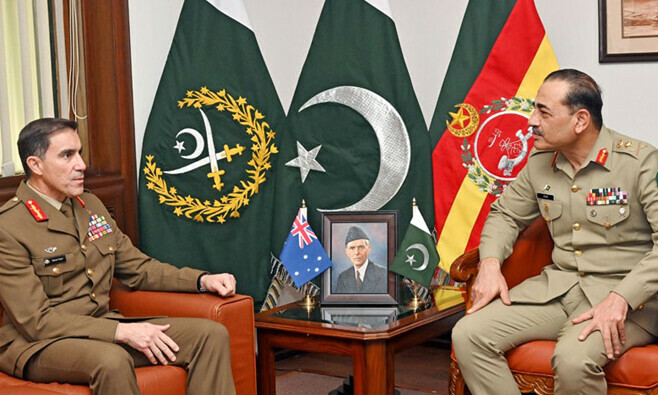
Australian Army Chief Lieutenant General Simon Stuart appreciated Pakistan’s efforts in counter-terrorism and expressed determination to strengthen bilateral defense and security cooperation between the two countries.
Army Chief General Asim Munir was met by Australian Army chief, the visiting army chief appreciated Pakistan’s efforts in counter-terrorism.
According to ISPR, in the meeting, the two army chiefs discussed issues of mutual interest, especially the global and regional situation.
General Syed Asim Munir while appreciating his relations with Australia emphasized the importance of strong bilateral relations for the promotion of common goals of peace and stability.
According to ISPR, issues related to the overall security situation of the region were also discussed during the meeting. The military chiefs reaffirmed their commitment to further strengthen cooperation in defense and security, recognizing the importance of ongoing cooperation for regional and global peace.
Earlier, on his arrival at GHQ, Australian Army Chief Lt. General Simon Stuart was warmly welcomed, armed troops of the Pakistan Army presented him with a guard of honor, the visiting military chief visited the martyrs’ memorial at GHQ and a garland of flowers was also laid.
Incidents of terrorism have been happening in Pakistan for the past several years
But the recent incidents are happening at a time when security forces are focusing on counter-terrorism and intelligence-based operations, intelligence-based operations are being successfully carried out across the country.
Since the Taliban came to power in Afghanistan, the TTP and other extremist organizations have grown stronger in Pakistan. These organizations are continuously carrying out terrorist activities in the border districts. According to data from the Pakistan Institute for Peace Studies (PIPS), 56 people were killed in terrorist incidents across the country in September this year, and 29 of the dead were from law enforcement agencies.
According to the report, various groups claimed responsibility for the attacks, including Islamic extremist organizations such as the Tehreek-e-Taliban Pakistan, the Hafiz Gul Bahadur group and the Khorasan branch of the Islamic State (ISIS).
On the other hand, outlawed separatist organizations like BLA and Baloch Liberation Front were also involved in these attacks.
After the occupation of Afghanistan by the Taliban, the incidents of terrorism have gradually increased in the two provinces of Pakistan, Khyber Pakhtunkhwa and Baluchistan.
A recent report by the Islamabad-based think tank Center for Research and Security Studies has said that during this year, there has been a sharp increase in the number of deaths due to terrorist incidents and anti-terrorist operations by security agencies.
Due to which 90 percent increase was seen in the incidents of violence as a whole.
According to the report, a total of 722 people were killed, including civilians, security personnel and militants, while 615 people were injured in 328 incidents recorded during the third quarter.
About 97 percent of these deaths occurred in Khyber Pakhtunkhwa and Balochistan, which is the highest rate in the last decade.
More than 92 percent of terrorist incidents and security forces operations were also recorded in these two provinces. A review of the literature on extremist organizations also suggests that one of the reasons for the increase in the intensity and number of attacks in the recently merged former tribal districts of Khyber Pakhtunkhwa is the involvement of extremist groups affiliated with TTP’s Hafiz Gul Bahadur and Joint operations with Lashkar-e-Islam of Mangal Bagh are to be done.
Similarly, Balochistan and Karachi have seen an increase in attacks by outlawed separatist organizations, especially the BLA.
In August, the BLA carried out multiple simultaneous attacks in around 10 districts of Balochistan, killing at least 60 people. They included security personnel and laborers from Punjab.
Militant violence in Pakistan has increased since the Taliban took over Afghanistan.
Looking at the security scenario, it seems that this wave of violence will increase further.
After a long trial and error, the Pakistan Army finally launched permanent operations in 2009 to combat the threat of terrorism. These resulted in a marked decline in militant activities and significantly weakened the Tehreek-e-Taliban Pakistan (TTP) and Baloch separatist networks. However, as the violence in Pakistan declined, complacency was confused with the restoration of peace.
The state did not realize the fragility of its achievements against terrorism. Despite the substantial reduction in terrorist attacks across Pakistan during this period, the underlying factors of radicalization and extremism worsened.
The major threat to Pakistan’s internal security after 9/11 was local and posed by the outlawed Tehreek-e-Taliban Pakistan (TTP), anti-Shia Deobandi militant groups and Baloch separatists.
However, the internal threat has now become externally active through the TTP Afghan sanctuaries and both militants and nationalist separatists have transformed into new forms of threats.
The TTP has become strategically mature, politically savvy and more active in its social media propaganda than in the past. By focusing on organizational discipline and the reunification of various ‘jihadi factions’, the TTP has become stronger than ever and is expanding its presence in both Khyber Pakhtunkhwa and Balochistan provinces. The militant threat is more complex as new roles have emerged. The Islamic State of Khorasan (Daesh Khorasan) is now emerging as the second most powerful group undermining Pakistan’s internal security.
It has captured groups like Lashkar-e-Jhangvi and Jundullah. Similarly, the Baloch insurgency has transformed from a tribal movement into an educated, middle-class struggle that supports separatism and is adopting more violent tactics such as suicide attacks. The US withdrawal from Afghanistan and the Taliban’s return to power have further highlighted the extraordinary risks for Pakistan due to the rising tide of violence.
Pakistan’s counter-terrorism and counter-extremism approach has not changed accordingly. In contrast, Pakistan’s then military and political leadership spoke to the TTP immediately after the Taliban takeover to fight the hardline terrorist networks created after the Peshawar Army Public School attack in December 2014. Compromised with national consensus.
The inconclusive peace talks not only allowed some factions of the TTP to return to Pakistan, but also gave them a legal status that has resulted in Pakistan’s counter-terrorism operations being more active.
In the absence of an international consensus to fight terrorism in Afghanistan, Pakistan should work with the relevant regional countries to prevent countries like China, Iran, Russia and the Central Asian Republic from increasing the threat of terrorism from Afghanistan. But be equally concerned.
Pakistan should reassess the current threat landscape before revising its counter-terrorism and extremism framework.
Given the rapidly changing security landscape in Pakistan, it seems likely that the wave of terrorism will continue here and the state will have to adopt a long-term approach to reduce the appeal of violent means to bring about societal change. The United Nations has acknowledged the efforts of the Pakistani government against elements involved in terrorism
A report issued by the UN’s counter-terrorism watchdog admitted that Pakistan is ‘taking action against wanted persons and properties in addition to arresting those who finance terrorism.
According to the United Nations organization, the workforce of TTP terrorists consists of 2,500 and 6,000 members.
The ‘reunification of TTP splinter groups’ in Afghanistan is a cause for concern, including an alliance of 5 groups including Shahryar Mehsud Group, Jamaat-ul-Ahrar, Hizb-ul-Ahrar, Amjad Farooqui and former Lashkar-e-Jhangvi Usman Saifullah group.
The United Nations warned that the alliance of the aforementioned groups not only “increased the threat of terrorism” within Pakistan, but also posed a threat to the entire region since the TTP’s rise to power and the resulting An increase in attacks has also been seen. It should be remembered that Pakistan submitted a dossier related to India’s funding to TTP and Jamaat-ul-Ahrar to UN Secretary General Antonio Guterres.
Both terror groups have been labeled as terrorists by the Security Council Committee. After handing over the dossier to the UN Under-Secretary General for Counter-Terrorism, Pakistan’s Permanent Representative to the United Nations said that India is sponsoring terrorism in Pakistan and the region and wants to paralyze the Pakistani economy.
He had said that we have urged the Secretary General to play a role in forcing India to stop its terrorist and subversive campaign against Pakistan.
Regarding the dossier, it was said that ‘since 2001, Pakistan has faced terrorist attacks on its soil, as a result of which, Pakistan has been suffering continuous losses from Indian-sponsored terrorism directly across the border.
India carried out false flag operations in Occupied Kashmir and inside its own country to defame Pakistan, that veil has been lifted and the world can see the real face of India which is India’s long state terrorism in Occupied Kashmir and destabilization of Pakistan. for the efforts of state-sponsored terrorism
The undisputed and well-known face of India’s state terrorism is Commander Kulbhushan Yadav, who was arrested red-handed in March 2016. The world is also aware of the RSS-BJP’s ‘worst terror’ against Muslims within India and against Pakistan.
On August 5, 2019, when India revoked Article 370 and revoked the special status of Occupied Jammu and Kashmir, India received a very negative response in the press since then.
The issue was well supported by the Pakistani government and raised on various international forums, but when this dossier came out, it was the vindication of what Pakistan had been saying for a long time, with Indian state support. All the evidences of terrorism in Pakistan were presented
Despite Indian efforts, this dossier was taken very seriously by the international community.
While appreciating the role of Pakistan and Pakistan Army in the war against terrorism, America has also said that the role of Pakistan Army against terrorism is exemplary.
The United States will work with Pakistan to establish peace in the region. The United States and Pakistan said in a joint statement on May 13, 2024 that the two countries will work together to counter Daesh Khorasan, Tehreek-e-Taliban Pakistan (TTP) and other terrorist organizations. The partnership between the two will promote security in the region.
High-ranking officials of the United States and Pakistan emphasized the importance of extensive cooperation and capacity building in the field of counter-terrorism.
This includes the exchange of technical expertise and best practices, investigative and prosecutorial assistance, provision of border security infrastructure and training. Since the last counter-terrorism dialogue between the US and Pakistan in March 2023, more than three hundred police and training of ‘front line responders’ is also included.
Multilateral linkages such as the United Nations and the Global Counter-Terrorism Forum will be strengthened.
The governments of the United States and Pakistan committed to increasing communication on these issues and continuing to work together to detect and prevent violent extremism through a whole-of-government approach.