

ISLAMABAD (TNS) Ten Days of Mercy for All Worlds Hazrat Muhammad (PBUH) is a message of love, devotion and mercy. This year’s conference theme is “State Responsibilities in the Effective Use of Social Media in Education and Training, in the Light of the Biography of the Prophet (PBUH)”.
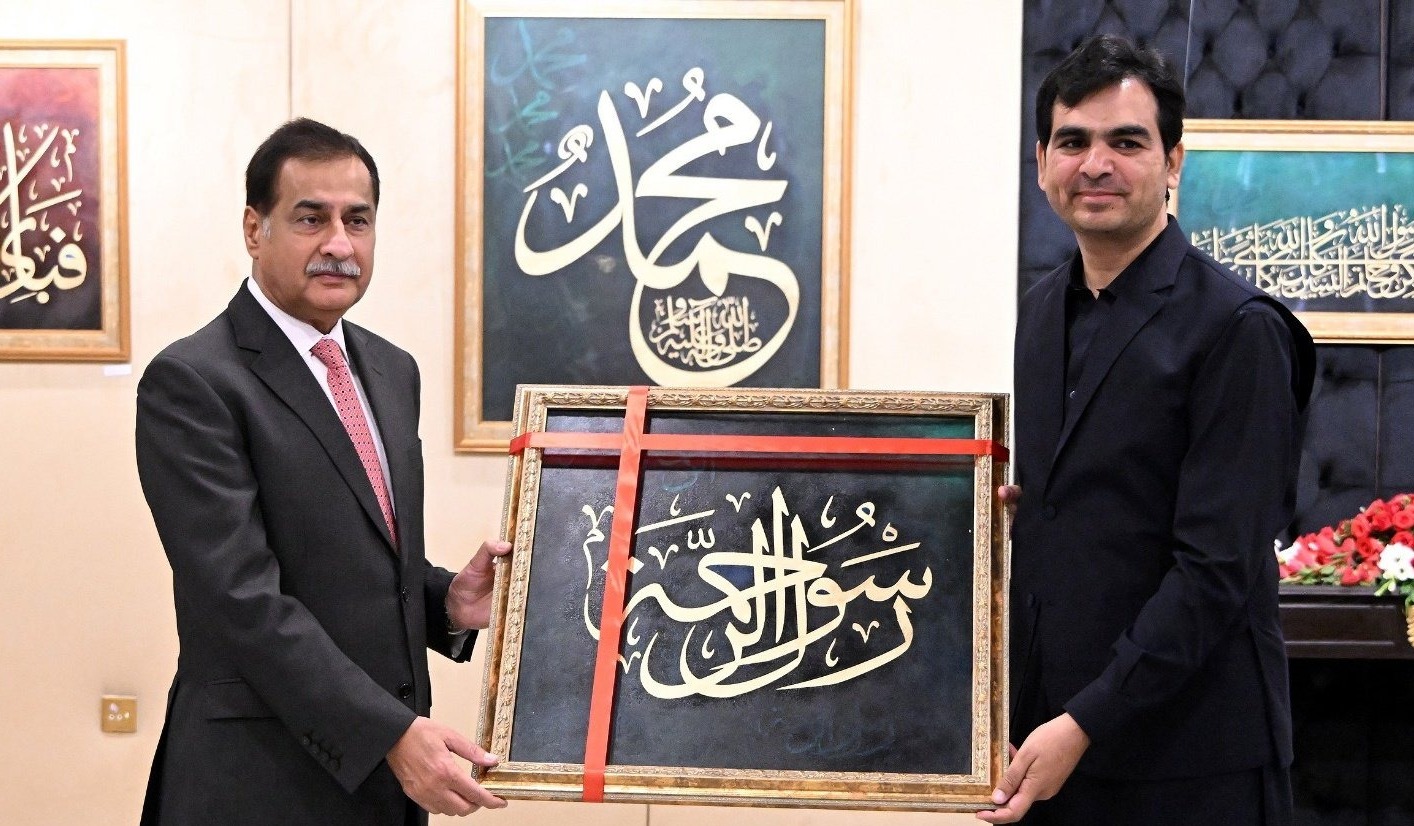
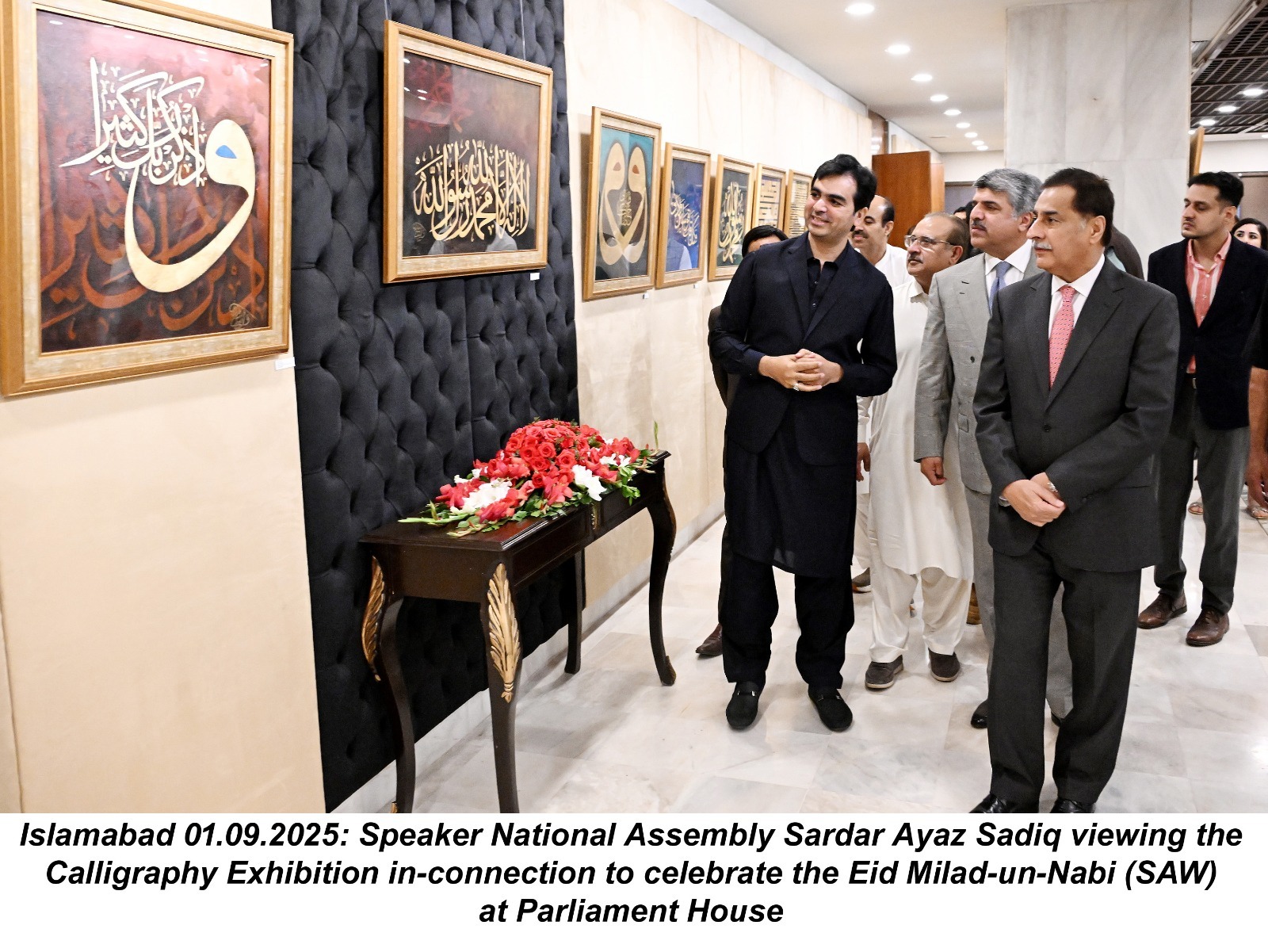
An exhibition of inspirational calligraphy artworks was organized in the National Assembly on the occasion of the blessed month of Rabi’ al-Awwal and the arrival of 1500 years since the birth of Hazrat Muhammad Mustafa (PBUH). These artworks present a glimpse of the blessed biography of the Holy Prophet (PBUH) and the glorious aspects of Islamic history. Speaker of the National Assembly Sardar Ayaz Sadiq said on this occasion that the Holy Personality of Hazrat Muhammad (PBUH) is a source of mercy and guidance for the entire humanity. Events based on the Biography of the Prophet (PBUH) refresh faith and are a beacon of light for the younger generation. In this way The spiritual and intellectual activities of the National Assembly promote unity, solidarity and brotherhood among the Muslim Ummah. Organizing such events in the National Assembly not only highlights religious and spiritual values but also plays a key role in promoting peace, brotherhood and religious harmony in the society. Speaker National Assembly Sardar Ayaz Sadiq inaugurated the exhibition at Parliament House. During the exhibition, renowned calligrapher Wasil Shahid briefed the Speaker National Assembly about the masterpieces of art and calligraphy exhibited in the exhibition. The event was attended by Deputy Speaker National Assembly Syed Ghulam Mustafa Shah, Member National Assembly Ijaz Jakhrani, Syed Hafeezuddin, people of different schools of thought and a large number of officers of the National Assembly Secretariat.
 The participants of the event described the exhibition as an excellent effort to highlight aspects of the life of the Holy Prophet (PBUH).Islamic teachings advocate truthfulness, honesty, respect, confidentiality, and moderation on social media, emphasizing that users use their influence for good and avoid slander, misinformation, and excessive use. From a state perspective, responsibilities include promoting a safe online environment, promoting ethical digital citizenship, preventing the spread of harmful content, and ensuring that online discourse is in the public interest while respecting the rights to freedom of expression and privacy. Social media is a double-edged sword that can both benefit and harm a person. What is good? What is evil? The standard of good or evil is Sharia: whatever Allah and His Messenger (peace be upon him) say is good, and whatever Allah and His Messenger (peace be upon him) say is evil, is certainly evil. According to Sharia, the criterion of good and evil is “taqwa.” The meaning of Taqwa is “to obey and obey the command of Allah, to avoid violating the command of Allah (piety), to protect and preserve the command of Allah, and to fear the bad consequences of violating the command of Allah.” This is called the “limits of Allah.” There is no doubt that social media has brought the longest terrestrial distances, even the east and west, the north and south, from the earth to space, to the fingertips of the human hand. The walls that had been erected between humans spread across the deep seas and the sky-high mountains, islands and continents, have been demolished by this invention and invention of the human mind. Not only this, but in the present era, social media has had a huge impact on civilization and culture, while our scientific and cultural heritage has also left deep impressions on our literary and literary literature. There is no doubt that social media has affected and destroyed the religious, moral and social values of the nation as much as anything else. There was a time when people like us in society, living a life of distance from religion, used to change the direction of their lives one day at the voice of their own conscience and become good and virtuous Muslims. But under the influence of the misuse of social media, this thing is now completely missing in our society. Young boys and girls are either completely indifferent and alienated from religion, morality and the purity of their character, or if they do have some so-called connection with religion, morality and their character and actions, the negative and misuse of social media is a very serious obstacle in the way of their having any meaningful and solid connection with religion and morality. For this reason, society has reached a point of destruction and ruin from which it seems beyond the power of human reason and insight to bring it back. We still have time to stand up against the moral evils of social media that have been embedded in us and stop this ongoing series of moral and religious destruction of our generations. This is possible only if we firmly establish “piety” in relation to mobile and social media, otherwise “what the eye sees cannot reach the lips.” If our approach to using social media does not change and reform and does not obey the commands of Allah and Hazrat Muhammad (peace be upon him), then the moral, religious, and cultural destruction that will occur will be severe.
 The Quran and Hadith strongly condemn indecency and obscenity. In Surah An-Nur, Allah says, “Indeed, those who wish that immorality and obscenity should be common among the believers (in the Muslim community), for them is a painful punishment in this world and the Hereafter.” In a hadith, the Prophet Muhammad (peace be upon him) described the exemplary fate of those who transgressed the “limits of Allah” in these words: “I know those people from my Ummah who will come to the Judgment Day with good deeds equal to Mount Tihama, but Allah will not even look at their good deeds and will scatter their good deeds like dust.” The companions asked, “O Messenger of Allah (peace be upon him) who will be those people?” The Prophet Muhammad (peace be upon him) said, “These will be the good deeds who used to transgress the limits of Allah in their solitude.” (Sunan Ibn Majah) Consider, today every person, regardless of age, gender, knowledge, lineage, position and position, violates the limits of Allah through social media, there is no need to describe it in words. It is not that we are not aware of the wrong, negative use of social media and its worst consequences, we certainly do, everyone knows and understands that social media has affected and defeated and destroyed the religious, moral and social values of the nation, like nothing else has done so much.New digital media are incompatible with Islamic practices. In Saudi Arabia, Grand Mufti Abdulaziz Al-Sheikh has taken a critical stance against social media platforms like Facebook and Twitter, saying they spread lies and can destroy relationships that are recognized in the real world. Some Islamic countries have issued fatwas against the use of social media like Twitter for being incompatible with religious law. Although some Islamic religious elites have advised their followers not to use social media platforms, the vast majority of scholars and preachers take advantage of this success and increase their loyalty to social media in engaging with society. During the formation of the Internet, there were websites like Islam Online that served as a one-stop shop for sacred information and complete services for the Muslim Ummah. The rise of digital platforms through the second era of the internet has led to the practice of discouraging the monopoly of religious orthodoxy. Allah Almighty said: “Tell the believing men to lower their gaze and guard their private parts, that will be a great purification for them, and Allah is well-acquainted with what they do [Surah No. 7]
Men and women alike are also common in violating this refined manner by a gentleman. Negative associations on the unbridled media are made in the name of “freedom of expression”,
Hazrat Abu Hurairah (may Allah be pleased with him) narrated that the Messenger of Allah (peace and blessings of Allah be upon him) said: “Whoever believes in Allah and the Last Day, let him speak good or remain silent. Encouraging people to abstain from the right to complete anything in the name of freedom of expression, which only ends when people start talking, is also a way of showing trust in Muslims. The trend of spreading illegal images on our social media has not stopped, but rather it has become a threat to the minds of the Muslim Ummah, along with the good qualities and manners described in the Hadith, which are attractive in listening to these letters or encouraging their followers to do so.
We should be conscious of the things we write online so as not to allow it. Today, the Western media has fueled the movement against terrorism by calling Muslims “terrorists”, “fundamentalists”, “hardline Islamists”. This is all a false belief about Islam which is due to the bias and ignorance of the media. Allah Almighty strongly dislikes the person who uses immoral language or bad language. Ibn Umar (may Allah be pleased with him) narrated that the Messenger of Allah (peace and blessings of Allah be upon him) said: “The best friend in the sight of Allah is the one who is the best to his friends, and the best neighbor in the sight of Allah is the one who is the best to his neighbors.” Arguments on social media are usually frequent, but it also benefits Muslims in playing a role in their lives.