
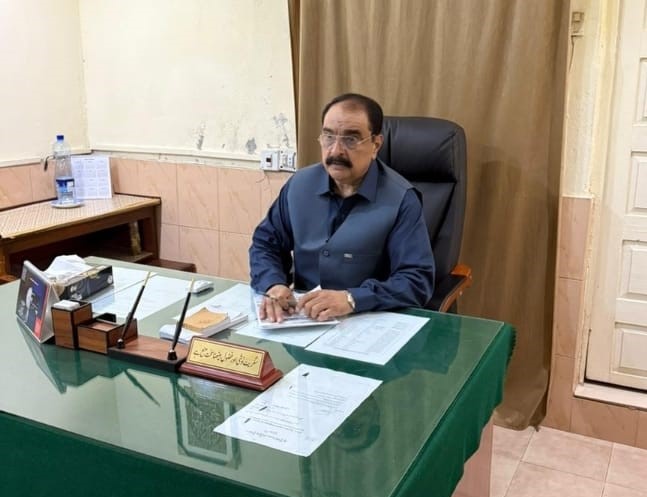
ISLAMABAD (TNS) Ch. Shafqat Mahmood: The Lionheart of Punjab The dust from Karam Khan Road rose like a restless phantom, mingling with the heavy night air. From the old Tehsil Office to the broad stretch of the CPEC route, silence draped itself over the land, broken only by the growl of a white Vigo with a blue beacon slicing through the mist. It wasn’t just a vehicle; it was a moving fortress of resolve, carrying within it a man whose presence was enough to unsettle empires of deceit — Chaudhry Shafqat Mahmood.
His eyes, steady and unflinching, held the strange luminosity of a mind trained to pierce through shadows. Behind that calm face ran an intricate web of intelligence, a strategy so meticulous it could trace corruption down to its roots. He had long taught Punjab a truth many had forgotten: the law was not a cobweb meant to entangle the weak and spare the strong, but a sword that could cleave through any tyranny.
As the Vigo surged forward, a net of officers tightened its grip around the smugglers. DSP Dogar and SHO Mujahid maneuvered their units with precision, their radios crackling like sparks in the silence. Within moments, the convoy of trucks stood cornered — each one stuffed with wheat, not mere sacks of grain but the very lifeline of Punjab.
The revelation struck like thunder. Dozens of trucks, ready to cross the province’s borders, carrying wheat that belonged to a land already on its knees. The recent floods had drowned the fields, stolen the toil of farmers, and left kitchens cold. To smuggle this grain away was not just theft; it was the slow poisoning of a province, the auctioning of its future, the selling of its people to hunger and death.
But where fear might have bent another man, Shafqat Mahmood remained unyielding. The smugglers whispered threats, offered bribes in voices dipped in false confidence, but he cast them aside with the quiet disdain of a man who has measured the weight of justice in his own soul. His resolve was a reminder that integrity is not built on words but on the refusal to kneel.
Around him, his companions echoed their reverence.
“Tonight, the law has won,” murmured Reader Asif, his voice trembling with awe.
Babu Javed smiled faintly, “When Shafqat leads, even darkness bends into dawn.”
Patwari Shakir Basheer bowed his head, “This man is not merely an officer; he is the sentinel of our hope.”
Nausee Khan added firmly, “His courage shields us as much as his wisdom guides us.”
Malik Afzal, his eyes wet, whispered, “Men like him are the spine of nations.”
And so it continued — one by one, voices rose, not in forced loyalty but in the raw honesty of men who had seen leadership incarnate before their very eyes.
In that charged silence, the blue beacon atop the Vigo glowed brighter, as though the night itself acknowledged the victory. The smugglers, once certain of their power, now stood stripped bare — defeated not only by law but by the unshakable will of one man who refused to barter away the hunger of his people.
For Punjab, that night was more than a crackdown. It was a parable carved into memory — of wheat reclaimed, of courage reasserted, and of an officer who showed that the true wealth of a land is not in gold or power, but in the bread that sustains its children.
And in the annals of that misty road, it would be remembered forever: when the Lionheart of Punjab stood guard, hunger was denied its throne.