

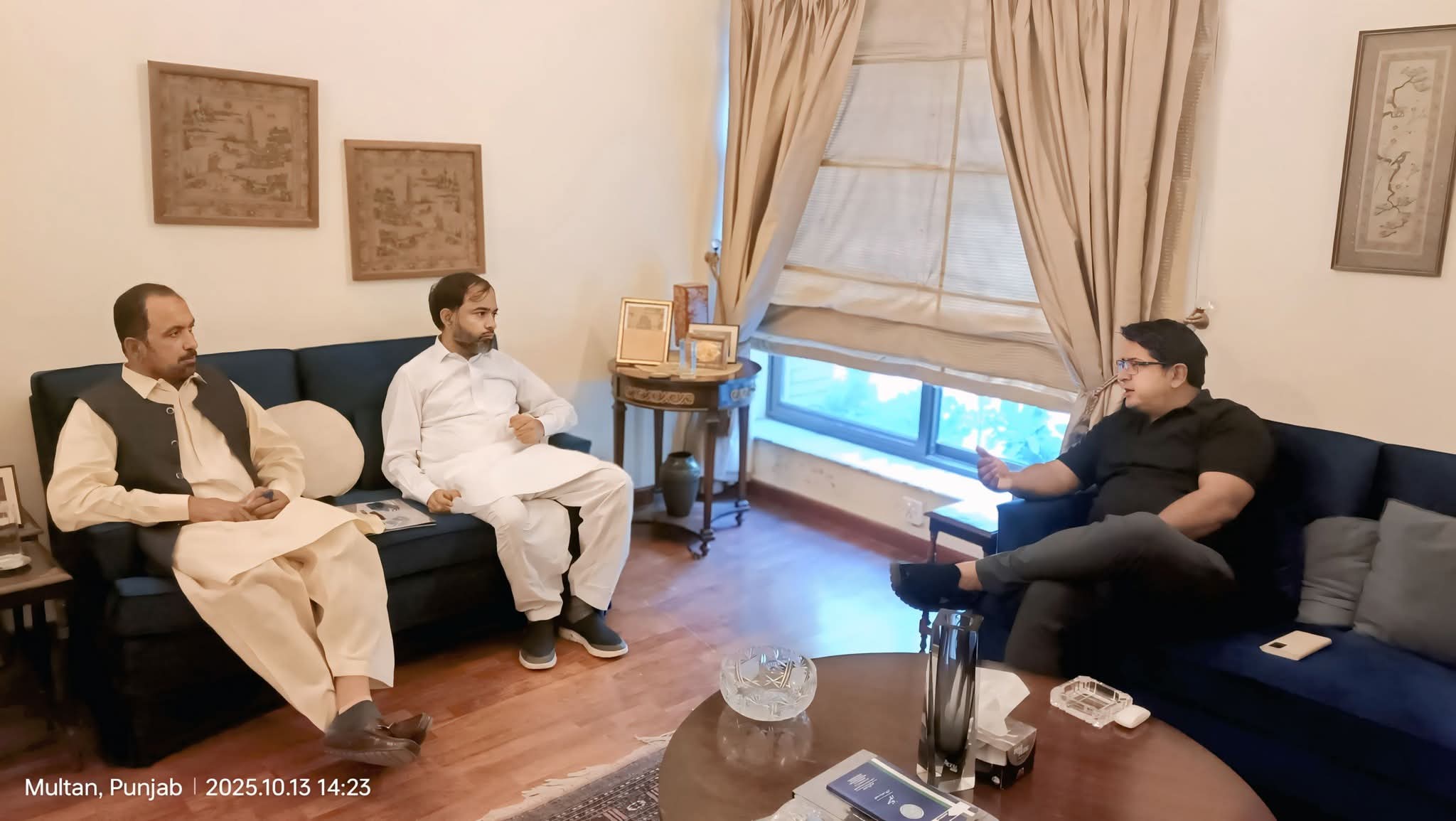
Khanewal (TNS) When the soft breeze of Khanewal carries the fragrance of ripening crops, it feels as though this land has always produced men and women who see politics as an act of service, and service as a form of faith. Among such names stands one that embodies this tradition: Syed Abid Imam.
Calm, articulate, and quietly confident, Abid Imam represents a rare continuity in Pakistan’s changing political landscape. His lineage is a fusion of two distinguished traditions — one rooted in Khanewal, the other in Jhang — both known for intellect, influence, and a sense of duty towards people and place.
His father, Syed Fakhar Imam, remains one of the most respected figures in Pakistan’s parliamentary history. Known for his integrity and intellectual discipline, Fakhar Imam served as Speaker of the National Assembly and restored to that House a sense of dignity and decorum that had long been eroded. His politics was never about power, but principle — a rarity in any era.
His mother, Syeda Abida Hussain, carried that same sense of public duty but expressed it with her own brand of boldness. A political trailblazer, she was the first woman ever elected to Pakistan’s National Assembly and later served as Ambassador to the United States.
In her poise and tone, one can detect both the softness of Jhang’s spiritual soil and the worldliness of a woman who has navigated Washington’s corridors of power. Her career remains a testament to how a Pakistani woman can balance tradition and modernity without surrendering to either.
Abida Hussain’s maternal lineage traces back to the historic town of Jhang, a cradle of spiritual and intellectual life in Punjab. Her grandfather, Syed Amir Ali Shah, was among the most respected spiritual and social figures of his time — a man whose influence extended from Jhang to Multan. He advocated education, agricultural reform, and community welfare long before these became fashionable causes. In many ways, his philosophy of politics as a vehicle for service found new expression in the lives of his descendants.
The family’s legacy also intertwines with that of Sir Sikandar Hayat Khan Khattar, the former Premier of undivided Punjab — one of the most formidable statesmen of the colonial era. The two families shared not only respect but a common political ethos — rooted in moderation, pragmatism, and a deep understanding of Punjab’s social fabric. That relationship endured long after independence.
True to form, Syeda Abida Hussain never let it fade. She was present in Islamabad last year at the chehlum (memorial ceremony) of Sardar Sikandar Hayat Khan Jr., the grandson of the late premier — a gesture that symbolized continuity of respect and the quiet endurance of old political courtesies that now seem almost extinct.
It is from this composite of intellect, service, and civility that Syed Abid Imam draws his own sense of direction. Educated, thoughtful, and soft-spoken, he represents a generation that prefers dialogue over disruption. In an age of political noise, his restraint stands out. Like his father, he believes that respect must precede rhetoric; like his mother, he sees politics not as a profession, but a public trust.
Between Khanewal’s fields and Jhang’s shrines lies a moral geography that has shaped generations of public servants — people for whom humility and responsibility still matter. That geography also defines Abid Imam. “We never made politics a business; we made it a path of service,” he once said. It is a sentiment that neatly sums up his family’s philosophy.
To understand him is to understand a rare continuity in Pakistan’s fractured political culture — one that values civility as much as conviction. In a political climate often marred by noise, opportunism, and hostility, Abid Imam’s calm, reasoned presence feels both refreshing and necessary.
The Imams and the Hussains of Khanewal and Jhang have always treated politics as an extension of community life, not a marketplace for ambition. Syed Fakhar Imam, Syeda Abida Hussain, Syed Amir Ali Shah, and now Syed Abid Imam form a chain of continuity — a lineage that blends the ethical with the intellectual, the spiritual with the civic.
Khanewal gave them grace. Jhang gave them depth. And time gave them the responsibility of carrying that heritage forward. Syed Abid Imam now bears that torch — with composure, clarity, and quiet strength.
In an era that prizes noise over nuance, Pakistan’s politics needs men like him — who think before they speak, and listen before they decide. He represents a generation trying to bring dignity back to public life.
Some legacies are inherited by blood; others must be earned through conduct.
Syed Abid Imam’s story suggests he carries both — the inheritance of lineage and the weight of responsibility.
And perhaps that is why, even in a cynical time, he seems destined not just to continue a family name — but to give it new meaning.