

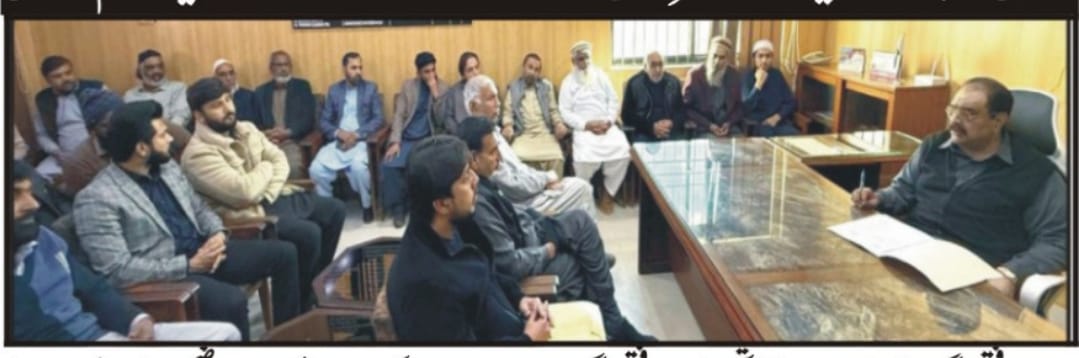
ISLAMABAD (TNS) Chaudhry Shafqat Mahmood and the Moral Architecture of Public Office In an era when public office is too often measured by authority rather than empathy, Chaudhry Shafqat Mahmood stands as a compelling reminder that true leadership is defined by service. Serving as Chief in Chakwal and Tehsildar of Fateh Jang, he has distinguished himself not merely through administrative competence, but through a rare fusion of governance and humanity.
This Ramadan marks a historic moment in the century-old history of Fateh Jang. For the first time, eight large community Iftar tables are being arranged across the town, supported by local philanthropists and coordinated under the leadership of Chaudhry Shafqat Mahmood. In a time of economic strain and rising inflation, when countless families struggle to make ends meet, such an initiative is not symbolic—it is transformative.
The significance of this effort lies not only in its scale but in its spirit. Hundreds of deserving individuals will be served daily with dignity and respect. These are not mere charity tables; they are platforms of collective responsibility. They represent a model where public administration collaborates with civil society to restore the essence of communal care.
Chaudhry Shafqat Mahmood’s leadership reflects a profound understanding: governance is not confined to files, notifications, and procedural efficiency. It is equally about listening to the unheard, easing the burdens of the vulnerable, and ensuring that authority remains anchored in compassion. Those who have interacted with him frequently note that his office doors remain open to ordinary citizens—the laborer seeking justice, the widow requiring assistance, the family navigating hardship.
In societies across the world, sustainable peace and order are not achieved solely through enforcement; they are cultivated through inclusion and social equity. By mobilizing philanthropists and organizing eight Iftar gatherings simultaneously, he has demonstrated how administrative leadership can inspire civic participation. The initiative underscores a powerful truth: when those in positions of responsibility choose empathy over indifference, communities flourish.
It is often asked what makes a person truly “great.” Is it rank? Is it wealth? History suggests otherwise. Greatness emerges when influence is exercised for the welfare of others. Fateh Jang’s unprecedented Ramadan initiative illustrates how visionary leadership can convert goodwill into structured action.
At a time when public trust in institutions faces challenges globally, examples like this restore confidence. They show that ethical governance and compassionate service are not mutually exclusive; rather, they reinforce one another.
If replicated widely, such models could redefine administrative culture—transforming offices of authority into centers of public reassurance. For now, Fateh Jang witnesses a remarkable chapter in its history: a moment where governance meets generosity, and leadership is measured not by protocol, but by the number of lives uplifted.
Chaudhry Shafqat Mahmood’s initiative is more than a seasonal act of charity. It is a statement—quiet yet powerful—that public service, when guided by conscience, can still illuminate society’s darkest corners.