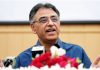


Islamabad, May 1 (TNS): National Security Advisor Nasser Khan Janjua said that by resolving the disputes India can also join CPEC.
In an interview with Lebanon based news channel Al-Mayadeen, Janjua said: “If India can join the CEPC, northern India can be taken care of with this shortcut, but by way of peace, by way of resolving the disputes. I think we have a great potential and I feel that future economic block is also here, like I said the future world is also here”.
“Chahbahar and Gwadar are actually projects of the connectivity of the region, it is multiplication of the region economically and also connecting with the world, and if you see Pakistan is a blessed country, because if you come to Pakistan you can go to all of these countries that I have just named. Like if you go to India you cannot go to all, if you go to Iran you cannot go to all, but if you come to Pakistan you can go to all. So we are the gateway of this region, and so is the (CEPC) so is the rest of connectivity, we can take anyone and everyone everywhere. Like, I usually say that if India looks at Pakistan by way of peace, by way of resolving dispute what is it that we cannot do for India? We can take India to China, one, we can take India to Afghanistan, central Asian republics and Russia, two, we can take India from Pakistan, Iran and turkey to Europe”, he added.
Janjua said: “Asia along with Europe is a region of prosperity, this is a region which will supply the livelihood to the whole of the world, this is a region which if connected from within and with outside world we’ll make the life better, will contribute the best for the betterment of the world, because everything is here. Now CEPC is a way of economic thinking, like I said in the beginning that war is also evolving the world, but peace is also evolving the world. So peace evolves the world by way of people coming together”.
“Now CEPC is an endeavor which is going to evolve this region economically. In CEPC is just half, because CEPC connects China, Pakistan and the world. Ok, where is the other half? The other half is Pakistan also with it Iran, because Iran also has Chabahar, then Afghanistan and Central Asian republics and sometime Russia. So this is yet to be connected”.
So when you are referring to (CEPC), basically it’s a turnaround of this region along with the world economically, basically that’s the thing, that is the spirit. And now when you come to opposition of US, actually it’s by way of competition again, that US is looking at China or Russia. so I will for the sake of the better future of the world, I would like to say, let’s not look at the world like this, It shouldn’t make up a competitive world, It shouldn’t make up a competitive world, we should not come to”.
He said that Afghanistan is being used for long term plan of big game.
Janjua said that it happened very recently when US has declared China and Russia as revisionist states.
“US has declared China and Russia as the strategic challenges. US has declared North Korea and Iran as rogue states. And US has also talked of Pakistan providing safe havens to terrorists. So this is how they have talked of their national security and the challenges. So where are the revisionist states China and Russia? They are in Asia. And when you come to North Korea and Iran, so it is the same region”, the Advisor said.
“So this is US outlook. I usually say that what is it that US and China cannot do by via of cooperation for the betterment of this world, why compete? Why confront? But unfortunately this is what is has happened. With this development US has also declared India as strategic partner, net security provider, they have come up with Indo-pacific strategy. That has altered the security architecture of the region. It is because of this competition. It is because of this competition where China and Russia have to be checkmated. Because of this that now on ground you see that Afghanistan is also being used for this long term plan of big game”.
“What is happening? The China and Russia have become conscious of this, that this is how they are thought of they are being checkmated. The way India has come to Afghanistan and is using its soil. What is happening? It’s making the two front situations for Pakistan. One sided in India, one sided”, he added.
Nasser Khan Janjua said India itself is seeking a two fronts situation, one side is China, one side is Pakistan. With this if you compare the defense budget of Pakistan and India, so we are somewhere spending about 8 billion on our defense, India can spend as much amount they want to, it is their economic capacity but they have crossed the figure of 50 billion.
“So what is to be seen is that there is asymmetry between the two states. Where Pakistan feels vulnerable, and then you come to realize that within the region there are so many Disputes without the dispute resolution mechanism, within the region Afghanistan is not stable, people are dying, people of Pakistan are dying, the narco economy has reached the figure of 130 billion”, he added.
“So I think we have been insensitive to the security architecture of the region, and we have rather contributed towards regional fragility, these are the policies framed by the powerful countries who believe in a competitive world. I think all of us have to be very mindful and we must believe in a cooperative world”, he went on to say.
On blame game, Janjua said: “When Pakistan is being assailed from the west, when Pakistan is being blamed. So what is happening? We are only fiddling with the fragile security landscape of this region, whereas this region Asia and Europe, this is a region of prosperity and progression in the future”.
On economic potential, Janua said that Pakistan has maximum manufacturing capacity, maximum development capacity, maximum connectivity potential. In fact this region by way of connectivity will multiply each other.
“Our region is the heart of the world, and we should all contribute towards its stability, we should not make it unstable, this region is the breadbasket, energy, everything you will get it here and this region will actually provide anything and everything to the world which it needs. Let’s do it by way of peace, let’s invest in peace”, he added.
On Pakistan’s endeavors and achievements in war against terrorism, Janjua said: “Oh my God, what do you want to ask me? The war which came to us by no fault of us, but a war which came to our houses, a war which came to our children, but the way Pakistani nation has stood to it”.
“We have stood like an iron against this war. all of us have fought, all of us have contributed, all of us have sacrificed, our brilliant arm forces, our police forces, our frontier corps, rangers… you name it, everyone has contributed, more so our people. So we are very resilient people, we are very resilient nation and we are full of potential. We can lower our near ones and dear ones in the grave but yet we can stand proud”, Janjua said.
“We have a border of 2611 km. with Afghanistan and it is terrain which if you will see is a beautiful landscape, but such like terrain makes it very difficult to fight terrorism. When you can call a place “heaven on earth” for its beauty, but when you look at it and fight it out, so that is very terrible experience. And I heard that in Swat and also heard that in balochistan. so we were basically assailed in FATA, and then balochistan was also assailed, and then Karachi was also assailed, so we were actually engaged at three places as a nation as a country. And if you talk of achievements, today we have cleared FATA. Our enemy has escaped to Afghanistan, and of course Pakistan and Afghanistan have to work together to get rid of this minis, so we need cooperative framework with Afghanistan to finally defeat. Then you come to Balochistan where people are burning the flags of Pakistan. And I was very lucky to be there myself, my arm forces all of the nation stood behind me and I hugged the people of Balochistan. And today Balochistan has the maximum flags of Pakistan”.
When asked about Madrasas in Pakistan, Janjua said: “This is been a question which has been asked quite frequently and Pakistan has been blamed for this. First of all, let me say that in situation of “madrasa” is as old as the religion of Islam itself. but when you relate “madrasa” to this region and then to Pakistan basically it is in 1979, when the ex-Soviet Union came to Afghanistan. You see nobody sent their soldiers to fight here, you know it. Did US or UK or France or Germany all of them did? Not! Who fought in Afghanistan? People of Afghanistan. Who stood with them? Pakistan! so what was it? Actually ma’am Hilary Clinton has also said this that we were the ones who raised these “madrasas”, and who were these “madrasa” students? For Jihad! so not only that people of Afghanistan and Pakistan were misused, but our concept of Jihad was also misused. So this is the history, but Ok, at that time we gained from it all of us gain from it. Now what had happened? That after dismemberment of USSR everybody left Afghanistan in a leash, from where nine eleven was inflicted? There are many conspiracy theories but at that time it looks, hence the US came and attacked Afghanistan, so what has been happening actually? The one time friends, it was a reverse Swing, one time friends turned out to be this time enemies. So “madrasas” lie somewhere in this confusion and that is why there is a blame on madrassas. there are some wonderful madrasas very good madrasas in Pakistan and everyone cannot be blamed, that was a time when an effort was made to use the madrasa students, today madrasa students don’t want to be used like that, there is a greater need to integrate them in the larger education system of Pakistan”.
“It is mainstreaming of madrasa students, so that they are available with all the opportunities which is available to all others. I don’t want that our religious education should be undermined, so we are bringing them, we are mainstreaming madrasa students actually. so what are we doing, we are actually adding up the subjects which are studied by all of the students in Pakistan, so they are ready to teach them, and they are also being mainstreamed by giving them the opportunities, and very soon they will be integrated in whole of the system, then this blame will also be over”.