

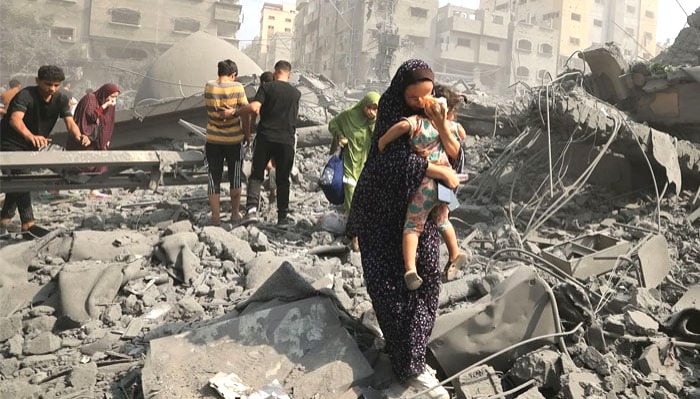
ISLAMABAD (TNS) The Gaza war is 2 years complete but Trump peace agreement is incomplete. Israeli army attacks on Gaza continue, 8 more Palestinians martyred. As a result of the Israeli aggression that has been going on for the past 2 years, 67,173 Palestinians have been martyred so far.
460 people have died due to the food shortage imposed by Israel, including 154 innocent children. On the other hand, direct talks between Hamas and the Israeli government are also ongoing in Egypt.
Many Muslim countries, including Pakistan, have welcomed the 20-point Gaza ‘peace’ plan, but when the facts about the Palestinians’ surrender, Israel’s complete independence and Gaza’s colonization became clear, the series of clarifications began. According to the report, Israeli Prime Minister Netanyahu has made some changes to the plan that were not previously present in the draft when the US President presented it to the leaders of Muslim countries.
This is perhaps why Foreign Minister Ishaq Dar had to clarify that this is not our document, although Prime Minister Shehbaz Sharif was initially enthusiastic about it. Other Muslim countries, including Saudi Arabia, Egypt and Turkey, were also not ready for the US and Israeli initiative.
US President Donald Trump describes his 20-point plan for a ceasefire in Gaza as a historic agreement to end the devastating two-year war, but in reality it is a document that is about the surrender of the Palestinian resistance in the face of the brutal occupation. The draft has in a way supported the genocide committed by the Zionist forces, which has killed thousands of people, mostly women and children, while forcing the entire population of the occupied territory to flee their homes.
The plan is really a way of saying that the country that committed war crimes has won. Former British Prime Minister Tony Blair and Trump’s son-in-law Jared Kushner played a key role in preparing the so-called peace plan. Jared Kushner was also the driving force behind the Abraham Accords during Trump’s first term as president.
For his part, Tony Blair, as prime minister, supported the US-led invasion and occupation of Iraq, based on false claims that it possessed nuclear weapons of mass destruction. Many in the Arab world and even in Britain consider him a war criminal.
It is not surprising that Israel immediately accepted the latest US plan. Israeli Prime Minister Benjamin Netanyahu, who is indicted by the International Criminal Court for crimes against humanity, was at Trump’s side at the press conference, and had nothing but praise for the American leader, who said, “Israel will have my full support to eliminate Hamas.” The peace plan has been aptly dubbed the “Trump-Netanyahu plan” to ensure Israel’s military dominance in the region.
Hamas has been given a 72-hour ultimatum to accept the plan, while the group was not consulted while working on it. Hamas has been given time to release hostages and return the bodies of Israelis who died in its custody.
Ironically, the Palestinians, who are the oppressed parties to the conflict, have not been consulted on the so-called peace plan, even though it is intended to decide their fate. Leaders of major Arab and Muslim-majority countries, including Pakistan, have already endorsed the plan, which analysts say would place Gaza under colonial rule. The deal briefly mentions the possibility of an independent Palestinian state in the future. Israel has already rejected the idea of a separate Palestinian state, although it is barred from annexing the West Bank, although some hardline Israeli ministers have threatened to do so. The Gaza plan would end the war immediately after a prisoner swap. Israeli forces are only to withdraw to the agreed-upon borders to prepare for the release of the hostages. During this time, “all military operations, including aerial and ground bombardment, will be suspended and the war will remain frozen until the conditions for a complete withdrawal are met.” In addition, “after the return of all hostages, Hamas members who pledge to remain peaceful and lay down their arms will be granted a general amnesty, and those who wish to leave Gaza will be given a safe escape route.” This is more or less a call for the complete surrender of the group that is leading the Palestinian resistance against the Zionist occupation. Hamas will have no role in the post-war administrative setup in the occupied territory. Even the Palestinian Authority, which controls the occupied West Bank, has been given no role in the post-war setup. This effectively eliminates the concept of a Palestinian state.Palestinian groups have been completely excluded from the post-war setup. However, the full implementation of the ‘phased withdrawal’ of the occupying forces is also uncertain in light of Israeli aggression.
In fact, the plan has further emboldened Israel, where a far-right group is in power, openly advocating the establishment of a ‘Greater Israel’ while there is no room for an independent Palestinian state. According to the US plan, ‘Gaza would be governed under a temporary transitional system by a technocratic, apolitical Palestinian committee’, which would operate under the supervision of a new international transitional body, the ‘Peace Board’, to be chaired by Trump and Tony Blair, among others. This would effectively give the US control of the occupied territory for an indefinite period.
The proposal is not thought to be too different from Trump’s February proposal to place Gaza under US control so that the enclave could be transformed into a tourist destination. The Trump administration would work with Arab and international partners to create a temporary ‘International Stabilization Force’ (ISF) to be deployed in Gaza. In addition, its primary task of maintaining peace and order would be to train and support the newly formed Palestinian police forces in Gaza.
The ISF would include forces from various Muslim countries. According to some reports, the bulk of the troops would come from Indonesia and Pakistan, the two largest Muslim-majority countries.
This could also be the reason for Trump’s praise for Pakistan’s prime minister and army chief. It should be noted that Trump had taken Pakistan into confidence on the plan. Israeli security forces will remain in Gaza until the ISF takes full control, while ‘Israel will maintain a security zone around Gaza until it is certain that there is no longer any threat of a return to terrorism’. A ceasefire would certainly end the killings by Israeli forces and allow much-needed humanitarian aid.
But the key question is, can the US plan bring long-term peace to the region without formally recognizing the Palestinian people’s right to an independent state? Hamas can be disarmed, but what about those in Gaza who lost family members in the two-year genocide? The anger of an entire generation of Palestinians who have seen only death and hunger cannot be contained.
If Donald Trump is to make the Gaza peace plan sustainable, it must be equitable and fair to the fundamental interests of Arabs, including Christian Arabs, and Jews in Palestine or Israel. The weakness in the plan is that Trump-Netanyahu has a history of making promises and ensnaring the other side, just like they did with Iran and Qatar.
This is why the lack of trust in the plan is a major challenge. Imagine, as mentioned in the plan, the hostages were released, but now time has passed and their life or death is irrelevant to Benjamin Netanyahu’s murderous ideology. What if Israel, with Trump’s support, launches another large-scale attack on Iran? That would change the situation completely, wouldn’t it? And thus the idea of peaceful coexistence in the region would be shattered. It has happened before.
People have won Nobel Peace Prizes by promising peace between Israel and the Arabs. How is this situation different from before, given that Donald Trump and Benjamin Netanyahu are key players in this matter? Members of the genocidal coalition government, already committed to their religious dogma, consider it their duty to spit in the faces of Christians who approach them, and to treat Muslims with even more cruelty, from whom they have taken their lands and claim them as their own, because they feel that the land belongs to the Jews on the basis of insidious and questionable religious orders of supremacists. This escalating conflict is in favor of those fighting for global domination.
If Russia and Saudi Arabia decide to mutually increase oil production, it will be against American oil companies, while it could be another possible trigger for increased violence. In such a case, a war between Israel and Iran could be used to block oil supplies to the market. But the other side of the picture is that if oil supplies are cut off, Russia will actually benefit from higher prices.
As the Gaza massacre has proven, ethnic divisions in the region are deeply rooted. Britain has long operated on the principle of ‘divide and rule’ based on religion and ethnicity. It successfully implemented this in Ireland, after which it followed the same approach in Asia and Africa. In 1917, Britain issued the Balfour Declaration to prevent Bolshevism (communism) in the Middle East. This measure divided the Palestinian territory on religious grounds. Later, US President Lyndon Johnson loosened the reins that the previous US President John F. Kennedy had tightened around Israel so that the US could use the Zionist state as its invincible ally in the Middle East. Since then, US-Israeli relations have been on good terms. There is an impression that Trump’s Gaza plan has the approval of the Saudi rulers, although they have apparently been absent from the negotiations.The idea that Riyadh could transform the colonial settler state of Israel into an equal place for the three religious groups of ancient Palestine, Christians, Muslims and Jews, is nothing short of a miracle. Egypt, whose military dictatorship is financially supported by Riyadh, is giving the Egyptian center of the religious-nationalist Muslim Brotherhood a foothold. In these negotiations, Egypt is also negotiating with Netanyahu’s Israel on behalf of Saudi Arabia.
The Cold War was at its height when Saudi leader Ali Fahd proposed the proposal at the Fez summit. It was the first time an Arab leader had proposed tacit recognition of Israel.
As expected, Iraq, Syria and Libya rejected Fahd’s two-state solution. In 1973, Saudi Arabia led a campaign to boycott US oil supplies in response to Israeli support. Shortly thereafter, the Saudi king who led the boycott was shot dead by his nephew. The new king soon backed away from the idea of fighting Israel in the near future.
Years later, Trump’s peace plan, which would give the Palestinians only a small part of their homeland, came out of the fact that many Arab rulers were afraid of the Palestinian issue. This issue is sensitive for both Israelis and Palestinians.
The Zionist press is portraying Trump as a Hamas supporter wearing a Palestinian headscarf, while Netanyahu is portraying him as a traitor to the cause of ‘Greater Israel’.
Was Fahd the Saudi leader Ali Fahdtjaviez just a hypothesis or was it a fantasy or real opportunity that the Arab world let slip? The plan offered that Israel would withdraw from all Arab territories, including Jerusalem, occupied in 1967. Israeli settlements built on Arab land, including Arab Jerusalem, after 1967 would be dismantled. Freedom of worship for all religions would be guaranteed in the holy sites. Palestinian refugees could return to their homes and those who chose not to go would be compensated.
The West Bank and Gaza would undergo a short transition period under the UN, not to exceed a few months, before they were fully liberated. An independent Palestinian state would be established with Jerusalem as its capital. All states in the region would be able to live in peace in the region. The UN or its member states would guarantee the implementation of the provisions included in this proposal.
Before the events of October 7, 2023, Hamas was seen as a greater threat to Arab governments than Israel. Netanyahu had supported the hardline Hamas in an alliance with Qatar to thwart the supposedly moderate Fatah, which had accepted two states.
The plan failed when the Muslim Brotherhood won the 2012 presidential elections in Egypt, just as Hamas had defeated Fatah in the 2006 elections. The West, which has a habit of dissolving democracies that it finds unsettling, annulled the results of both elections.
After overthrowing the elected government of Mohammad Mossadegh in Iran in 1953, the Anglo-Americans restored the Shah of Iran as a first blow to oil politics. Israeli provocations later thwarted the religious-nationalist victory in the oil-rich former French colony of Algeria. Now it was the turn of the secular allies of the former Soviet Union. Iraq, Libya and Syria were dragged into wars that weakened them and to some extent favored Israel, while in all these cases Saudi Arabia played a role by providing resources and other means. So why did the Saudis make an attractive proposal on the Palestinian cause in 1981? Was it because they wanted to stop the growing excitement and anger that the Iranian revolution posed as a threat to those Arab governments that had not fully supported the Palestinian cause? The Saudis had unveiled their plan at the Fez summit of Arab leaders in Morocco in 1981. At that time, Ayatollah Khomeini’s revolution was barely two years old. This threat was exacerbated when Ayatollah Khomeini met with Yasser Arafat at his home in Tehran and established an elite military guard called the Quds Force in the name of Jerusalem, the holy city for Muslims. Qatar reportedly asked the US to delay the announcement of the plan, but the US ignored the request. If the reports are true that Israel altered the plan and the contents of this cruel agreement leave no room for doubt, then the Muslim world should ask itself some important questions. First of all, how is Israel allowed to change a deal that Muslim countries had already agreed to, and why did the US allow it to do so? Secondly, how can this agreement be finalized without including the Palestinians, who are the most affected by the Israeli aggression, in the consultation process? This plan is about disarming Hamas and it will also limit the Palestinian Authority, unless it asks for forgiveness and forgiveness of its ‘sins’ from Israel.Who will run Gaza if the two main Palestinian governing parties are excluded from the deal? What if the Palestinian ‘technocrats’ who are supposed to run the occupied strip swear allegiance to Israel and abandon the idea of an independent state?
That is the impression one gets from reading the document. The plan makes no mention of making a two-state solution a reality, with Jerusalem as the capital of the Palestinian state. It only uses the vague term ‘credible path’.
The truth is that there is nothing credible about the plan, and its chances of success are zero. Reports indicate that Hamas will likely reject it, while Fatah is also unhappy about the plan. Trump has threatened a ‘very sad end’ if Hamas rejects the plan.
On the other hand, Israel’s continued attacks on Gaza’s civilians show how ‘committed’ Israel is to peace. One should ask oneself what they got in return for blindly trusting Israel and America?