

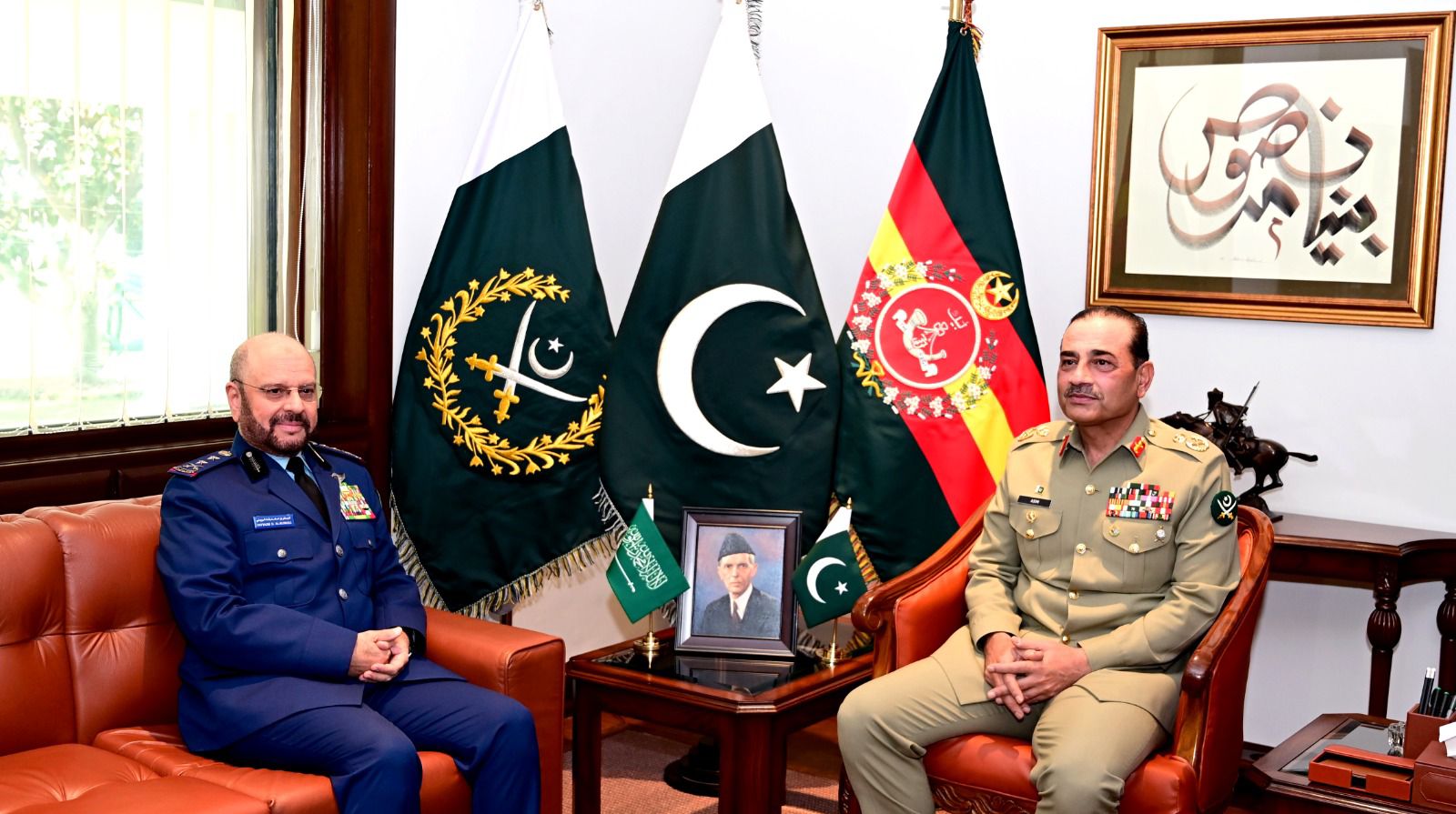
ISLAMABAD (TNS) Pakistan and Saudi Arabia have deep, historic and strong relations, which are based on defense, economy and people-to-people level. Saudi Arabia and Pakistan have a bright history spanning seven decades. Immediately after independence, Saudi Arabia recognized Pakistan in 1947, and this laid the foundation for such deep relations between the two countries that have remained strong to this day. Saudi Arabia’s status as a spiritual center for the people of Pakistan due to the Qibla of Muslims, while Pakistan’s majority Muslim population further strengthens this relationship. Riyadh and Islamabad stand together on many important platforms, including the Organization of Islamic Cooperation. Saudi Arabia has always supported Pakistan on the Kashmir issue, while Pakistan supported Saudi Arabia against terrorism. In 1998, when Pakistan conducted nuclear tests and the Western world imposed sanctions, Saudi Arabia provided full support to Islamabad by providing oil at concessional rates. Even today, Saudi Arabia is a major economic partner for Pakistan, playing a key role in the investment and energy sectors. The two countries have a long history of joint military training and defense cooperation. Pakistani experts have played a significant role in the development of the Saudi forces. Recently, a new defense agreement has been signed under which the two countries will be considered allies. The relations between Saudi Arabia and Pakistan are strategic not only in political and economic aspects but also in religious and security aspects. The leadership of both countries has signed an agreement under which an attack on one will be considered an attack on the other. This agreement is a reflection of the fact that the relationship between Riyadh and Islamabad is not just diplomatic but a reflection of a common destiny. A new defense agreement has been signed between Pakistan and Saudi Arabia, under which both countries will consider an attack on each other as an attack on themselves. Pakistan has been entrusted with the task of providing training and technical assistance to the armed forces of Saudi Arabia. In recent visits, emphasis has been placed on further strengthening economic and trade relations. It is hoped that more facilities for Pakistani workers in Saudi Arabia and new doors of economic development will open in Pakistan through Saudi investment. Efforts are also being made to further strengthen investment and trade relations between the two countries. These relations have the potential to bring many benefits to the people of both countries, including more facilities for Pakistani workers and economic growth through Saudi investment. Relations between Pakistan and Saudi Arabia are not limited to the government level, but are also strong at the people-to-people and cultural levels. Educational and cultural ties between the two countries are expected to increase. Saudi Arabia was one of the first countries to recognize Pakistan in 1947, and since then the two countries have maintained strong relations. King Faisal developed close relations with Pakistan, which resulted in the construction of the Shah Faisal Mosque in Islamabad and the naming of Lyallpur (now Faisalabad) in his honor. The military leadership of Pakistan and Saudi Arabia on Monday agreed to further strengthen bilateral defense and security ties, expand counter-terrorism cooperation and deepen strategic partnership, the Inter-Services Public Relations (ISPR) said in a statement. According to the statement, Chief of General Staff of the Saudi Armed Forces General Fayyad bin Hamid Al-Ruwaili called on Field Marshal Asim Munir at GHQ Rawalpindi, during which the two leaders held detailed discussions on matters of mutual interest, regional security environment and promotion of bilateral defense cooperation. Both sides stressed the need to further expand this long-standing and strategic military partnership that encompasses key areas such as defense, security and counter-terrorism measures. The Field Marshal and the Saudi General agreed that it is imperative to further strengthen defense cooperation between the two countries in the context of changing regional challenges. During the meeting, General Fayyaz bin Hamid Al-Ruwaili appreciated Pakistan’s cooperation with the Saudi Armed Forces, terming it highly valuable and reaffirmed his confidence that Riyadh is determined to further advance the strong relations between the two countries. Upon the Saudi General’s arrival at GHQ, he was also honored to lay a wreath at the Martyrs’ Memorial and present a guard of honor by a well-dressed contingent of the Pakistan Army. Prime Minister Shehbaz Sharif, in his meeting with the Saudi Chief of General Staff, reiterated his firm resolve to further strengthen the historic brotherly relations between the two countries in all sectors, including economic, defense and security. According to a statement issued by the Media Wing of the Prime Minister’s Office, the meeting was also attended by Deputy Prime Minister and Foreign Minister Senator Ishaq Dar, Field Marshal Asim Munir, Defense Minister Khawaja Muhammad Asif, Special Assistant to the Prime Minister Tariq Fatemi and other senior officials. It was further said that while expressing his best wishes to the Custodian of the Two Holy Mosques King Salman bin Abdulaziz and Crown Prince Muhammad bin Salman bin Abdulaziz Al Saud, the Prime Minister reiterated his firm determination to further strengthen the historic brotherly relations between Pakistan and Saudi Arabia in all sectors including economy, defense and security.He stressed that the relations between the two countries are based on a common religion, common values and mutual trust. The Prime Minister recalled his visits to Riyadh over the past two months, during which the historic strategic mutual defense agreement was signed between the two sides. The Prime Minister reiterated Pakistan’s unwavering commitment to further deepen bilateral defense cooperation, including joint training, exercises and exchange of expertise.
The Prime Minister also highlighted the shared resolve of the two countries to combat all forms of terrorism and extremism and promote peace and stability in the region. General Fayyad bin Hamid Al-Ruwaili conveyed a congratulatory message on behalf of the Saudi leadership to the Prime Minister and the people of Pakistan. He reiterated the Kingdom’s strong desire to take the existing excellent defense and strategic partnership with Pakistan to new heights. Furthermore, Pakistan and Saudi Arabia signed a historic defense agreement during Prime Minister Shehbaz Sharif’s visit to Saudi Arabia. This agreement is being described as the biggest breakthrough in Pak-Saudi defense relations in decades. This agreement is a manifestation of the shared determination of both countries to enhance their security and establish peace in the region and the world. (This agreement) focuses on promoting aspects of defense cooperation between the two countries and strengthening common defense against any aggression. The most important point of the agreement is that ‘an attack on either country will be considered an attack on both.’ The two countries have long had a multifaceted relationship, based on strategic military cooperation, mutual economic interests and a shared Islamic heritage. It is also important to note that this agreement comes at a time when Israel has raised concerns about the overall security of the Middle East. Pakistan and Saudi Arabia have long been engaged in defense cooperation and their diplomatic relations have always been strong, but with this agreement, this relationship has entered a completely new dimension. Dr. Abdul Karim Bin Issa, Secretary General of the Muslim World League, has said that the defense agreement between Pakistan and Saudi Arabia will not only help bring the two countries but also the Ummah closer. The leadership of the two countries recently signed a historic defense agreement that is a symbol of the unity and solidarity of the Muslim Ummah. This defense agreement will not only strengthen the relations between the two countries but will also help in bringing other Muslim countries closer. It should be noted that Pakistan has assumed the role of providing security not only to Saudi Arabia but also to the entire Middle East. The timing and context of this agreement must be taken into account, because after the Israeli aggression, Arab countries are looking for security guarantees from elsewhere. The role of America as a security guarantor has become a question mark in recent days and its reputation has been severely damaged. This agreement may have been under consideration for some time, but it is important to look at its background. This agreement has been called the most important military and diplomatic initiative in the last 50 years after the Lahore Islamic Summit. Saudi Arabia is not an ordinary Muslim country, but one of the richest countries in the world with strong diplomatic influence. This agreement will play a role as a barrier for Israel; ‘Israel will not be able to do anything with the combination of Pakistan’s military capability and Arab economic power.’ The recent four-day military conflict between India and Pakistan ‘showed our skill, capability and determination that we can also fully defend our Arab friends,’ which presented Pakistan as a regional security guarantor, he also said that the agreement could also have an impact on terrorist elements within the country, especially the banned TTP. The strategic joint defense agreement indicates that it could also include nuclear and missile defense systems. Pakistan has always called its nuclear and missile programs ‘strategic assets’. For Saudi Arabia, it is an insurance against uncertainty and a sign of independence. Although the deal formally includes a nuclear guarantee [at least according to available information], Pakistan’s nuclear arsenal casts a deterrent shadow. The long-awaited financing agreement for Rekodic is now close. He explained that the International Finance Corporation (IFC) is leading the loan consortium, a role that brings strong credibility and reassurance to global lenders as the IFC typically works in financing large and complex resource sectors. The federal minister said that one of the final elements is the participation of the US Export-Import Bank (US EXIM), which has temporarily put new approvals on hold due to the recent US government shutdown. EXIM’s involvement should resume ‘relatively soon’ once the shutdown is fully lifted. The financial structure is now essentially in place as the IFC-led consortium has completed the financing arrangements for the nearly $3.5 billion project and only the final lender’s approval remains.He met with the IFC Managing Director and all the consortium partners during a recent visit to Washington, which bolstered his confidence that work was about to begin. The finance minister stressed the transformative potential of Reko Diq for Pakistan’s export base. Annual exports are stagnant at around $30 billion, but the Reko Diq mine is poised to generate $2.8 billion in exports in its first year of operation, which is about 10 percent of Pakistan’s total exports today. He said it was a game changer. In addition to Reko Diq, Pakistan is in talks with the United States and other partners on key minerals, a sector that has become central to global supply chain strategies as the world seeks alternative sources of copper, lithium, cobalt and rare earths. A key minerals deal worth more than $1 billion has been signed with US investors, a US official said on condition of anonymity. “For obvious reasons, minerals and mining and key minerals are a key sector of interest,” he said. And that we are moving forward, he added, “There is tremendous interest and we have tremendous potential.” Aurangzeb said that Pakistan’s objective is clear, namely to improve economic fundamentals and incorporate favorable geopolitics into long-term, private sector-led investment flows, in which Saudi Arabia emerges as the most productive partner in this transformation and it is all about transforming trade and investment. And all this will be on board, led by the private sector. In addition, Pakistan has invited Saudi Arabia to invest in key Pakistani infrastructure projects. According to the statement, these infrastructure projects include M-6 Motorway Sukkur-Hyderabad, M-10 Motorway Hyderabad-Karachi Port, M-13 Motorway Kharian-Rawalpindi and Mansehra-Naran-Jalkhudh-Chilas Road.
Pakistan’s Federal Minister for Communications Abdul Aleem Khan invited Saudi Arabia’s Minister for Transport and Logistics Services, Engineer Saleh bin Nasser Al Jasser, to invest in key Pakistani infrastructure projects during the Pakistan International Maritime Expo and Conference. He apprised the Saudi minister about Pakistan’s growing road network and investment opportunities in key national projects. Pakistan wants to further enhance cooperation with Saudi Arabia in the fields of transport, logistics, and infrastructure development. This project is commercially beneficial due to its tourism potential and attractive to investors. Pakistan’s road infrastructure is dynamic and self-sufficient, supported by an effective toll system that plays a significant role in the maintenance and development of roads. The Ministry of Communications and the National Highway Authority are working on new motorway projects connecting the northern regions with important urban and economic centers, which will further strengthen regional trade and connectivity. He reiterated that Pakistan and Saudi Arabia enjoy brotherly and long-term relations and there is great potential for cooperation in the infrastructure sector. Keep in mind that Pakistan’s Prime Minister Shahbaz Sharif met with Saudi Crown Prince Mohammed bin Salman in Riyadh on October 28, 2025 and thanked the Saudi Crown Prince for his continued support for the promotion of bilateral relations. In the meeting, Saudi Crown Prince and Prime Minister Prince Mohammed bin Salman and Pakistani Prime Minister Muhammad Shahbaz Sharif agreed to launch an ‘Economic Cooperation Framework’ between the two countries. According to a joint statement issued by the Ministry of Foreign Affairs, this agreement is based on the strong ties of historical partnership, brotherhood and Islamic solidarity established between the two countries spanning almost eight decades. This framework is based on the common economic interests of Saudi Arabia and Pakistan and renews the commitment to promote mutual trade and investment in order to advance the common interests of the people of both countries. Under this framework, several strategic and key projects will be considered in various sectors of economy, trade, investment and development, which will further strengthen cooperation between the two governments. This will enhance the role of the private sector and promote bilateral trade. Priority sectors include energy, industry, minerals, information technology, tourism, agriculture and food security. The two sides are currently working on several joint economic projects, including the signing of a Memorandum of Understanding (MoU) for a power exchange project between Saudi Arabia and Pakistan, and another MoU for cooperation in the energy sector. The statement added that this framework is a continuation of the efforts to promote brotherly relations between the two countries and reflects a shared vision that will pave the way for practical steps in various economic, trade and investment sectors to establish a sustainable partnership. The leaders also expressed their determination to hold a meeting of the Saudi-Pakistan Supreme Coordination Council soon to give practical shape to this new chapter of bilateral cooperation. In a post on the social media platform X, Shehbaz Sharif said that the meeting discussed measures to further expand trade, investment and economic cooperation. The Prime Minister’s message further stated that the two countries reaffirmed their commitment to the long-term strengthening of brotherly relations. The Prime Minister also thanked the Saudi Crown Prince for his unwavering support.
Shahbaz Sharif had said that he was grateful to the Saudi Crown Prince who had played a significant role in advancing the shared vision of deep partnership and prosperity between the two countries and peoples. Undoubtedly, the historic strategic mutual defense agreement between Pakistan and Saudi Arabia proves the depth of the Pak-Saudi strategic partnership and the strength of defense cooperation. Army Chief Field Marshal Syed Asim Munir played a key role in the success of the agreement, with the agreement Pakistan has now become a partner of Saudi Arabia in the protection of the Two Holy Mosques.
Saudi Arabia and Pakistan also have a long history of military cooperation, which began with the signing of a defense protocol agreement in 1967. Its scope included the deployment of Pakistani military advisors and trainers in Saudi Arabia and the provision of training opportunities to Saudi military officers in Pakistan’s military academies. Similarly, a defense agreement signed in 1982 further expanded this range of mutual cooperation, which included the deployment of Pakistani troops in the kingdom for defense purposes and training, defense production, and joint exercises.
Since then, the leaders and defense officials of the two countries have been meeting regularly to coordinate strategic policies on defense. This has become even more important in the recent past as self-reliance in defense production is a key pillar of Saudi Crown Prince Mohammed bin Salman’s Saudi Vision 2030. In 1989, when Iraq invaded Kuwait and Saudi Arabia faced defense threats on its borders, Pakistan immediately sent its troops to Saudi Arabia.
When Pakistan faced severe economic difficulties after the nuclear explosions in 1998, Saudi Arabia provided Pakistan with abundant crude oil and other resources. Under Crown Prince Mohammed bin Salman’s Vision 2030, Pakistan has been provided with numerous trade and investment opportunities with Saudi Arabia, including employment of Pakistani workers in major projects underway in Saudi Arabia.
Even now, a large number of Pakistanis are working in Saudi Arabia in various sectors as well as doing business, which is economically very important and helpful for Pakistan and their families. The deep bilateral relations between Saudi Arabia and Pakistan are rooted in shared history and mutual interests. Both have a deep devotion to Islam.Saudi Arabia is the center of Muslim faith, while Pakistan has emerged on the world map as an Islamic republic. The personal relationship between the leaders of the two countries has played a very important role in advancing solidarity and in recent years, they have stood by each other in difficult situations. Pakistan’s political and military leadership appear determined to overcome the current economic crisis and, as in the past, the leadership of the country supports Pakistan’s struggle for a prosperous future.
Saudi Arabia’s Prime Minister and Crown Prince Mohammed bin Salman, the architect of modern Saudi Arabia, is a figure of the era and a harbinger of dawn for the Islamic world. Under his leadership, a new dawn has dawned in Saudi Arabia, where the horizons of development are bright, where modernity and tradition are harmoniously building a new sky.
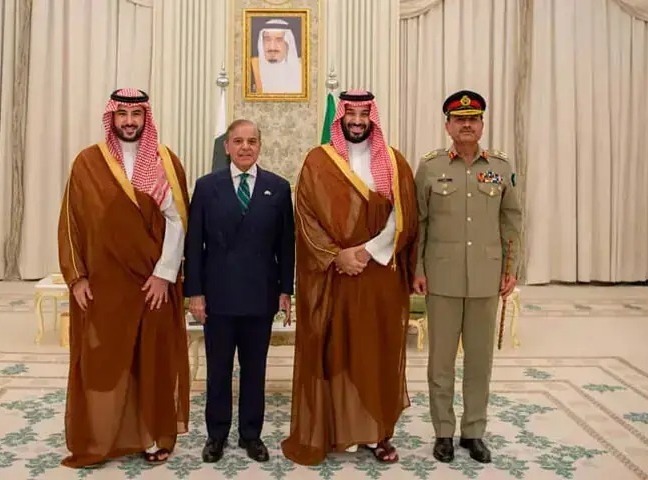
His reforms, development projects and public welfare initiatives are making Saudi Arabia an exemplary country on a global scale, he has become an important figure not only in the Arab world but also in international politics. He is a man of courage, whose decisions are a symbol of courage, whose thinking is a guardian of the vastness and whose eyes are lighting the lamps of hope in the windows of the future.
Pakistan and Saudi Arabia have historically been based on brotherhood, religious harmony and economic cooperation. Pakistan has supported Saudi Arabia in every difficult time and Saudi Arabia has also supported Pakistan’s economy by providing financial assistance, oil supplies, investment and employment to thousands of Pakistanis. However, it is a historic occasion that the two countries have signed a formal defense agreement that will not only strengthen cooperation in the military sector, but will also propel both countries to a new position in global politics.
While this agreement will provide Pakistan with modern military technology, intelligence cooperation and joint training opportunities, Saudi Arabia will benefit from Pakistan’s military expertise, experienced manpower and nuclear-powered security policies. The two countries can conduct joint military exercises, coordinate border defense, and adopt a unified course of action in the event of any external threat. The success of this defense agreement with Saudi Arabia also depends on how far-sighted, serious, and consistent both countries pursue their priorities.
We must not forget that the success of any agreement depends not only on its paper words but also on its practical implementation, transparency, and alignment with the public interest. In short, the strategic mutual defense agreement between Pakistan and Saudi Arabia is certainly a major diplomatic and defense development, which can give a new direction to the relations between the two countries, but for the success of this agreement, balanced strategy, diplomatic prudence, economic insight, and giving top priority to national interest are necessary. Pakistan must transform this opportunity beyond defense into a comprehensive vision of development, peace, and regional stability, so that this agreement does not just become a part of history, but becomes a shining example of effective and successful cooperation.
Pakistan and Saudi Arabia’s defense rapprochement is of utmost importance. It not only strengthens each other’s security but also increases the chances of military balance, diplomatic coordination and stability in the region. This defense alliance is actually a protective shield against uncertain global conditions and a hope for promoting mutual cooperation in the Islamic world. Remember that the Chief of General Staff of the Saudi Armed Forces, General Fayyaz bin Humaid Al-Ruwaili, who is on a visit to Pakistan, met Prime Minister Shahbaz Sharif and Field Marshal General Asim Munir, in which the commitment to further strengthen the historical brotherly relations between the two countries was reiterated. Prime Minister Shahbaz Sharif met with the Chief of General Staff of the Saudi Armed Forces, General Fayyaz bin Humaid Al-Ruwaili in Islamabad. The meeting was attended by Chief of Army Staff Field Marshal Syed Asim Munir, Deputy Prime Minister Ishaq Dar, Khawaja Asif, Tariq Fatemi and senior officials of both countries.
Expressing his best wishes to the Custodian of the Two Holy Mosques King Salman and Crown Prince Mohammed bin Salman, Shahbaz Sharif reiterated his firm resolve to further strengthen the historic brotherly relations with Saudi Arabia in all sectors including economy, defense and security. The Prime Minister welcomed Fayyaz bin Humaid Al-Ruwaily and appreciated Saudi Arabia for its unwavering support and solidarity provided to Pakistan at all times. The Prime Minister mentioned his highly successful visits to Riyadh during the last two months, during which historic strategic mutual defense agreements were signed between the two sides. Shahbaz Sharif also highlighted the shared resolve of both countries to combat all forms of terrorism and extremism and promote peace and stability in the region. He reiterated Saudi Arabia’s strong desire to take the existing excellent defense and strategic partnership with Pakistan to new heights.